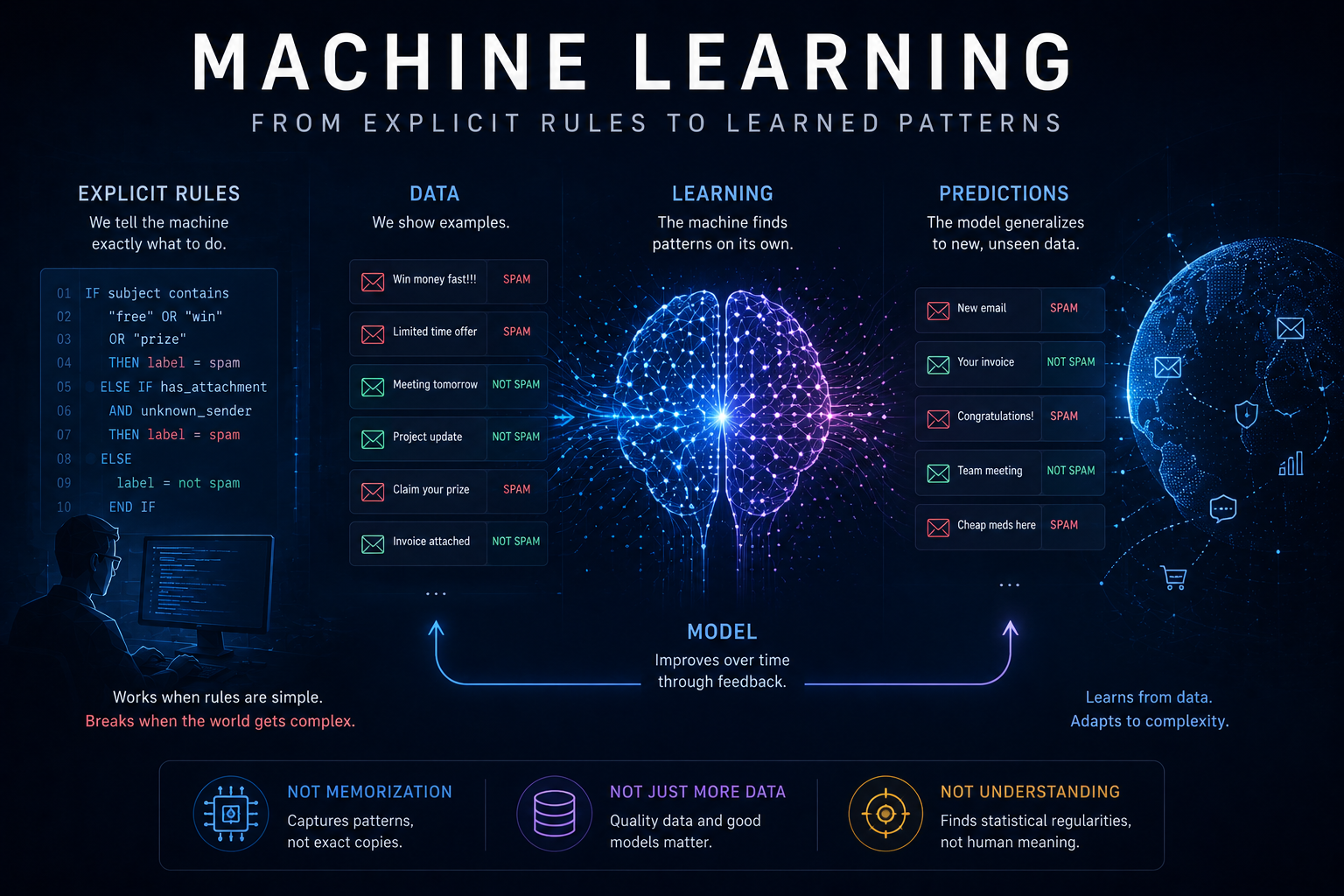
For most of computing history, getting a machine to perform a task followed a simple idea:
- Humans wrote the rules.
- Machines followed them.
If you wanted a computer to calculate taxes, sort numbers, or process payrolls, you explicitly told it what to do step by step. The logic was fully defined in advance. And for many problems, that worked perfectly well. But eventually, computers ran into a different kind of problem. Problems where the rules existed implicitly, but were almost impossible to write down cleanly.
Take something as simple as recognizing a face. At first, it sounds straightforward:
- two eyes
- one nose
- one mouth
But the moment you try turning that into precise rules, everything falls apart.
- Faces appear under different lighting conditions.
- Different angles.
- Different expressions.
- Partial visibility.
- Different ages.
- Different backgrounds.
The variability explodes faster than the rules can keep up. Language creates the same problem. A sentence can mean different things depending on context, tone, or subtle phrasing. Human communication contains ambiguity everywhere. And that exposed a limitation in traditional programming:
some problems are too messy to solve through explicit instructions alone.
A Different Way to Build Intelligence
So a different idea emerged. What if, instead of telling machines how to solve a problem, we simply showed them examples and allowed them to discover the patterns themselves?
That shift changed everything. Because the system no longer depended entirely on hand-written logic. Instead, it started learning relationships directly from data. And that is the core idea behind machine learning.
At a basic level, machine learning works like this:
- the system receives inputs
- it produces outputs
- it compares those outputs to reality
- and then it adjusts itself to perform better next time
Over time, patterns begin to emerge internally. Not because a programmer manually encoded every rule. But because the system inferred statistical regularities from experience.
The Spam Filter Example
Spam detection is probably one of the simplest ways to see this clearly. Imagine you have thousands of emails already labeled:
- spam
- not spam
You feed those examples into a system. Initially, the predictions are terrible. The model makes random or naive guesses. But after each prediction, it receives feedback about whether it was correct. And then something important happens. The system adjusts itself slightly.
Maybe certain phrases correlate strongly with spam.
Maybe suspicious links matter.
Maybe unusual formatting patterns appear repeatedly.
No human explicitly writes: “If this exact phrase appears, classify it as spam.” Instead, the model gradually discovers useful patterns on its own through exposure to examples. That distinction is the heart of machine learning.
Traditional programming depends on humans defining rules manually. Machine learning depends on systems extracting patterns from data. And the deeper you think about it, the more radical that shift actually is.
Learning Is Not Memorization
One thing that often gets misunderstood is the idea of “learning” itself. Learning does not mean storing every example perfectly. Because if a system only memorized past data, it would immediately fail on anything slightly new. Real learning requires generalization.
The system has to capture deeper structure:
- similarities
- relationships
- recurring patterns
- underlying regularities
so that it can handle inputs it has never seen before. That turns out to be much harder than it sounds. And it is also why machine learning systems sometimes fail in strange ways. A model may perform brilliantly on familiar data while completely collapsing when conditions shift outside its training distribution. Which reveals something important: many AI systems are better at interpolation than true understanding.
Data Alone Is Not Enough
Another misconception is that machine learning is simply about feeding massive amounts of data into larger systems. But more data does not automatically produce better intelligence. Bad data creates bad learning.
If the data is noisy, biased, incomplete, or unrepresentative, the system learns distorted patterns instead of useful ones.
And even with good data, the structure of the model still matters.
Some systems are simply incapable of capturing certain kinds of complexity no matter how much data you provide. So machine learning is really a combination of:
- data
- structure
- optimization
- and feedback
All four matter simultaneously.
The Strange Part About Modern AI
I think one of the most fascinating things about machine learning is that performance and understanding are not necessarily the same thing. A system can classify millions of images correctly without “understanding” what a cat is the way humans do. It recognizes statistical structure.
Not meaning in the conscious sense. And that creates a strange tension in AI discussions today.
Machines are becoming increasingly capable at tasks that once seemed to require understanding, while still operating through mechanisms very different from human cognition.
Which forces an uncomfortable question: How much intelligence actually requires understanding at all?
Different Ways Machines Learn
Once you understand the basic idea of learning from data, different learning approaches start making intuitive sense.
Sometimes the system receives examples with correct answers attached.
This is supervised learning.
Sometimes it only receives raw data and must discover structure independently.
This is unsupervised learning.
And sometimes it learns through trial and error by interacting with an environment and receiving rewards or penalties.
This is reinforcement learning.
- Different methods.
- Same underlying principle:
- improving behavior through experience rather than explicit instructions.
Why This Changed Computing Forever
I think the reason machine learning became so transformative is because it fundamentally changed the relationship between humans and software. Traditional programming was about encoding knowledge manually. Machine learning shifted the burden of pattern discovery from humans to machines. Instead of explicitly telling systems how to solve every problem, we started building systems capable of extracting structure from reality themselves.
That may ultimately be one of the biggest transitions in computing history. Because the moment machines stopped depending entirely on human-written rules, software stopped being limited only by what humans could explicitly describe.
And that opened the door to modern AI.