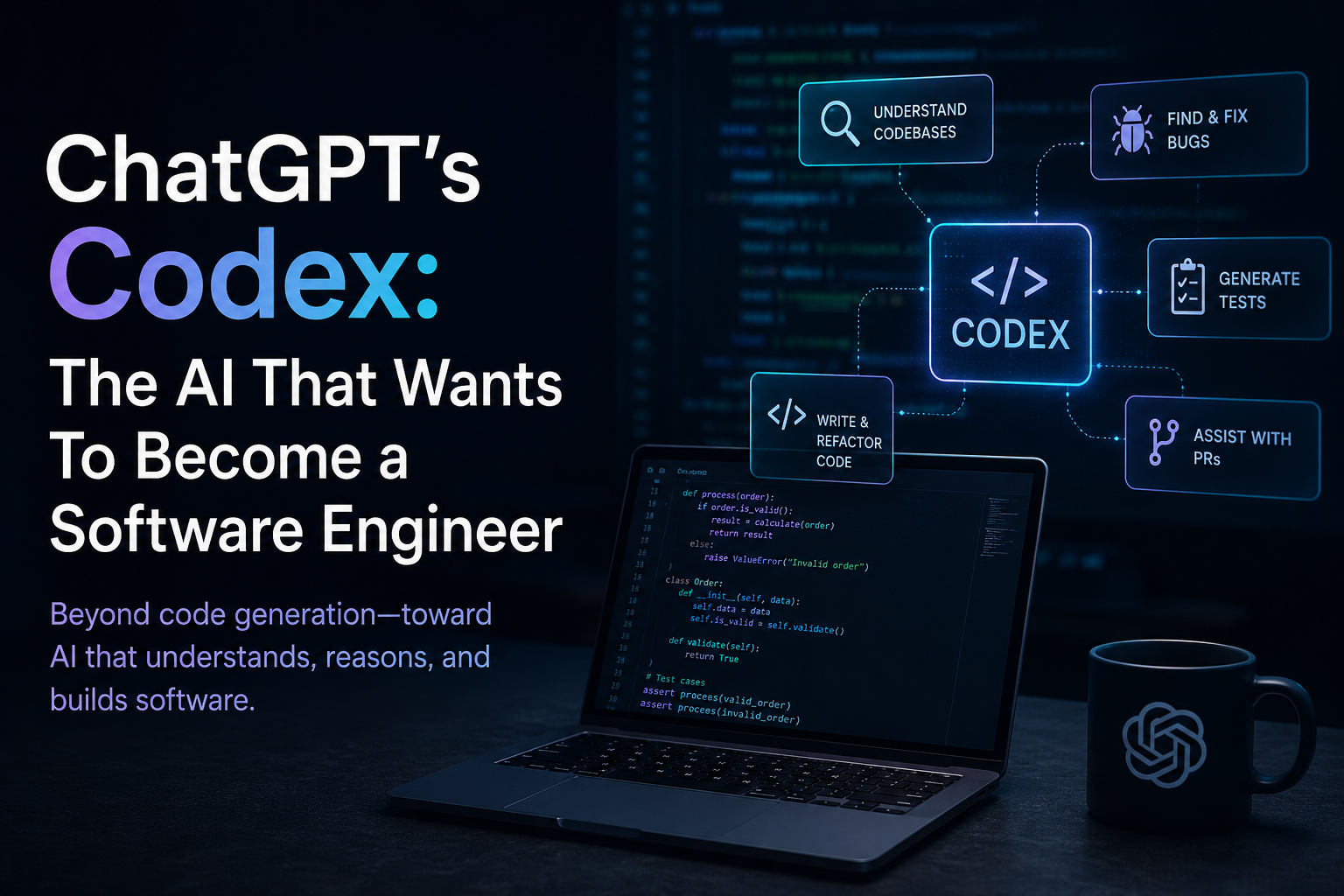
Most people think Codex is just an AI that writes code. But I think that framing misses something important. Because writing code is only one small part of software engineering. Real development work usually involves something much messier:
- understanding unfamiliar systems
- debugging failures
- connecting abstractions
- modifying old code
- navigating dependencies
- and reasoning across large projects that evolved over years
And this is exactly where Codex becomes interesting.
To understand what Codex actually is, it helps to stop thinking about it as an autocomplete system and start thinking about it as an engineering-oriented reasoning system. That distinction matters.
Earlier coding assistants mostly operated locally inside small contexts. You wrote a function, and the model predicted the next few lines. Sometimes useful. Sometimes surprisingly good. But fundamentally narrow.
Codex moves toward something broader. Instead of simply generating code fragments, it attempts to operate across development workflows themselves. Imagine asking a system:
- find the bug causing authentication failures
- trace where the issue originates
- modify the relevant files
- add tests
- and explain what changed
That is not just text prediction anymore. The system is now operating across structure, context, and objectives simultaneously. And I think this is where many people misunderstand what is happening in AI right now. The important shift is not that AI can generate syntax.
Generating syntax is relatively easy. The harder problem is navigating complexity. A modern software repository may contain:
- thousands of files
- multiple frameworks
- legacy decisions
- hidden dependencies
- poor documentation
- and years of accumulated technical debt
Humans spend enormous amounts of time simply building mental models of these systems before they can safely modify them. Codex is increasingly being trained for exactly that environment. It can explain unfamiliar repositories, identify relationships between components, generate tests, refactor sections of code, and assist with debugging workflows. In some cases, it behaves less like a coding tool and more like a collaborative engineering layer. That does not mean it understands software the way humans do.
And I think this distinction is critical.
A system may successfully modify code without possessing human-like comprehension of the product, business context, or long-term architectural consequences. Which means Codex can still produce:
- fragile implementations
- incorrect assumptions
- hallucinated APIs
- security vulnerabilities
- or subtle edge-case failures
The outputs may appear convincing while still containing deep structural problems underneath. That is why human oversight remains essential. But even with those limitations, something important is changing. Programming is slowly becoming less about manually translating ideas into rigid syntax and more about describing intent at higher levels of abstraction.
That changes who can build software. Historically, software creation required people to think in machine-oriented structures:
- languages
- frameworks
- compilers
- syntax
- memory models
- system constraints
AI systems like Codex partially compress that translation layer. A person can increasingly describe: what they want, why they want it, and how the system should behave and let the AI generate large portions of the implementation. That does not eliminate engineering. But it changes where engineering effort gets concentrated. Less time may go toward boilerplate construction. More time may go toward:
- system design
- verification
- architecture
- goal definition
- and reasoning about tradeoffs
And I think this may ultimately be the real significance of Codex. Not that machines learned to code. But that software itself is becoming more accessible through natural language abstraction. The deeper shift is not happening at the level of code generation.
It is happening at the level of interaction between humans and computation itself.