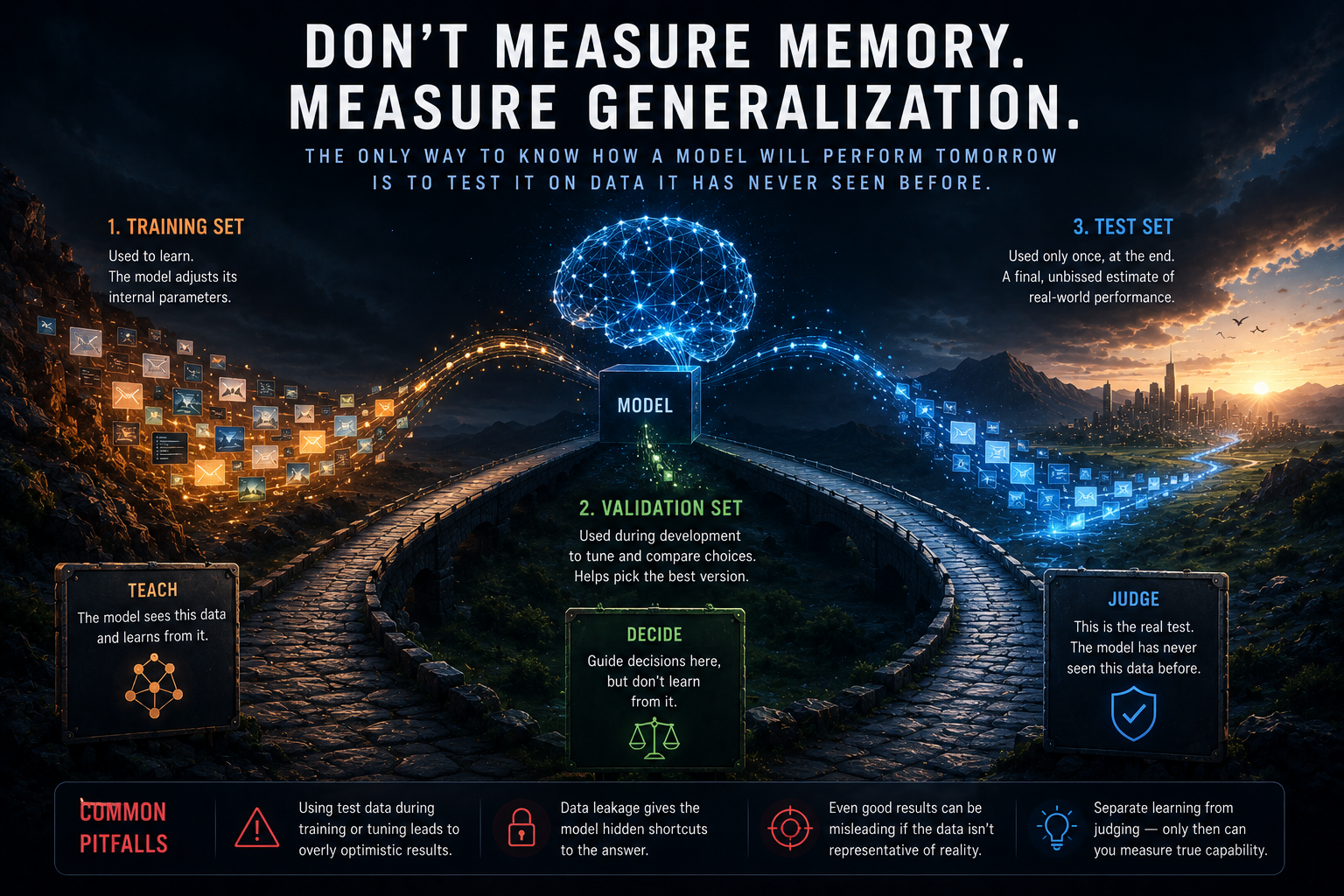
One of the easiest ways to fool yourself in machine learning is to build a model that appears incredibly accurate. And then discover it doesn’t work in the real world. At first, that sounds strange. If the model is accurate, shouldn’t it work?
Not necessarily.
Because there is a subtle difference between solving a problem and memorizing examples of that problem. And that distinction sits at the heart of modern machine learning.
The Memorization Trap
Imagine giving a student the exact same questions for practice and for the final exam. Chances are they’ll perform extremely well. But what have you actually measured?
Understanding?
Or memory?
The problem is that high performance alone does not tell you which one you’re looking at. Machine learning faces the same challenge.
A model can become remarkably good at handling examples it has already seen. It can adapt itself to those specific patterns and achieve impressive accuracy. But that doesn’t necessarily mean it has learned something general. It may have simply become very good at remembering.
And that creates one of the biggest problems in machine learning: How do you tell the difference between memorization and genuine learning?
The Real Purpose of Evaluation
I think many people assume evaluation exists to measure performance. But that’s only partially true. The real purpose of evaluation is to estimate what happens when the model encounters something new. Because that’s what the real world actually looks like. Every prediction is made on data the model has never seen before.
Tomorrow’s emails.
Tomorrow’s customers.
Tomorrow’s market conditions.
Not yesterday’s training examples. So if we want to understand how useful a model really is, we need to simulate that situation. The model needs to face information that was not involved in its learning process. Only then can we see whether it has discovered patterns that generalize beyond specific examples.
Why One Dataset Isn’t Enough
This creates an interesting challenge. Usually, we only have one dataset. So how do we test a model on unseen data if all of our data is already sitting in front of us? The solution is surprisingly simple. We give different parts of the data different jobs. One portion teaches the model. Another helps us make decisions while building it. And a final portion remains untouched until the very end.
That last part is important. Because the moment the model becomes influenced by evaluation data, the evaluation stops being trustworthy. The test itself starts becoming part of the learning process. And once that happens, the results become increasingly optimistic.
The Illusion of Progress
I think this is where machine learning becomes surprisingly similar to human behavior. Whenever we know how we’re being measured, we naturally begin adapting to the measurement itself.
Students optimize for exams.
Companies optimize for metrics.
Social media platforms optimize for engagement.
Models do exactly the same thing. If a machine learning system repeatedly encounters the same evaluation data, it gradually becomes specialized for performing well on that specific benchmark.
Performance rises.
Confidence rises.
But actual capability may remain unchanged. The numbers improve. Reality doesn’t. And that’s a dangerous illusion.
The Hidden Danger of Leakage
There is another problem that makes this even harder. Sometimes information leaks into places it shouldn’t. Not intentionally. Just accidentally. A feature contains information that indirectly reveals the answer. A preprocessing step uses information from the entire dataset. A decision made during development subtly incorporates evaluation results.
The model appears brilliant. But for the wrong reason. And because the shortcut works during testing, nobody notices; until deployment. Then performance collapses. Not because the model stopped working. But because the hidden signal it relied on no longer exists.
Why Generalization Matters
Ultimately, machine learning is not really about performing well on known examples. It’s about performing well on unknown ones. That may sound obvious. But it’s easy to lose sight of. A model’s true value isn’t measured by how accurately it predicts yesterday’s data. It’s measured by how reliably it handles tomorrow’s. And tomorrow is always unseen. That’s why the separation between learning and evaluation matters so much.
Without it, we stop measuring capability. We start measuring familiarity. And those are not the same thing.
The Bigger Lesson
The deeper I look at machine learning, the more it feels like a lesson that extends far beyond AI. Because the same principle appears everywhere.
There is a difference between:
- memorization and understanding
- optimization and capability
- performance and competence
The challenge is that, from the outside, they often look identical. At least for a while. Which is why the hardest part of machine learning isn’t teaching a model to learn.
It’s making sure you’re measuring whether it actually did.