One of the most interesting questions in AI is this:
If machines were already learning from data, why did we need neural networks?
After all, simpler models already worked.
They could detect spam.
Predict house prices.
Identify patterns in data.
So what problem were neural networks actually solving? The answer has less to do with intelligence and more to do with complexity.
The Limits of Simple Learning
Imagine trying to identify a cat in an image. At first, it sounds straightforward.
The image contains pixels.
The model analyzes those pixels.
The model predicts whether a cat is present.
Simple enough. But the moment you think about it more carefully, the problem becomes surprisingly difficult.
A single cat can appear:
- from different angles
- under different lighting conditions
- partially hidden
- sitting, running, or sleeping
The raw pixels can look completely different every time. And yet humans recognize the cat almost instantly. Why?
Because we are not really looking at pixels. We are recognizing structures.
Edges.
Shapes.
Patterns.
Relationships.
And that reveals a limitation of many simple machine learning models. They are good at finding direct relationships. But the real world is rarely organized that way.
Reality Is Layered
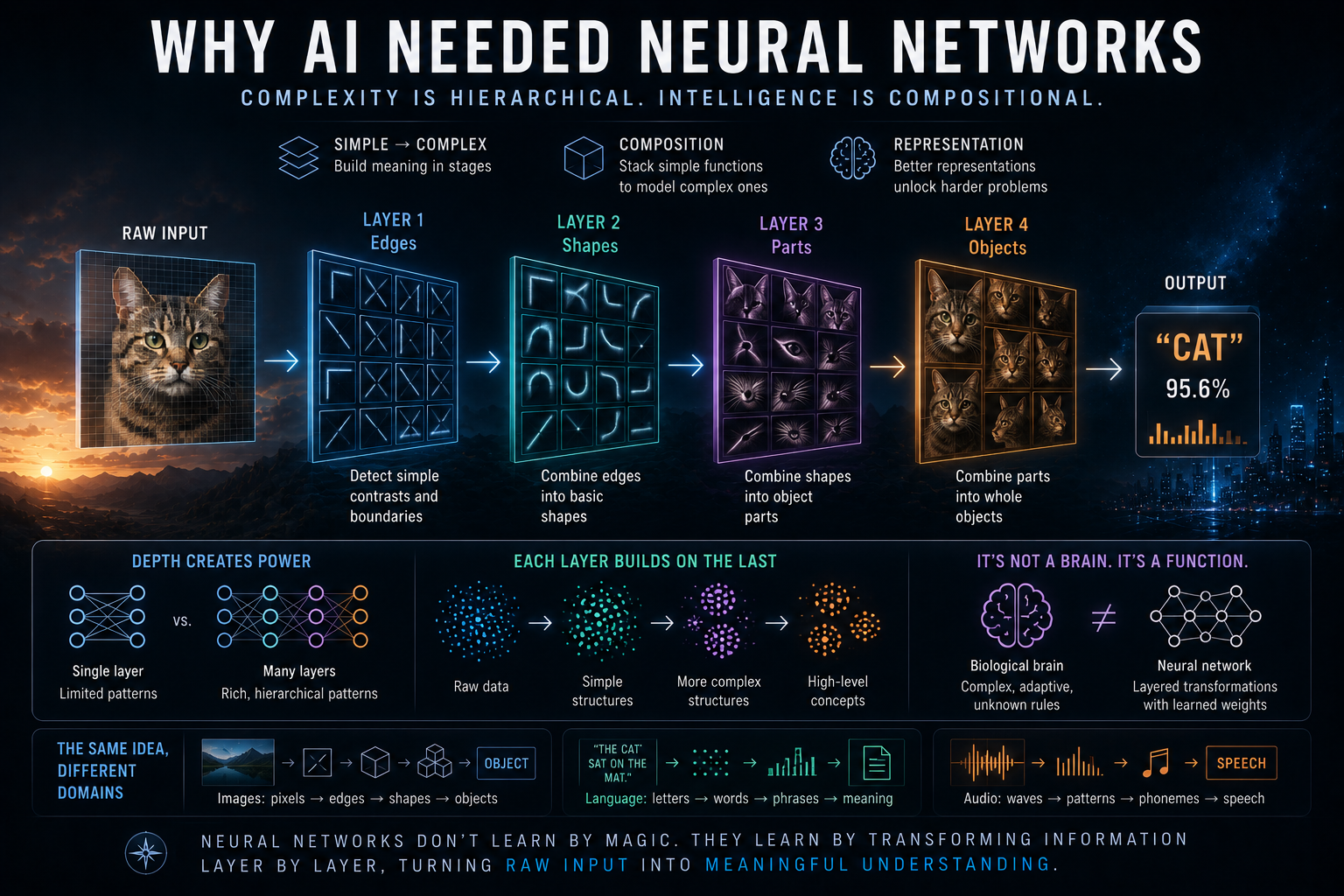
I think one reason intelligence feels mysterious is because reality itself is hierarchical. Consider how humans see the world. We don’t process every sensory input independently. Instead, meaning emerges through layers.
Edges become shapes.
Shapes become objects.
Objects become concepts.
Concepts become understanding.
The same pattern appears in language.
Letters become words.
Words become phrases.
Phrases become ideas.
Ideas become meaning.
The world is full of structures built on top of other structures. And that creates a problem for simple models. Many patterns cannot be understood all at once. They have to be built gradually.
A Different Approach
This leads to a surprisingly powerful idea. What if a model didn’t try to learn everything directly? What if it learned in stages? Instead of jumping from raw input to final prediction, the system could progressively transform information into more useful forms.
One layer extracts simple patterns. Another combines those patterns into more meaningful structures. Another builds even higher-level abstractions. And eventually, a decision emerges. That is the core idea behind neural networks.
Not a giant leap in intelligence. A different way of organizing learning.
The Power of Layers
At their core, neural networks are surprisingly simple. Each layer receives information. It transforms that information. Then passes the result forward. Individually, these transformations are not particularly impressive.
The magic comes from composition. Because when many simple transformations are chained together, something interesting happens. The system becomes capable of representing patterns that would be extremely difficult to capture directly.
A single layer may detect simple visual contrasts.
A deeper layer may recognize shapes.
A deeper layer may recognize parts of objects.
Eventually, the system can recognize an entire cat. No individual layer understands the image. But collectively, the layers create a representation that makes recognition possible.
The Hidden Importance of Representation
I think one of the most underrated ideas in AI is that intelligence often depends less on learning and more on representation. How information is organized determines what can be learned from it.
A good representation makes patterns obvious.
A poor representation hides them.
This is why neural networks became so important. They do not just learn patterns. They learn increasingly useful ways of representing reality itself. And that changes what becomes possible.
The Misleading Comparison
One thing that often creates confusion is the comparison between neural networks and human brains. The terminology certainly encourages it.
Neurons.
Networks.
Connections.
But the resemblance is mostly historical. Neural networks are not miniature brains. They are mathematical systems built around layered transformations and adjustable parameters.
What matters is not biology. It is structure. And that structure turns out to be remarkably effective for capturing complex relationships hidden inside data.
The Bigger Shift
The deeper I look at neural networks, the less they feel like a breakthrough in learning and the more they feel like a breakthrough in abstraction. Earlier models often tried to connect inputs directly to outputs. Neural networks introduced layers in between. Layers that gradually transform raw information into increasingly meaningful representations.
And perhaps that idea extends beyond AI.
Because many difficult problems become easier once they are broken into layers. Understanding itself often works that way. We rarely jump from raw information to insight. We build intermediate representations first. Then we build on top of them.
Again and again. Until complexity becomes manageable.
Which may be exactly why neural networks work in the first place.