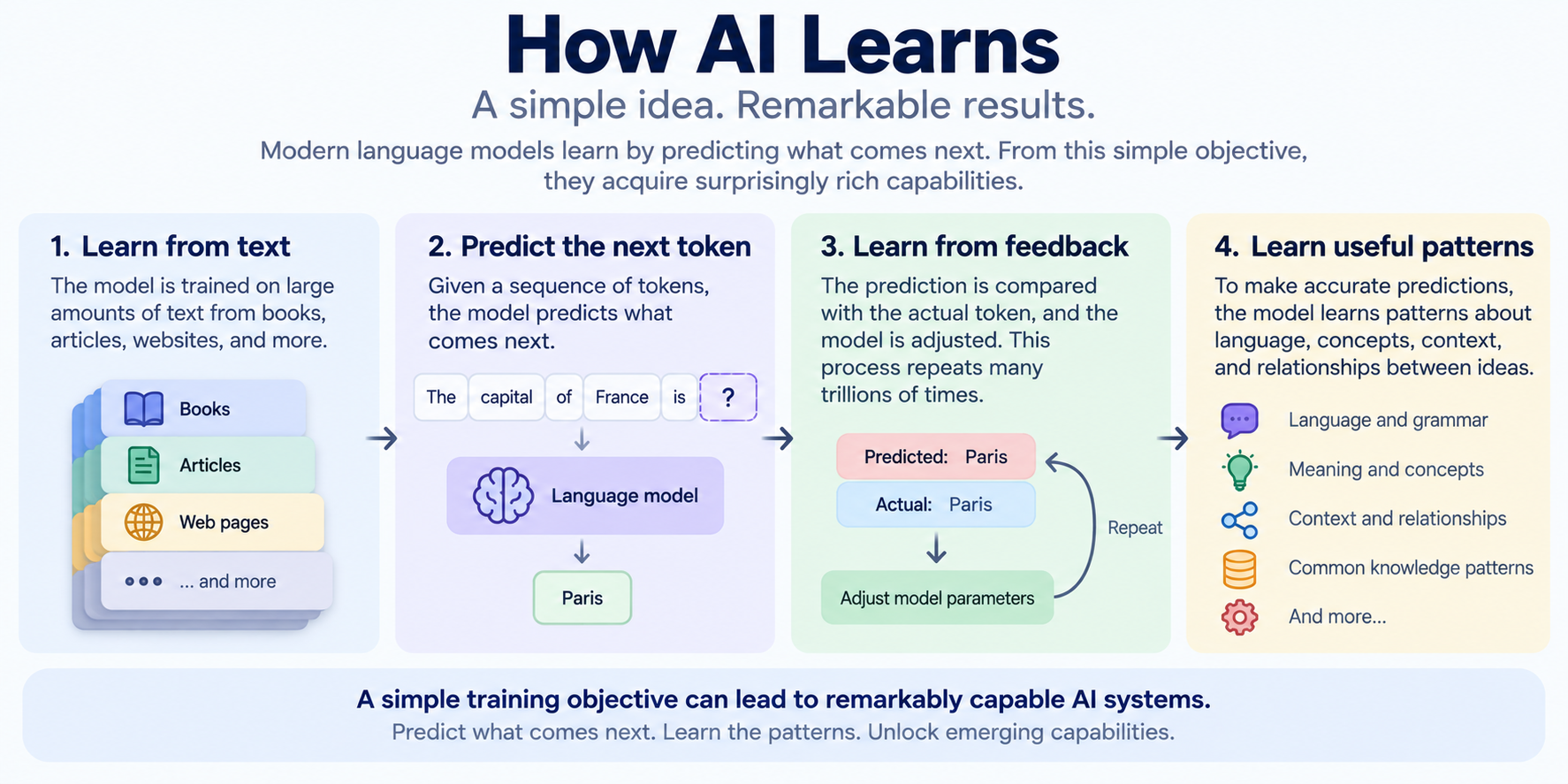
One of the strangest things about modern AI is that a remarkably simple training objective can produce surprisingly capable systems.
Predict what comes next.
That’s the basic idea behind how AI learns and the training objective used by many modern language models.
Not explicitly solve math problems.
Not manually learn grammar rules.
Not receive a database of facts one by one.
Instead, the model repeatedly encounters text and learns to predict the next token.
At first glance, that seems far too simple to explain what systems such as ChatGPT can do. Yet the task becomes much more powerful when you consider what a model must learn to perform it well.
To predict language accurately, a model has to capture patterns involving syntax, meaning, context, and relationships between concepts.
That’s the key idea behind how language models learn from data.
The simple task that isn’t simple
Imagine being given the beginning of a sentence:
The capital of France is…
Most people immediately think of Paris.
But notice what is required to make that prediction.
You need to recognize the structure of the sentence. You need to understand the relationship between France and its capital. You need enough knowledge about the world to identify the likely continuation.
The prediction looks simple on the surface, but the information needed to make it accurately is not.
This is the important insight behind next-token prediction.
A language model is trained to predict what comes next, but becoming good at that task requires it to capture many of the patterns contained in the training data.
How AI learns through prediction
It is easy to assume that AI systems are explicitly taught language rules, facts, and reasoning strategies.
But during language-model training, much of the learning comes from repeatedly predicting tokens from large amounts of text.
The basic cycle is:
Predict → compare with the actual token → adjust the model → repeat
The model makes a prediction.
The actual next token is available in the training data.
The difference between the prediction and the target produces a learning signal, which is used to adjust the model’s parameters.
Then the process happens again.
And again.
Across an enormous number of training examples, the model gradually becomes better at predicting the patterns present in the data.
The important point is that the model is not normally given a separate lesson for every grammatical rule or conceptual relationship. Instead, those patterns can be learned because capturing them helps reduce prediction error.
Why language contains so much structure
The reason next-token prediction can be such a demanding learning problem is that language is highly structured.
Grammar creates structure.
Meaning creates structure.
Context creates structure.
Relationships between concepts create structure.
Even some patterns associated with reasoning appear in language.
If a model wants to predict the next token accurately, it has to capture whatever regularities in the data help it make better predictions.
For example, nobody needs to manually provide a rule saying that certain nouns tend to appear with particular verbs. The model can learn statistical patterns from repeated examples.
Likewise, relationships between concepts can become useful because those relationships help predict what words and tokens are likely to appear together.
The objective remains the same:
Predict the next token.
But the patterns that help accomplish that objective can become increasingly sophisticated.
Learning patterns instead of memorizing rules
This is an important distinction.
A language model is not simply a collection of explicitly programmed grammar rules and facts.
Its parameters are adjusted during training so that the model becomes better at predicting patterns in its data.
Those learned patterns can include relationships involving:
- Words and phrases
- Grammar
- Concepts
- Topics
- Context
- Common sequences of events
- Relationships between entities
The model therefore develops internal representations that allow it to capture regularities across its training examples.
This is one reason a seemingly simple prediction objective can support surprisingly complex behavior.
Why prediction can produce useful internal representations
The deeper you look at language-model training, the more it resembles a form of compression—not compression in the file-size sense, but in the sense of capturing regularities that explain many observations.
Imagine trying to predict an enormous amount of text without learning anything about the patterns inside it.
That would be extremely difficult.
To make better predictions, the model benefits from capturing reusable patterns.
Patterns about language.
Patterns about people.
Patterns about concepts.
Patterns about how events and ideas are described.
Those patterns become encoded in the model’s learned parameters.
This does not mean the model develops a complete or accurate internal representation of reality. But it does mean that improving prediction can encourage the model to capture increasingly useful regularities in its training data.
In this sense, prediction acts as a pressure to learn representations that help explain and generate language.
Why scale matters
This also helps explain why scale matters in AI training.
With more training data, a model encounters more examples and a wider range of patterns.
With larger models, there is more capacity to represent complex relationships.
With more computation, the training process can perform more optimization over those parameters.
As these factors increase, models can capture increasingly rich patterns in their training data.
At a high level:
More data → more patterns to learn
More model capacity → more complex relationships can be represented
More computation → more opportunity to optimize those representations
The underlying prediction objective does not necessarily need to change for the resulting capabilities to become more sophisticated.
The scale of the learning process can change what the model is capable of representing.
The important limitation: prediction is not truth
There is an important distinction that should not be overlooked.
A language model is trained to predict patterns in its data. That is not the same thing as being trained to verify whether every generated statement is true.
A response can therefore be linguistically plausible while being factually incorrect.
A statement may fit the surrounding context and still fail to match reality.
This helps explain an important characteristic of modern AI systems.
They can be remarkably fluent and knowledgeable while also producing confident errors.
The model’s ability to generate convincing language should therefore not be confused with a guarantee of factual accuracy.
This distinction becomes especially important when a task requires current, private, or highly specific information that may not be available in the model’s learned parameters.
What the model actually learns
It is tempting to say that a language model simply “learns the internet” or “learns everything in its training data.”
That is too simplistic.
The model learns parameters that capture patterns from its training process.
Those parameters can encode useful information about language and relationships found in the data, but they are not a searchable copy of the original training dataset.
This distinction matters because it explains why a model can produce knowledge-like responses without functioning like a traditional database.
It also helps explain why the model cannot necessarily retrieve a specific document or verify a specific fact simply because something similar appeared in its training data.
The bigger lesson
What fascinates me most about large language models is that many capabilities associated with intelligent behavior are not created by manually programming each capability.
Instead, researchers train models to become increasingly good at a relatively simple objective: predicting what comes next.
As the model becomes better at that task, it can learn increasingly useful patterns involving language, concepts, context, and relationships.
The result is remarkable.
A system trained to predict the next token can develop capabilities that appear far more sophisticated than the original objective suggests.
But to understand why its responses can change so dramatically depending on the input, we need to look at how the model actually generates text from the context it receives..
That is the next step.