Why can a single prompt fail on a complex task, even when the instructions are clear and well-written?
Because complex tasks are rarely single operations. They are usually combinations of multiple distinct steps: understanding the problem, identifying relevant information, organizing it, reasoning about it, and producing the final output.
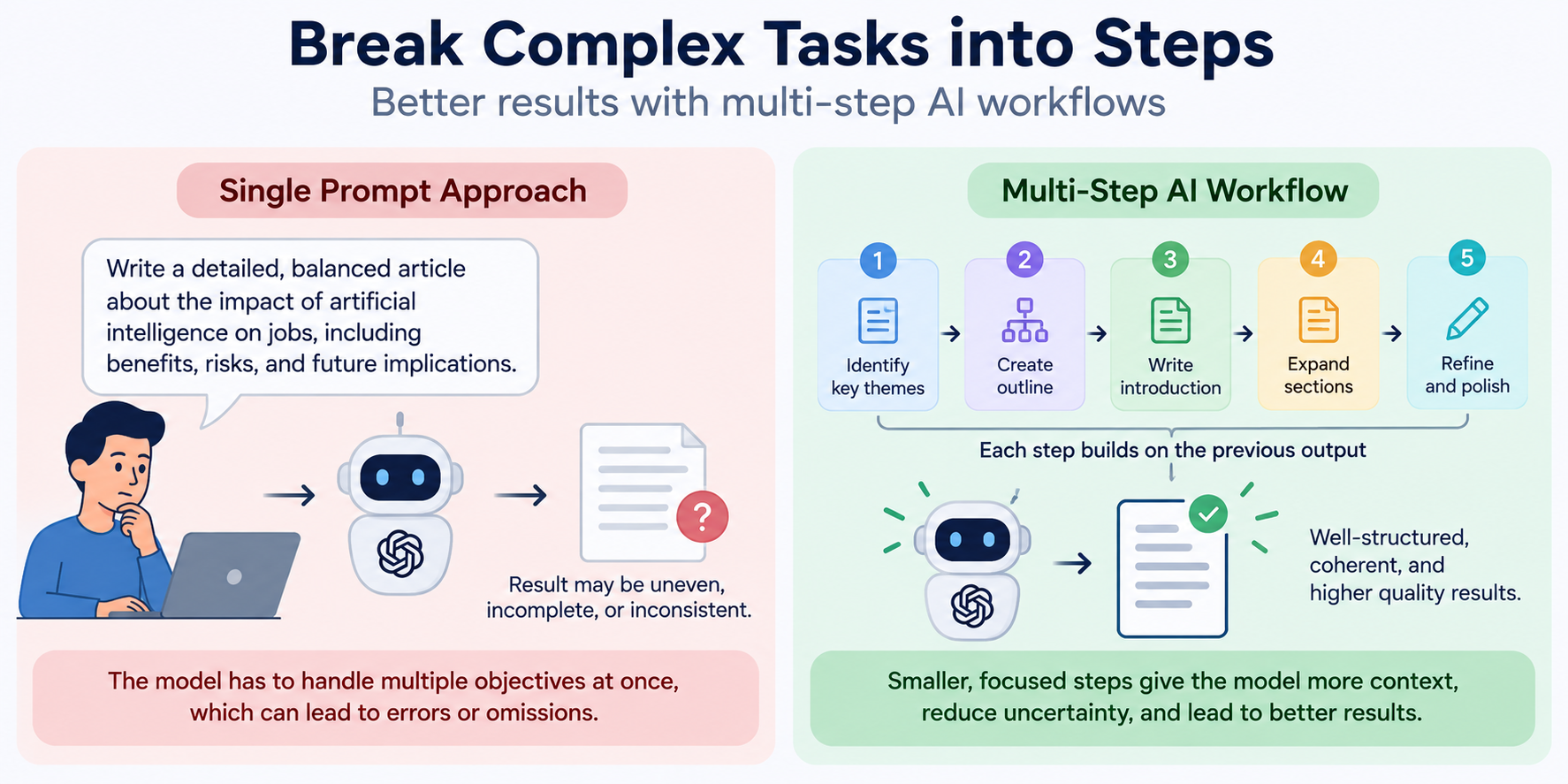
When all of these operations are compressed into a single prompt, the model has to handle multiple objectives at once. There are few constraints between those stages, so an error or omission in one part can affect everything that follows.
A better approach is to break the task into smaller, connected steps.
This is the basic idea behind multi-step AI workflows and AI task decomposition.
Why a single prompt can struggle with complex tasks
A well-designed prompt can reduce ambiguity by providing clear instructions, constraints, examples, and structure. But some tasks are complex enough that improving the prompt alone is not sufficient.
From the model’s perspective, a single prompt creates a large space of possible responses.
It must determine several things simultaneously:
- What the task is
- How to approach it
- What information or reasoning is required
- How the final output should be structured
Even when the instructions are clear, the model still has to resolve these objectives within one generation process.
That can increase the chance of errors, omissions, inconsistency, or uneven results.
This leads naturally to the idea of task decomposition: instead of treating a complex task as one large problem, break it into smaller sub-tasks with clearly defined objectives and outputs.
What is a multi-step AI workflow?
A multi-step AI workflow breaks a larger task into a sequence of smaller operations.
Each step has a specific purpose and produces an output that can be used by a later step.
Instead of asking the model to complete everything at once, you create a process such as:
Task → Step 1 → Step 2 → Step 3 → Final output
The output from one step becomes part of the context for the next.
This gives the model a more constrained problem at each stage.
Why decomposition can improve results
Consider what happens when you break a complex task into smaller parts.
Each sub-task has a narrower objective. The model has fewer things to decide at once, and the output of the previous step provides additional structure for the next step.
The intermediate outputs are therefore more than temporary results. They become constraints and context for subsequent steps.
To see why this matters, remember that a language model generates its output based on its available context.
When intermediate results are added to that context, they help narrow the range of possible outputs at the next stage.
Instead of making one large jump from the original request to the final answer, the model follows a sequence of smaller, more guided steps.
Single prompt vs. multi-step workflow
Consider a task such as:
Write a well-structured article about the impact of artificial intelligence on jobs.
The single-prompt approach
You might write:
“Write a detailed, balanced article about the impact of artificial intelligence on jobs, including benefits, risks, and future implications.”
This can work.
But the model has to decide the structure, arguments, examples, tone, and level of detail while producing the article.
The result may therefore be uneven. Some sections might be underdeveloped, others repetitive, and important aspects may be overlooked.
The multi-step approach
Instead, you could decompose the task:
Step 1:
“List the key themes that should be covered in an article about the impact of AI on jobs.”
Step 2:
“Organize these themes into a clear outline with sections and subsections.”
Step 3:
“Write an introduction based on this outline.”
Step 4:
“Expand each section into a detailed paragraph, following the outline.”
Step 5:
“Refine the full article for clarity, coherence, and flow.”
Each step has a narrower objective.
The model is no longer deciding on the structure while simultaneously writing the article. The structure has already been established.
Likewise, it does not need to invent the key themes while composing the final piece. Those themes were generated and organized earlier in the workflow.
The intermediate outputs provide additional context that guides subsequent steps.
How intermediate steps reduce uncertainty
The difference between these approaches can be understood in terms of the model’s possible outputs.
With a single prompt, there are many possible ways to interpret the task and many possible structures for the final response.
With a multi-step workflow, each stage establishes information that constrains the next stage.
For example:
Original task
↓
Key themes
↓
Article outline
↓
Introduction
↓
Individual sections
↓
Edited article
At each stage, the model has more information about what it is supposed to produce.
The workflow therefore turns one broad problem into a sequence of narrower problems.
This can make the overall process more predictable and easier to control.
Multi-step workflows can make errors easier to catch
There is another important advantage to decomposition: intermediate outputs can be inspected before the process continues.
Suppose the model creates an incomplete outline and then immediately uses it to write the entire article.
The missing topic can propagate through every subsequent step.
With a multi-step workflow, you can inspect the outline first. If something is missing, you can correct it before asking the model to generate the next stage.
The same principle applies to other tasks.
A workflow might produce:
- An analysis
- A structured summary
- A set of recommendations
- A final report
Each intermediate result can potentially be checked or revised before it becomes input to the next step.
This creates an opportunity to catch problems earlier rather than discovering them only in the final output.
More prompts aren’t always better
It is important not to confuse multi-step workflows with simply using more prompts.
Adding more steps does not automatically improve the result.
The value comes from designing steps that reduce uncertainty or isolate meaningful parts of the problem.
Poorly chosen steps can still produce poor results. If an intermediate output is vague, incomplete, or incorrect, later stages may build on that mistake.
There is also a cost to additional steps. Each stage introduces processing overhead and another opportunity for the workflow to drift away from the original objective.
So the goal is not:
Use as many prompts as possible.
The goal is:
Match the structure of the workflow to the structure of the problem.
Simple tasks may need only one step. Complex tasks may benefit from several.
When should you use a multi-step AI workflow?
Task decomposition is most useful when a request contains several distinct operations that can be separated.
For example:
Research and reporting
Instead of asking the model to research a topic and produce a polished report in one step:
Research → organize findings → identify insights → write report
Data analysis
A more structured workflow might be:
Inspect data → identify patterns → analyze results → develop recommendations → produce report
Content creation
A content workflow could be:
Identify topics → create outline → draft → review → refine
The exact workflow depends on the task.
The important question is:
Can the problem be broken into meaningful stages where the output of one stage helps define the next?
If so, decomposition may make the task easier to control.
When decomposition may not help
Not every task needs a multi-step workflow.
If the request is simple and well-defined, adding multiple stages can create unnecessary complexity.
For example:
“What is the capital of France?”
Breaking this into five separate prompts would add overhead without providing a meaningful benefit.
Likewise, a short creative task may not benefit from a rigid workflow if the intermediate constraints would make the process unnecessarily complicated.
This is why workflow design involves a tradeoff.
More structure can improve control, but too much structure can increase complexity without improving the result.
Test your understanding
Consider these three tasks.
1. Analyze a dataset and produce a report
How could you decompose the task?
One possible structure is:
Inspect the dataset → identify important patterns → analyze the findings → develop insights and recommendations → produce the report
Each stage has a distinct purpose and creates useful input for the next.
2. Write a short story with a twist ending
How could you structure this without overcomplicating it?
You might use:
Define the premise → decide the twist → create a basic story structure → write the story → revise
The workflow should remain relatively simple because the task does not necessarily require extensive decomposition.
3. Answer a complex philosophical question
This is more difficult.
Philosophical questions may not have a single objectively correct sequence of steps. Decomposing the problem might involve:
Clarify the question → identify relevant concepts → consider competing perspectives → develop an argument → evaluate weaknesses → formulate the response
The challenge is that the intermediate steps themselves may require interpretation and judgment.
Decomposition can still impose structure, but it cannot eliminate the inherent ambiguity of the problem.
The bigger shift: from prompts to workflows
The key mental model is this:
A multi-step AI workflow is a guided trajectory through the model’s output space.
Instead of asking the model to jump directly from a complex request to a final answer, you guide it through intermediate states that progressively constrain and refine the result.
The intermediate outputs become part of the context for subsequent steps.
This changes how you think about prompting.
Rather than asking:
“What is the perfect prompt?”
you can ask:
“What sequence of steps makes this problem easier for the model to solve?”
That shift is important.
A complex task does not necessarily need a more elaborate single prompt. Sometimes it needs a better-designed workflow.
And once these workflows can incorporate external information, invoke tools, and use the results of previous steps, they become the foundation for more capable AI systems.