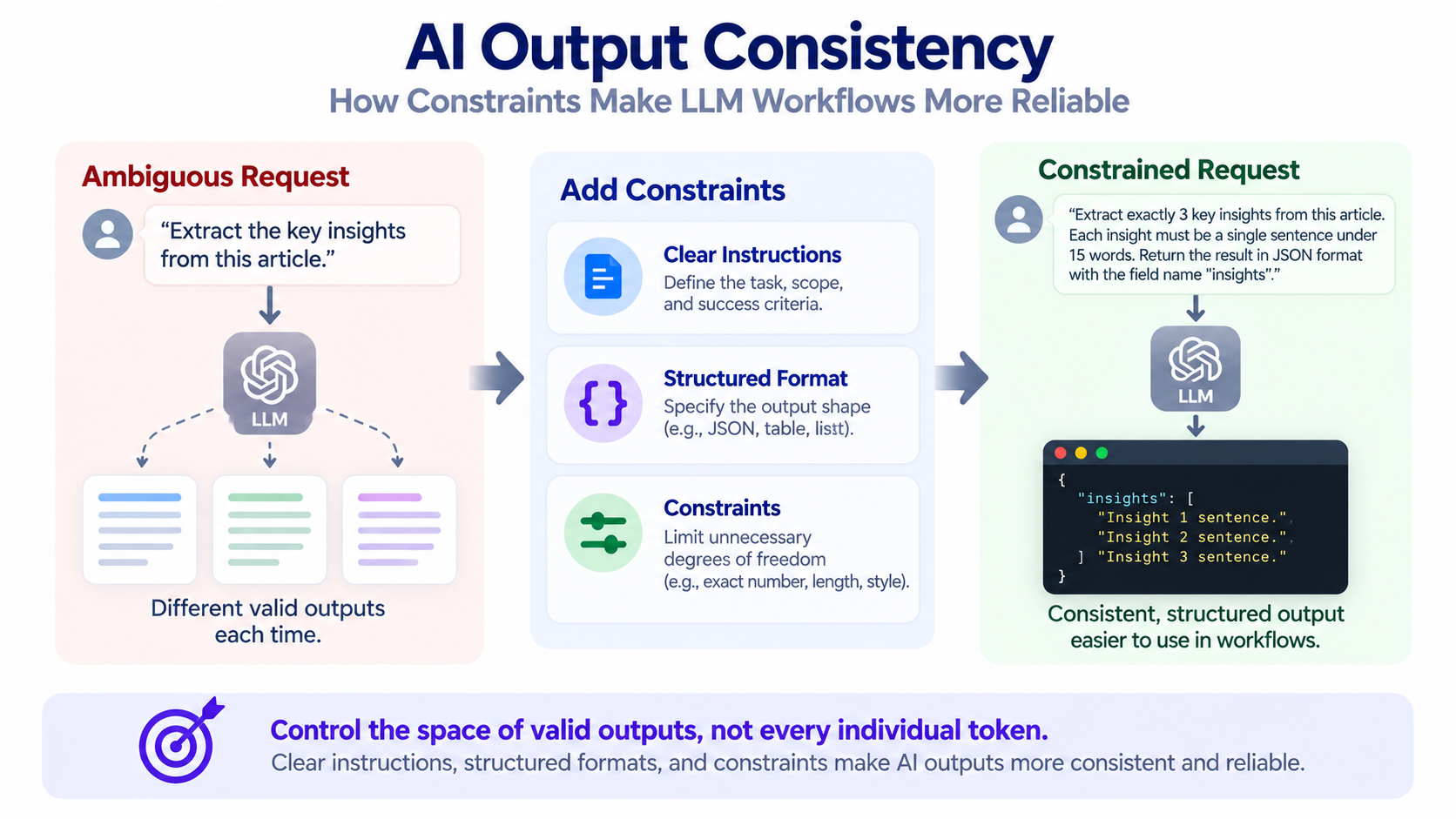
AI output consistency is not simply a matter of making a model “answer the same way” every time. A language model generates text by selecting among possible next tokens, and when an input permits several plausible continuations, different outputs can emerge even when the underlying task appears unchanged. Some of that variation comes from the generation process itself; much of the practically important variation, however, comes from ambiguity in what the system has been asked to do.
That distinction changes how reliability should be designed. If a request leaves the task, scope, format, or success criteria open to interpretation, the model must resolve those uncertainties while generating its response. Different executions can therefore follow different plausible paths. The problem is not necessarily that the model has malfunctioned. The problem is that the system has left too much of the decision space unspecified.
The practical response is to reduce ambiguity and constrain the space of acceptable outputs. Clear instructions define the task. Structured formats define the shape of the result. Constraints limit unnecessary degrees of freedom. Together, they make probabilistic generation more predictable without requiring every valid response to be identical.
The Real Source of Variability Is Often Ambiguity
Consider a request such as: “Extract the key insights from this article.”
It sounds straightforward until the missing decisions are made explicit. How many insights should be extracted? What makes an insight “key”? Should the output summarize the author’s main argument, identify surprising observations, or capture practical implications? Should each insight be a sentence, a phrase, or a paragraph?
The model has to infer answers to all of these questions. Because several interpretations may fit the instruction, several different outputs can be reasonable. One execution might produce three concise insights; another might produce seven longer observations. Neither necessarily represents a failure of text generation. They are different resolutions of an underspecified task.
This is why reliability cannot be reduced to the idea of simply “asking better.” The issue is structural. If important decisions remain implicit, the model must make those decisions itself.
The same principle applies even when the wording of the input is identical. Generation can involve probabilistic sampling, and multiple continuations can have meaningful probability. But tighter task definitions can reduce the amount of variation that matters by making fewer interpretations acceptable.
The objective, then, is not to eliminate all variation. It is to eliminate unnecessary variation.
AI Output Consistency Comes From Controlling the Output Space
Once ambiguity is recognized as part of the problem, three control mechanisms become particularly useful: instructions, formats, and constraints.
Clear instructions tell the model what transformation it is supposed to perform. Instead of asking it to “analyze” a document, a workflow can specify the dimensions of analysis that matter. The model then has less need to invent the task definition.
Output formats constrain how the result should be represented. A numbered list, a fixed set of fields, or a structured object gives the response a predictable shape. This does more than make the result visually tidy. It makes the output easier for another system or workflow step to consume.
Constraints narrow the remaining degrees of freedom. A requirement such as “return exactly three insights, each as a single sentence under fifteen words” removes several possible forms of variation at once.
These mechanisms do not force the model to produce one predetermined sequence of tokens. Instead, they change the context in which generation occurs, making a narrower region of possible responses more appropriate to the task.
That is the central idea behind reliable AI output: control the space of valid outputs rather than attempting to control every individual token.
A Structured Output Becomes a Contract Between Steps
The importance of format becomes clearer when a model is part of a larger system.
Imagine one workflow component extracts information from a document and another component compares the extracted information across several documents. If the first component returns an unconstrained paragraph, the second component has to determine what information is present, where it appears, and how it should be interpreted.
That second component is now solving two problems: the comparison task and the interpretation of the first component’s output.
A structured interface removes much of that uncertainty. If the extraction stage consistently returns fields such as claim, evidence, and limitation, the comparison stage can operate on those fields directly. It does not need to rediscover the structure every time.
This is why structured output is more than presentation. It functions as a contract between workflow steps.
The contract does not have to eliminate all variation. Different documents can produce different claims and evidence. What remains stable is the interface through which those differences are expressed.
That distinction is crucial for composability. A workflow becomes easier to extend when each component has a predictable input and output boundary. Instead of asking every downstream component to interpret arbitrary prose, the system establishes bounded transformations that can be connected together.
Constraints Narrow the Model’s Decision Space
At each stage of generation, a language model is choosing among possible next tokens. The probability distribution can contain many plausible continuations, particularly when the task allows broad interpretation.
Constraints change the conditions surrounding those choices.
Suppose the instruction is simply:
Extract key insights from this text.
The model has substantial freedom over quantity, length, organization, and interpretation.
Now consider:
Extract exactly 3 key insights. Output them as a numbered list. Each item must be a single sentence under 15 words.
The second instruction narrows several dimensions simultaneously. The model must produce three items, use a numbered structure, keep each item sentence-like, and remain below the specified length.
This does not mean that the model has been forced into one exact response. There can still be many possible three-item lists. What has changed is the region of the output space in which acceptable responses are concentrated.
That is why constraints can improve consistency. They remove branches that are irrelevant to the task.
The same mechanism explains why formats such as JSON or fixed field structures can be useful in system design. Once the response has an expected shape, the model is operating within a more predictable pattern, and downstream components have fewer possibilities to account for.
Consistency and Correctness Are Different Problems
There is a subtle danger in treating consistency as the ultimate objective.
Suppose an article contains five genuinely important insights, but the extraction step is required to return exactly three. The output may become more consistent across runs while becoming less complete. The constraint has succeeded at controlling variation, but it has also removed potentially useful information.
This reveals an important tradeoff: tighter constraints can improve consistency while reducing flexibility.
The right constraint is therefore not necessarily the strongest one. It is the constraint that removes harmful variability without excluding useful answers.
For an extraction task, a fixed number of items may be appropriate if downstream processing requires it. In another task, it may be better to specify a maximum rather than an exact number. A classification system may benefit from a closed set of labels because downstream logic depends on those labels. A creative system may need much more freedom because variation is part of the desired result.
The design question is consequently not “How tightly can the model be constrained?” It is “Which dimensions of variation are harmful to this particular workflow?”
That distinction prevents reliability engineering from becoming rigidity engineering.
More Instructions Can Actually Create More Ambiguity
A common response to inconsistent model behavior is to add more instructions. But more instructions are not automatically better.
Imagine a prompt that tells the model to be highly detailed while remaining extremely concise, to be creative while staying strictly factual, and to explore many possibilities while providing one definitive answer. Each instruction may sound reasonable in isolation, but together they create competing objectives.
The model must determine how to reconcile those objectives. That reconciliation becomes another decision inside the generation process.
The better principle is therefore precision over volume.
A short instruction that clearly defines the task, expected output, and meaningful constraints can provide stronger control than a much longer prompt containing overlapping or conflicting requirements.
This also explains why prompt engineering should not be treated as an exercise in endlessly accumulating rules. The purpose of instructions is to reduce uncertainty, not to transfer a larger and larger set of unresolved decisions into the prompt itself.
Creative Tasks Reveal the Limits of Over-Constraint
The tradeoff becomes particularly visible in creative work.
Consider the instruction:
Generate creative ideas for a marketing campaign, exactly 3 ideas, each under 5 words.
It appears highly controlled, but the control may be working against the objective. Creative campaign ideas often derive their value from context: the audience, positioning, message, execution, and distinction from competing ideas. A five-word limit may compress the output so severely that the model can produce slogans but not sufficiently developed campaign concepts.
A better design would constrain the interface while preserving freedom in the creative content. For example, the system could request three campaign concepts, each with a short title and a brief explanation of the central idea.
The number and structure remain predictable, but the model retains enough freedom to produce something meaningful.
This illustrates a broader principle: constraints should target the dimensions where inconsistency creates downstream problems. They should not automatically constrain every dimension of generation.
Reliability Becomes an Architectural Problem
The consequences become more significant when multiple AI steps are connected.
Suppose a workflow contains an extraction stage, a comparison stage, and a reporting stage. If the extraction stage produces unpredictable prose, the comparison stage must interpret it. If the comparison stage then produces another loosely structured response, the reporting stage must interpret that response as well.
Ambiguity can therefore propagate through the system.
Each module may be individually capable, yet the overall workflow can remain fragile because the boundaries between modules are poorly defined. The problem is not necessarily the intelligence of any individual component. It is the lack of control over what one component hands to the next.
Structured outputs interrupt that propagation.
The extractor can return a defined set of fields. The comparison stage can consume those fields and return a defined comparison structure. The reporting stage can then transform that structure into readable prose.
The underlying model remains probabilistic throughout. What becomes more predictable is the system-level interface.
This is an important shift in perspective. AI reliability is not solely a property of the model. It is also a property of how the model is embedded in a system.
The Goal Is Controlled Variation, Not Identical Answers
A reliable AI system does not necessarily need to produce the same answer every time.
For factual extraction, repeated variation may be undesirable because downstream systems expect stable information. For creative ideation, variation may be the entire point. For summarization, several differently worded summaries can all be useful if they preserve the relevant information and conform to the expected structure.
Reliability therefore means controlled variation within a defined boundary.
Instructions establish what the system is trying to accomplish. Formats establish how the result should be represented. Constraints establish which kinds of variation are acceptable. Verification can then be added where correctness matters independently of consistency.
This distinction prevents a common category error: assuming that making outputs more uniform automatically makes them better.
A system can consistently produce the wrong structure, consistently omit important information, or consistently follow an overly restrictive instruction. Consistency is valuable because it makes system behavior easier to predict and compose, not because uniformity is inherently good.
The Larger Principle: Design the Boundaries
The most useful mental model is to think of an AI workflow as a sequence of bounded transformations.
A model receives an input, performs a transformation, and produces an output. If the boundaries are vague, the model has to infer too much. If the boundaries are explicit, the system can tolerate the model’s probabilistic nature while keeping the overall workflow within predictable limits.
This does not turn language generation into deterministic computation. Nor does it guarantee correctness. It changes the engineering problem from trying to eliminate uncertainty to containing the uncertainty that matters.
That is the deeper reason clear instructions, structured outputs, and constraints work together. They do not remove the model’s ability to generate different responses. They make those differences less likely to cross the boundaries that the rest of the system depends upon.
Once each step has a clear purpose and a bounded interface, larger workflows become easier to compose. The next problem is then no longer simply how to constrain generation. It is how to determine whether a generated result is actually correct—and what the system should do when it is not.
That is where reliability moves from controlling outputs to verifying them.