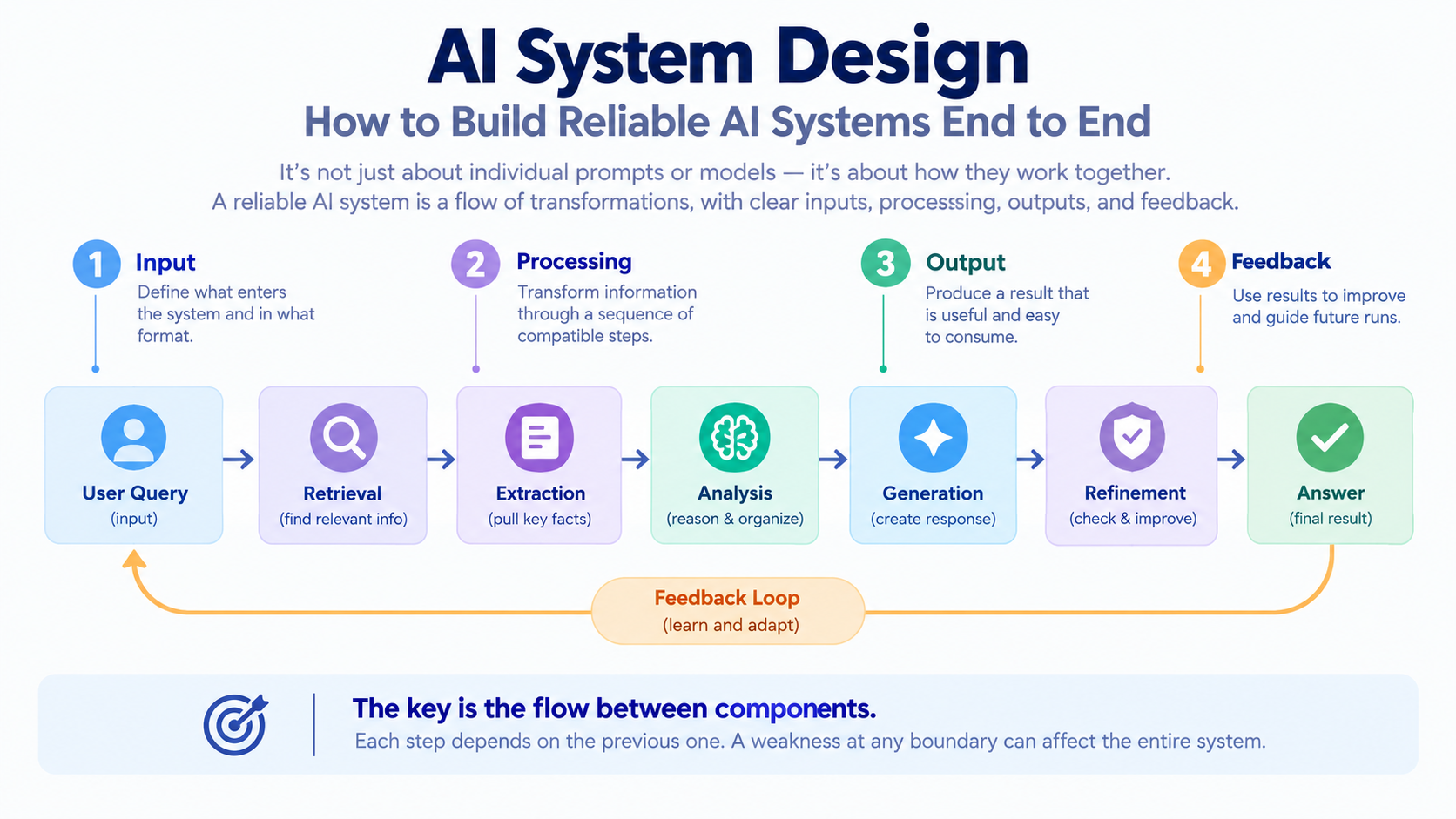
AI system design begins with a question that is easy to overlook when working with individual prompts or model calls: what determines whether an entire system succeeds when it is made up of multiple steps? The answer is not necessarily the quality of any single component. A system can contain individually capable prompts, models, retrieval mechanisms, and tools and still fail because the components do not work together coherently.
The important property is the flow between components. What enters the system determines what information is available to later stages. Each transformation changes that information in some way. The resulting output becomes the input to another step, and feedback can influence what happens in future runs. A weakness at any boundary can therefore affect the entire system.
This changes the design problem. You are no longer designing isolated prompts or individual actions. You are designing a flow of transformations, with explicit decisions about inputs, processing, outputs, and feedback.
Why Strong Individual Steps Can Still Produce a Weak System
Imagine a simple pipeline in which one step extracts key facts, another analyzes them, and a third generates a report.
The analysis step might be excellent. The report generator might also be excellent. Yet if the extraction stage misses a critical fact, the later stages cannot recover it. They can reason perfectly about the information they received while still producing an incorrect result.
This is one of the defining properties of multi-step systems: later components are constrained by what earlier components make available.
The problem can also occur in the opposite direction. Suppose every component performs its intended task accurately, but one produces unstructured prose while the next expects a structured list. The information may be present, but the interface between the two stages is ambiguous. The downstream component must interpret and restructure the result before it can continue.
The individual components have not necessarily failed. The connection between them has.
This is why system performance cannot be understood simply by evaluating every step independently. The interactions between steps matter because each transformation changes the conditions under which the next transformation operates.
AI System Design Starts With the Boundaries of the Flow
Once the problem is viewed at the system level, four dimensions become central: input, processing, output, and feedback.
Input design determines what enters the system and in what condition. Processing defines how that information is transformed from one stage to the next. Output design determines what the system ultimately produces and whether that result can actually be used. Feedback determines how information from the system’s performance influences later behavior.
These are not independent boxes.
A poorly designed input can create uncertainty that propagates through every subsequent transformation. A poorly defined processing stage can introduce ambiguity into its output. A weak output interface can make an otherwise useful result difficult to consume or evaluate. And without feedback, the system has limited ability to learn from what happened during previous runs.
The system should therefore be designed as a connected sequence rather than as a collection of independent tasks.
Input Design Determines What the System Can Know
The first boundary is the input.
Everything that happens later depends, to some extent, on what enters the system. If the input is incomplete, noisy, or ambiguous, downstream components inherit those limitations.
Consider a system designed to answer a user’s question using external documents. The raw question may not always provide enough information to determine exactly what the user is asking. Important terms may be ambiguous. The intended scope may be unclear. Relevant context may be missing.
Input design can therefore involve clarification or normalization before the main processing begins.
The goal is not to make every input perfectly specified. It is to ensure that the system has enough structured information to perform the transformations that follow.
This matters because downstream processing cannot reliably compensate for information that was never captured in the first place. A later analysis step can organize available evidence, but it cannot recover a critical fact that the input stage discarded or never obtained.
That makes early-stage clarity disproportionately important.
The Processing Pipeline Is a Chain of Dependent Transformations
Once the input is defined, the system transforms it through a sequence of stages.
Each stage should have a clear role. More importantly, its output should be compatible with what the next stage expects to receive.
Consider an end-to-end system for answering questions using external documents:
User query → Retrieval → Extraction → Analysis → Generation → Refinement → Answer
The retrieval stage determines which documents or information become available. The extraction stage identifies the relevant passages within that information. Analysis then turns those passages into the key points needed for the answer. Generation converts those points into a response, while refinement improves the final result for clarity and correctness.
Each stage therefore changes the representation of the information.
The retrieval system does not simply “find information.” It determines the information available to the rest of the pipeline. The extraction stage does not simply “shorten documents.” It determines which parts of that information receive emphasis. Analysis does not merely restate passages. It structures them into information that can support the final response.
The pipeline is consequently a chain of dependencies. A decision made near the beginning can determine what is even possible near the end.
Outputs Need to Be Designed for Their Next Use
A system’s output is not necessarily just the final response shown to a user. Every intermediate output is potentially the input to another component.
That makes output design a system-level concern.
Suppose an extraction step produces a paragraph containing several relevant passages mixed with commentary. A human might understand it easily enough. But if the next component needs to compare individual passages or trace each claim back to its source, the format introduces unnecessary ambiguity.
A more useful interface might separate the relevant information into clearly defined units. The exact structure depends on what the next step needs, but the principle remains the same: an output should be designed according to how it will be consumed.
This is where the previous article’s discussion of AI agents becomes important. An agent operates through a sequence of actions and observations, but those actions only compose reliably when the information passed between them remains usable. System design extends that principle beyond the agentic loop itself.
The question is no longer simply whether a component can produce a good result. It is whether the result gives the next component the information it needs in a form it can reliably use.
The Feedback Loop Turns a Pipeline Into a System
A sequence of transformations can produce an output, but a system becomes more adaptable when it can use information about that output to influence future behavior.
Suppose a question-answering system repeatedly produces answers that users find unclear. If the architecture has no feedback mechanism, each run remains largely independent. The system can generate another answer, but it has no explicit mechanism for incorporating information about what went wrong.
With feedback, the system can evaluate its outputs and use that information to adjust future runs. The adjustment might occur in an intermediate step, through improved input handling, or through changes to the way outputs are evaluated.
This creates another loop:
Input → Process → Output → Evaluate → Adjust → Future input/process
Feedback therefore changes the system from a static sequence into something that can be refined over time.
The important point is that feedback does not have to mean that the underlying model is retrained. It can operate at the system level by changing inputs, constraints, intermediate transformations, or evaluation procedures.
Error Propagation Makes Early Stages Especially Important
Errors in a multi-step system do not remain isolated.
Suppose the retrieval stage fails to find an important document. The extraction stage cannot extract information from a document it never received. The analysis stage then reasons over incomplete evidence. The generation stage produces an answer based on that analysis, and the refinement stage may improve its clarity without recognizing that the underlying evidence is incomplete.
The final response can therefore appear coherent while being fundamentally wrong.
This is one of the more dangerous properties of system-level failure: a later stage can make an earlier error look more polished without correcting it.
The same pattern applies to interpretation. If an extraction stage misinterprets a passage, the analysis stage may treat that interpretation as an established fact. By the time the information reaches the final output, the original mistake may be difficult to identify.
This is why preventing early errors is often more valuable than attempting to repair them at the end. Once incorrect information has propagated through several transformations, later stages may have no reliable signal indicating that something went wrong upstream.
More Steps Do Not Automatically Mean a Better System
Once people begin thinking in terms of pipelines, there is a temptation to add more stages. If retrieval helps, perhaps another retrieval stage will help. If analysis improves the output, perhaps several analysis stages will make it better.
But every additional transformation introduces another interface.
More components create more opportunities for mismatched assumptions, incompatible formats, redundant processing, and error propagation. Complexity can therefore increase faster than capability.
A system should have a step because that step performs a necessary transformation, not simply because another component might improve the result.
This is particularly important when designing around language models. A collection of sophisticated prompts does not automatically become a sophisticated system. Without clearly defined roles, inputs, outputs, and relationships between stages, the prompts remain isolated operations.
The architecture comes from the connections and boundaries, not from the number of components.
System Boundaries Define What You Are Actually Designing
Another important question is where the system begins and ends.
An AI system may depend on external documents, databases, APIs, tools, human approvals, or other services. If these dependencies are treated as invisible assumptions, it becomes difficult to understand where failures originate.
A system boundary should make clear what the system expects as input, what it is responsible for transforming, what external components it depends on, and what it guarantees as output.
For example, in a document question-answering system, the boundary might include the user’s question, the retrieval mechanism, document processing, analysis, response generation, and final refinement. The external document repository may sit outside that boundary while still being a critical dependency.
This distinction matters because a system cannot be evaluated properly without understanding its dependencies. If the external data source is incomplete, that is a different failure from an analysis stage misinterpreting information. Both may produce the same bad final answer, but the corrective action would be different.
System boundaries therefore make diagnosis possible.
A Complete Example: Answering Questions From Technical Documents
Consider the goal of answering a user’s question using external technical documents.
The first stage is input design. The system captures the question and, where necessary, clarifies its terms or intent. This establishes what the rest of the system is actually trying to answer.
The next stage is retrieval. Relevant documents are identified from the available data source. The quality of this stage determines the evidence available downstream.
The system then performs extraction, selecting the passages most relevant to the question. This creates a more focused representation of the retrieved material.
Next comes analysis. The system identifies the important points within those passages and structures the information needed to answer the question.
The generation stage then produces the response using those analyzed points. Finally, a refinement stage checks the response for clarity and correctness before it reaches the user.
The flow can be represented as:
Question → Retrieval → Extraction → Analysis → Generation → Refinement → Answer
What matters is not simply that each stage exists. Each stage changes what the next stage can do.
Poor retrieval constrains extraction. Poor extraction produces noisy analysis. Poor analysis gives generation a weak foundation. Generation that ignores the system’s constraints can introduce information that was not supported by the preceding stages. Refinement can improve the presentation of the answer, but it cannot necessarily recover evidence that was lost at retrieval.
The system therefore has to be evaluated as a chain.
Grounding Depends on the Whole Flow
The document-question-answering example also reveals why grounding cannot be treated as the responsibility of a single final step.
If the goal is for the answer to remain grounded in the document, the entire flow must preserve the relationship between the source material and the final response.
Retrieval determines what evidence enters the system. Extraction determines which portions of that evidence are emphasized. Analysis determines how those portions are interpreted. Generation determines how the interpretation becomes an answer.
A failure at any of those boundaries can weaken grounding.
The final generation step cannot guarantee that an answer is grounded merely by being instructed to “use the documents.” If the relevant document was never retrieved, or if the relevant passage was discarded during extraction, the generation stage does not have access to the missing evidence.
Grounding is therefore not simply a final-prompt property. It is a system-level property of the information flow.
The Difference Between a Pipeline and a Reliable System
A pipeline can be represented as a sequence of steps. A reliable system requires more.
Each transformation needs a purpose. Each interface needs an expected structure. Each dependency needs a defined boundary. Important outputs need appropriate validation. And the system needs some way to learn from failures or evaluate whether its results are meeting the intended objective.
This is why system design requires a different mindset from prompt design.
Prompt design asks whether a particular model interaction is likely to produce a useful response. System design asks a larger question: what happens to information as it moves through the entire architecture?
That shift changes how problems are diagnosed.
Instead of asking only, “Which prompt failed?” you ask:
- What entered the system?
- What did each stage receive?
- What did each stage transform?
- What did it pass downstream?
- Where could information have been lost or distorted?
- What evidence supports the final output?
- What feedback can improve the next run?
These questions make the flow itself observable.
The System-Level Mental Model
The most useful way to think about an AI system is not as a collection of prompts, tools, or model calls. It is an orchestrated flow of transformations.
The system receives an input. That input is transformed through a sequence of defined stages. Each stage produces something that becomes the basis for the next stage. The final output is evaluated, and feedback can influence future runs.
Input → Transform → Transform → Transform → Output → Feedback
The exact number of transformations is less important than their alignment.
A strong component cannot compensate indefinitely for information lost upstream. A polished final response cannot repair an incorrect intermediate interpretation. An additional step does not automatically improve a system if its interface introduces another source of ambiguity.
The quality of the system therefore emerges from the relationships between its parts.
Once this mental model is adopted, AI system design becomes a matter of tracing information through the architecture: identifying where uncertainty enters, how it propagates, where transformations occur, what each boundary expects, and how the system can use feedback to become more reliable over time.
That is the foundation for designing AI systems end to end. The next challenge is to make those flows dependable enough that their individual components can be composed without allowing errors, ambiguity, or incompatible assumptions to accumulate.