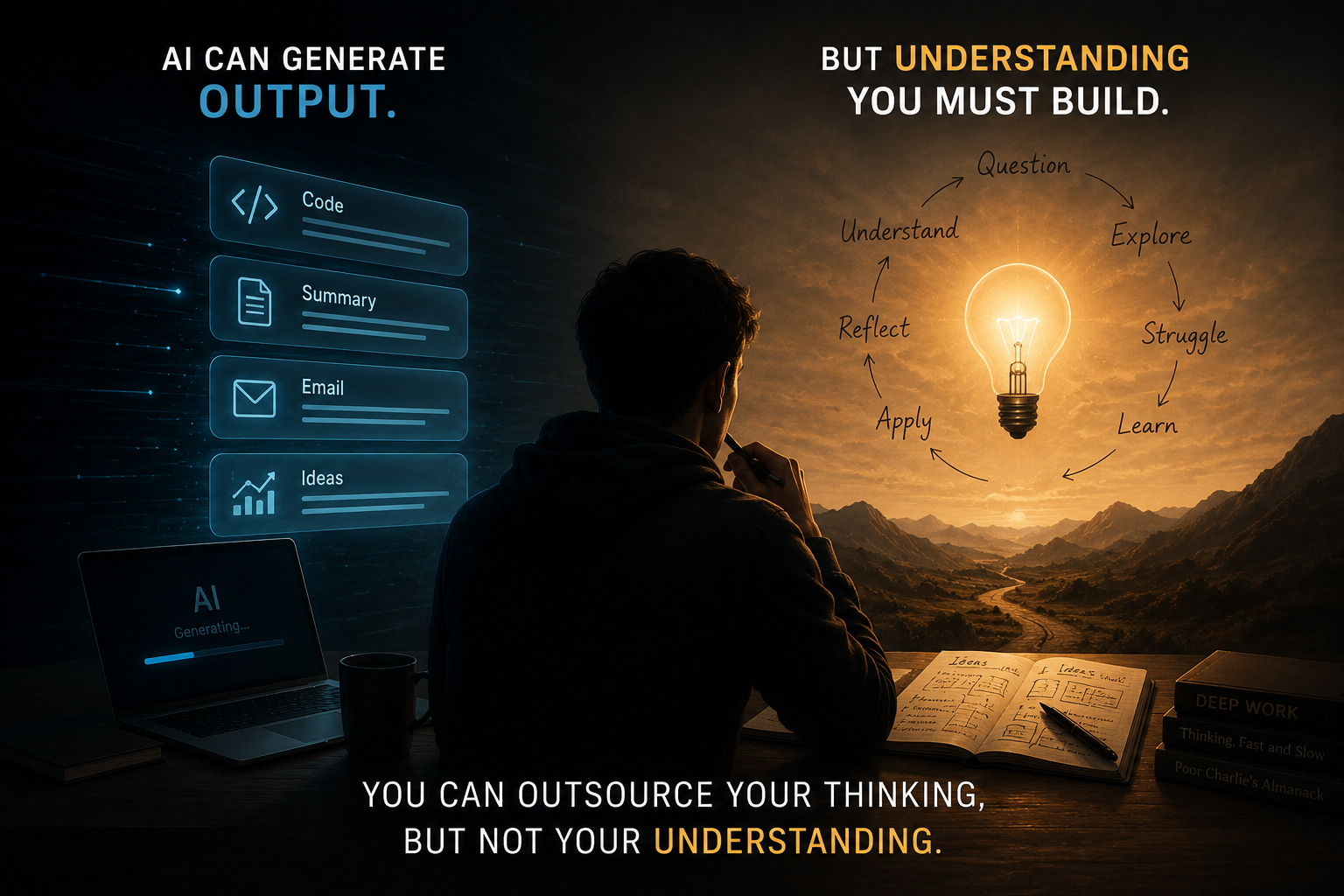
A few days ago, Andrej Karpathy reposted a quote that has been stuck in my head ever since:
“You can outsource your thinking, but you cannot outsource your understanding.”
The more I sit with it, the more it feels like the perfect description of the AI era we’re entering. AI can now write code, summarize books, generate presentations, explain physics, draft emails, create business ideas, and imitate expertise convincingly enough that most people can’t tell the difference anymore.
And honestly, I still think that’s incredible. But alongside all this progress, something else seems to be happening quietly in the background.
People are starting to confuse generated output with actual understanding. Those two things are not the same.
The New Illusion
Before AI tools became mainstream, understanding usually came before output. If you wrote good code, people assumed you understood programming. If you wrote clearly about a topic, people assumed you had spent time learning it. If you explained an idea well, there was a good chance you had wrestled with it internally first.
Now the order has flipped.
You can generate polished output first and worry about understanding later (or never. That changes everything. Students can submit assignments they cannot explain. A founder can post AI-generated insights they barely understand. A developer can ship code copied from ChatGPT without really knowing how it works.
The strange part is that most of it looks convincing on the surface. That’s the real power of modern AI systems. Not just intelligence. But believable intelligence.
The Hidden Cost of Convenience
I think AI is one of the most powerful tools humanity has ever built. Used well, it can accelerate learning, remove friction, and help people create things they otherwise couldn’t. But there’s also a line we should be careful not to cross.
The moment we stop trying to understand things for ourselves, we become dependent on systems we can no longer evaluate critically. That dependency is subtle at first.
- You stop reading deeply because summaries are faster.
- You stop struggling with concepts because AI can explain them instantly.
- You stop thinking through problems because generated answers are always available.
Over time, convenience slowly replaces curiosity. And the dangerous part is that it still feels productive. I definitely don’t think the solution is to reject AI or avoid using these tools. That would make no sense.
The Real Advantage
The real challenge is learning how to use AI without letting it weaken the habit of thinking for yourself. AI should help us think better, learn faster, and explore ideas more deeply. But if we use it only to produce answers without building understanding, we risk becoming intellectually passive while appearing intellectually capable.
That may become one of the defining tradeoffs of the AI era. The real advantage will not belong to the people who use AI the most.
It will belong to the people who continue to think critically while using it.