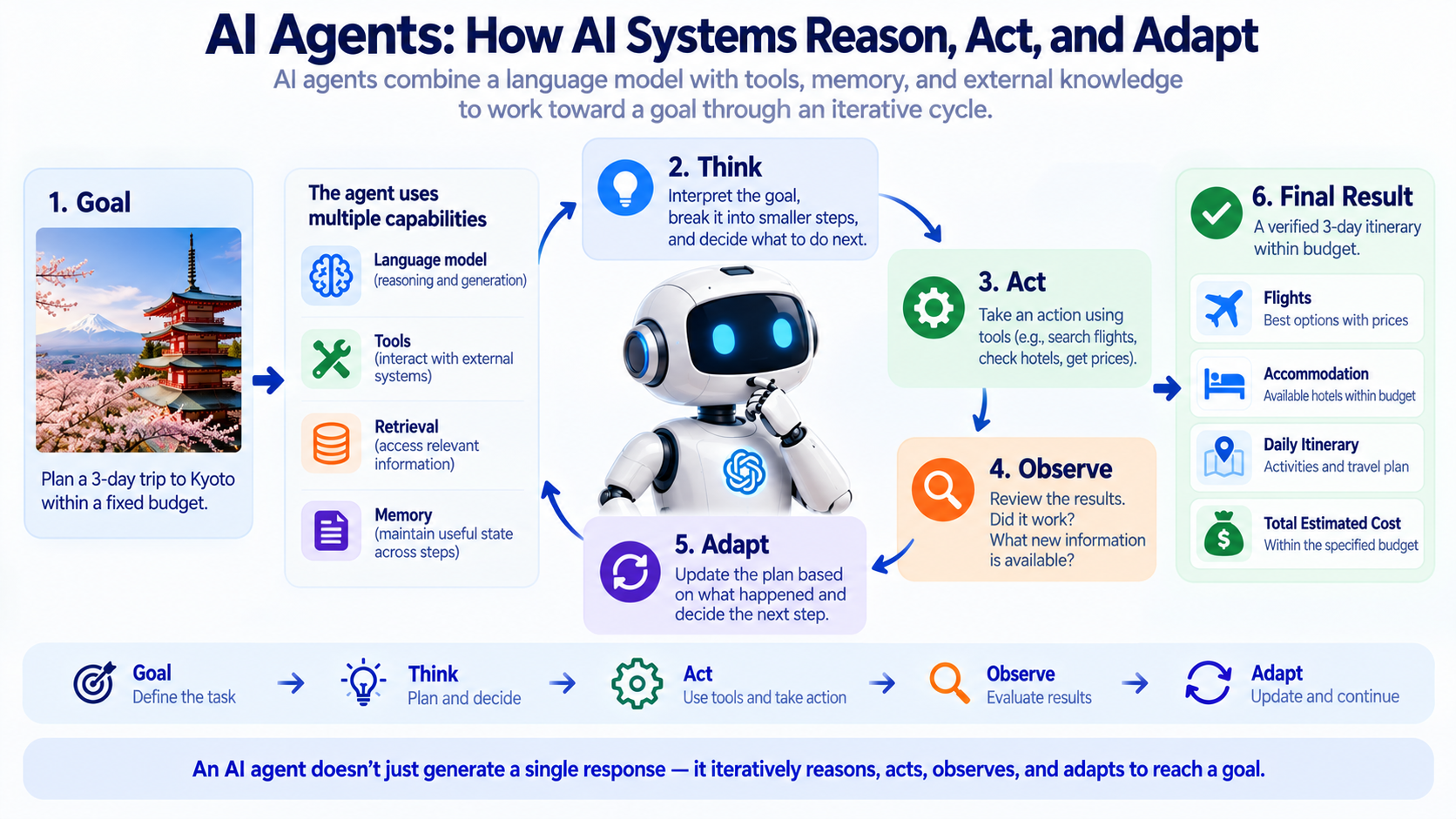
AI agents take the capabilities of language models and connect them into a system that can work toward a goal over multiple steps. A language model can generate a response. A retrieval system can bring external information into context. Tools can allow a system to interact with external services, while memory can preserve useful information across steps. But none of these capabilities, by themselves, explains how a system can coordinate them over time.
The important change occurs when the system can decide what to do next based on what happened previously. Instead of producing one response from a fixed input, it can interpret a goal, choose an action, observe the result, update its approach, and continue. The system is therefore no longer trying to produce the entire solution in a single pass. It is managing a process.
That process is the foundation of an AI agent.
Why One-Shot Responses Become Insufficient
A simple interaction can be represented as:
Input → Model → Output
The model receives information and produces a response. This works well when the task can reasonably be completed in one step, but many real-world goals do not have that property.
Consider a request to plan a three-day trip within a fixed budget. A language model can immediately produce an itinerary that appears plausible. But producing an itinerary is not the same as checking whether the assumptions behind it remain valid. Flight prices can differ, accommodation can have limited availability, transportation costs can affect the budget, and one decision can force another to change.
A more capable system therefore needs to do something a one-shot response cannot easily provide: use the results of intermediate actions to determine what happens next.
This creates a fundamentally different structure:
Goal → Think → Act → Observe → Think → Act → Observe → …
The difference is not simply that the system takes more steps. The important change is that the steps are connected by feedback. What happens during one step can change the next decision.
The Loop Changes the Nature of the System
An AI agent can be understood through a recurring loop:
Think → Act → Observe → Repeat
The system first interprets the goal. It needs to establish what is being asked, what successful completion would mean, and what constraints matter. It can then decompose the broader objective into smaller tasks and determine which action should happen next.
That action might involve generating information, retrieving something from an external source, calling a tool, or performing another operation. Once the action occurs, the system receives a result. It can then ask whether the action succeeded, whether anything changed, and whether the result revealed information that should alter the plan.
The next decision is therefore informed by the previous outcome.
This is the central architectural shift. The intelligence of the system is no longer represented only by its final response. The system’s behavior emerges from the sequence connecting reasoning, action, observation, and feedback.
What an Agent Actually Does Between Steps
The loop becomes clearer when a goal is decomposed into the decisions an agent must make.
Suppose the objective is to plan a three-day trip within a fixed budget. Rather than generating the entire itinerary immediately, the system can progressively construct it.
It might first determine the major requirements: transportation, accommodation, activities, local travel, and total cost. It can then search for flight options and observe the prices returned. If those prices consume more of the budget than expected, the system can adjust its assumptions before proceeding.
The next action might be to search for accommodation. The resulting prices and locations can then influence the itinerary. Activities can be selected only after the remaining budget and geographic constraints are clearer.
The important property is not the particular travel example. It is the dependency between steps.
The system does not decide everything once and execute a fixed script blindly. Instead, each observation becomes information for the next decision. The solution is progressively constructed from what the system discovers.
That is what makes the loop useful for tasks whose conditions cannot be known completely in advance.
An AI Agent Is More Than a Language Model
It is tempting to describe an AI agent as simply a particularly capable language model. That description misses the architectural distinction.
A language model provides much of the system’s language and reasoning capability, but the surrounding system determines how that capability operates over time. A useful agentic system may combine:
- a language model for reasoning and generation
- tools for interacting with external systems
- retrieval for accessing relevant information
- memory for maintaining useful state
- instructions and constraints for controlling behavior
- an execution loop for deciding what happens next
These components play different roles.
The model can determine that current flight prices are needed. A tool can actually retrieve those prices. The returned information can then become part of the context for the next decision. Memory can preserve useful intermediate state, while constraints can determine whether the system is permitted to continue or must stop.
This distinction matters because generating text about an action is not the same as executing the action.
A model can write a convincing description of how someone could search for flights without ever contacting a flight service. The surrounding system is what turns the proposed action into an actual operation and returns its result to the loop.
Tools Turn Decisions Into Actions
The difference between deciding and acting becomes especially important once an agent interacts with external systems.
A model might determine that it needs current flight prices. That decision alone does not provide the information. The system needs a mechanism capable of performing the lookup.
The loop therefore becomes:
Think → Choose tool → Act → Receive result → Observe → Think again
The model can determine which action is useful. The external tool performs the operation. The result is returned to the agent as new information. The agent then incorporates that information into its next decision.
This is the point at which an AI system moves beyond reasoning about a task and begins interacting with the environment relevant to that task.
But the capability comes with a corresponding requirement: the more actions a system can take, the more important it becomes to control which actions it is allowed to take and under what conditions.
Constraints Keep the Loop Within Boundaries
An agent’s reasoning is not completely free-form. Its behavior is shaped by the instructions and constraints surrounding the loop.
A system might be required to check a budget before proceeding, verify important information before using it, ask for clarification when necessary information is missing, avoid certain actions, stop after a maximum number of steps, or validate an output before returning it.
These rules influence both planning and action selection. They establish boundaries around what the system can do.
This leads to an important distinction between flexibility and uncontrolled behavior. Giving an agent more freedom can allow it to solve a wider range of situations, but freedom without boundaries can also make the system difficult to predict or control.
The objective is therefore not maximum autonomy. It is enough flexibility to solve the task while maintaining enough control to keep the process within acceptable boundaries.
Memory and Retrieval Give the Loop Continuity
An iterative system also needs some way to carry useful information from one step to the next.
Consider the travel-planning example again. Once the system has selected a flight, that decision becomes part of the state of the task. The remaining budget changes. A preferred hotel location may constrain later choices. Activities already considered should not necessarily be reconsidered from scratch.
The system may therefore need to retain information such as:
- the selected flight
- the remaining budget
- the preferred hotel location
- activities already considered
- constraints established by earlier decisions
Retrieval provides another form of continuity. When relevant information exists outside the current context, the system can retrieve it when needed rather than relying only on what is already available.
The resulting pattern can be represented as:
Goal → Retrieve information → Decide → Act → Store result → Retrieve again → Continue
Memory and retrieval are related but distinct. Memory allows the system to carry relevant state forward, while retrieval allows it to bring relevant information into the current step.
Together, they help the agent maintain a coherent trajectory rather than reconstructing its situation from scratch at every stage.
An Agent Is Not Automatically Autonomous
The term “agent” can create a misleading impression of independence. A system may perform multiple steps without a human specifying each individual action, but that does not mean it has independently generated goals in the human sense.
Its objectives, permissions, available tools, constraints, and stopping conditions are established by the surrounding system or user. The system operates toward a goal within that structure.
A more precise way to think about an AI agent is therefore as a goal-directed system that can iteratively select and execute actions within defined constraints.
The amount of autonomy can vary considerably. One system might require approval before every significant action. Another might execute many routine steps automatically but stop when it encounters uncertainty. Another might have broader permissions within a tightly controlled environment.
What matters is not whether the system appears autonomous, but what decisions it is actually permitted to make and what mechanisms govern those decisions.
The Loop Introduces New Failure Modes
Iteration creates capabilities that a one-shot response does not have, but it also creates new ways for errors to propagate.
Suppose an agent makes an incorrect decision during its first step. If later actions depend on that decision, the initial error can influence the rest of the trajectory. The system may retrieve irrelevant information, repeat ineffective actions, waste tool calls, or continue pursuing a flawed plan.
The problem is therefore not simply that an individual step can be wrong. In a loop, one incorrect step can become the context for the next incorrect step.
That is why agentic systems need explicit control mechanisms. Depending on the task, these can include:
- maximum step limits
- validation rules
- tool permissions
- confirmation requirements
- error handling
- budget limits
- stopping conditions
- human approval for sensitive actions
These controls become increasingly important as the system gains more freedom to act.
The relationship is straightforward: greater ability to act creates greater potential consequences when the system acts incorrectly.
Planning Is Not the Same as Acting
One of the easiest ways to misunderstand agents is to confuse a generated plan with an executed process.
A language model might produce:
- Search for flights.
- Compare prices.
- Choose the cheapest option.
- Book the flight.
This looks like a multi-step workflow, but the text itself does not demonstrate that any of those actions occurred.
An actual agentic process would require the system to generate or select an action, execute it, receive the result, incorporate that result, and determine what to do next.
The distinction is therefore execution plus feedback.
A model can describe a process without performing it. A system can also execute a fixed sequence without being meaningfully adaptive. What distinguishes the iterative agentic pattern is that intermediate actions and observations influence subsequent decisions.
That is why simply asking a model to “think step by step” does not, by itself, create an agent. The important architectural property is the loop connecting decisions to actions and actions to observations.
Three Systems That Look Agentic but Are Not the Same
The distinction becomes clearer when comparing three situations.
A single-response chatbot receives a question and produces an answer without taking intermediate actions. It may be highly capable, but it does not necessarily contain the iterative Think → Act → Observe → Repeat pattern.
A second system might divide a task into ten steps but execute all ten without checking the results of intermediate actions. It has a plan, but it lacks meaningful feedback. If conditions change during execution, the system has no mechanism for adapting its later decisions.
A third system might simply generate a multi-step plan such as “First do X, then do Y, then do Z.” Again, this is not enough by itself. The important question is whether those actions are actually executed and whether their results influence what happens next.
These distinctions prevent the term “agent” from becoming synonymous with any system that produces a long answer or describes multiple steps.
The Agentic Mental Model
The most useful mental model is not a magical autonomous intelligence. It is a loop.
The system receives a goal. It reasons about what should happen next. It takes an action. It observes the result. It updates its understanding. Then it decides what to do next.
Think → Act → Observe → Repeat
The surrounding capabilities make that loop useful. Tools provide the ability to act. Retrieval provides access to relevant external information. Memory carries useful state across steps. Instructions and constraints keep behavior within defined boundaries.
The significance of the architecture is therefore larger than any individual component. A language model can generate text, but an agentic system connects generation to action and feedback so that the result of one step can influence the next.
The system is no longer simply generating an answer.
It is managing a process.
That shift connects the ideas developed throughout the earlier AI system architecture: language generation provides the core capability, retrieval and memory provide continuity, tools provide interaction, and constraints provide control. The agent combines these capabilities into an iterative system capable of pursuing goals across multiple steps.
But the loop also creates a harder problem. Once a system can choose actions, execute them, observe their consequences, and continue, it becomes necessary to control not only what the system can do, but how reliably it does it.
The next question is therefore no longer simply how to build an AI agent. It is how to make the behavior of that agent reliable enough to compose into larger workflows.