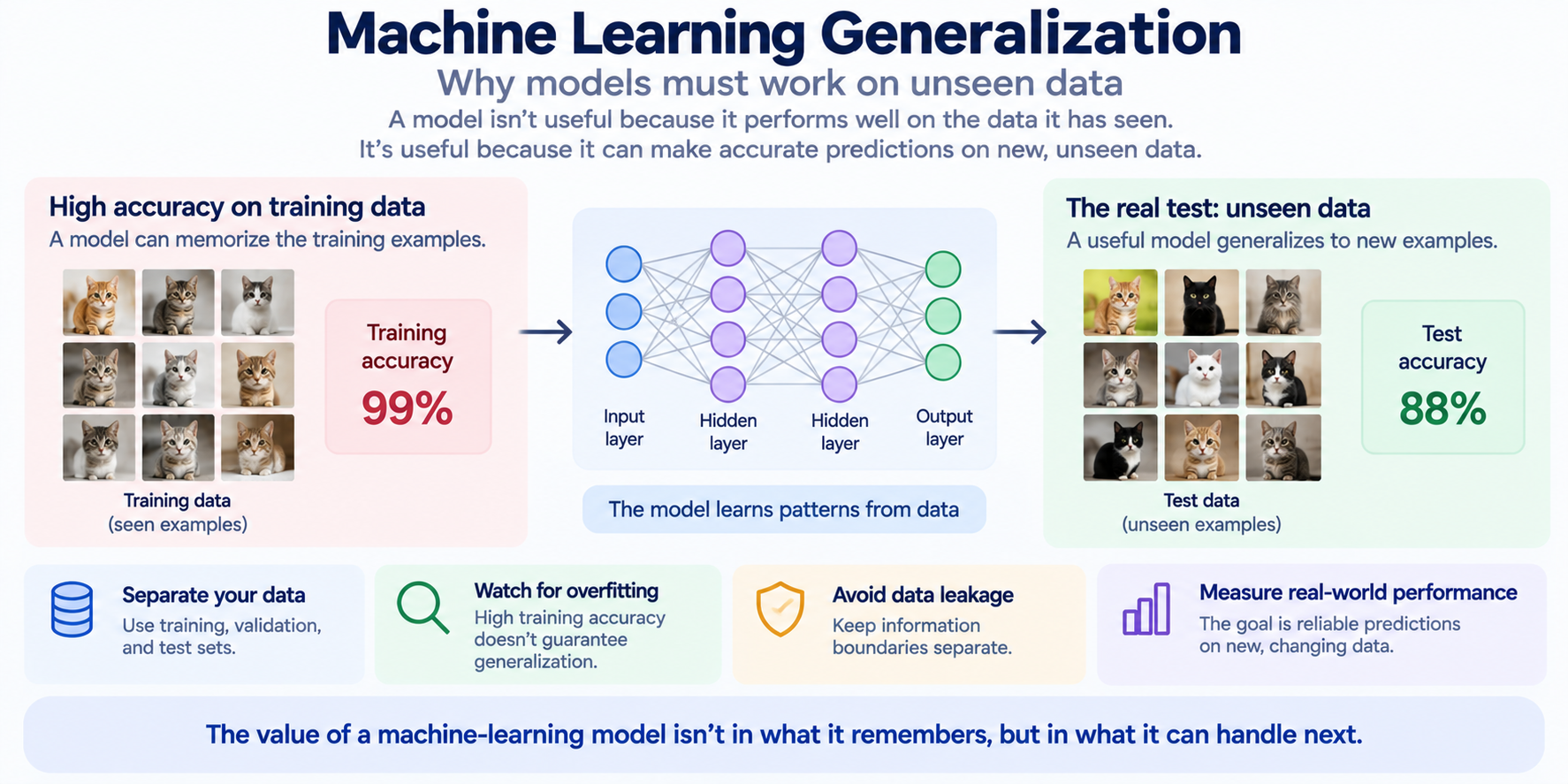
One of the easiest ways to fool ourselves in machine learning is to build a model that appears incredibly accurate—only to discover that it doesn’t work in the real world.
At first, that sounds strange.
If the model is accurate, shouldn’t it work?
Not necessarily.
The problem is that performing well on known examples is not the same as generalizing to new ones. This challenge lies at the heart of machine learning generalization, a concept we’ll explore in depth later in this article.
A machine-learning model can become very good at the data it has seen without learning patterns that transfer reliably to unseen data. Understanding that difference is central to evaluating whether a model has actually learned something useful.
The memorization trap
Imagine giving a student the exact same questions for practice and for the final exam.
Chances are they’ll perform extremely well.
But what have you actually measured?
Understanding?
Or memory?
Machine learning faces the same problem.
A model can become remarkably good at handling examples it has already seen. It can adapt its parameters to patterns in those examples and achieve impressive accuracy.
But that does not necessarily mean it has learned something that generalizes.
It may simply have become very good at fitting the training data.
This creates one of the biggest questions in machine learning:
How do you tell the difference between learning useful patterns and memorizing the examples?
What generalization means in machine learning
The purpose of a machine-learning model is usually not to reproduce the data it has already seen.
It is to make useful predictions when it encounters new data.
This ability is called generalization.
A model that generalizes well can apply patterns learned during training to examples it was not trained on.
That is what matters in real-world use.
Tomorrow’s emails.
Tomorrow’s customers.
Tomorrow’s market conditions.
These inputs are not simply copies of yesterday’s training examples.
They are new observations.
So a model’s real value depends not only on how well it performs on training data, but on how reliably it performs when the data changes.
Why evaluating machine learning generalization matters
This is why evaluation is so important.
It is tempting to think that evaluation simply measures how well a model performs.
But a good evaluation is trying to answer a deeper question:
What is likely to happen when the model encounters data it has not seen before?
To estimate that, the model needs to be evaluated on data that was not used to fit its parameters.
This gives us a way to distinguish performance on familiar examples from performance on unseen ones.
The goal is not simply to produce an impressive number.
The goal is to determine whether that number tells us something meaningful about the model’s ability to generalize.
Why one dataset isn’t enough
This creates an interesting practical problem.
Usually, we start with a dataset containing the examples available to us.
So how can we test a model on unseen data if all of our data is already sitting in front of us?
A common solution is to divide the available data into different subsets with different purposes.
A training set is used to fit the model.
A validation set can be used during development to help make decisions about the model or its configuration.
A test set is held back for final evaluation.
The exact setup varies by task, but the principle is important:
The data used to evaluate the model should not simply become another source of information for improving it.
Once evaluation data influences development, it becomes harder to treat the resulting performance as an unbiased estimate of generalization.
The illusion of progress
This is where machine learning becomes surprisingly similar to human behavior.
Whenever we know how we’re being measured, we naturally begin adapting to the measurement itself.
Students optimize for exams.
Companies optimize for metrics.
Social media platforms optimize for engagement.
Models can do something similar when a particular evaluation set or benchmark repeatedly influences development.
Performance rises.
Confidence rises.
But the underlying ability to generalize may not improve by the same amount.
The numbers improve.
Reality doesn’t necessarily change.
That’s a dangerous illusion.
The hidden danger of data leakage
There is another problem that makes evaluation even harder: data leakage.
Information can accidentally cross a boundary that was supposed to remain separate.
For example:
- A feature may indirectly reveal the target.
- A preprocessing step may use information from the entire dataset.
- A development decision may be influenced by test results.
- Information that would not be available at prediction time may accidentally enter the training process.
The model can then appear remarkably accurate.
But it may be succeeding for the wrong reason.
The problem often becomes visible only after deployment, when the hidden signal it relied on is no longer available.
Performance can then collapse.
Not necessarily because the model suddenly became worse, but because the information that made the evaluation look so good was never legitimately available in the real-world setting.
Generalization is the real goal
Ultimately, machine learning is not really about performing well on known examples.
It is about performing well on unknown ones.
That may sound obvious, but it is easy to lose sight of.
A model’s true value isn’t measured only by how accurately it predicts yesterday’s data.
It is measured by how reliably it handles tomorrow’s.
And tomorrow is always unseen.
That is why separating training, development, and evaluation matters so much.
Without that separation, we can stop measuring capability and start measuring familiarity.
And those are not the same thing.
The bigger lesson
The deeper I look at machine learning, the more it feels like a lesson that extends far beyond AI.
There is a difference between:
- Memorization and generalization
- Optimization and capability
- Performance and competence
The challenge is that, from the outside, they can look remarkably similar—at least for a while.
A model can produce impressive results and still fail when the conditions change. One reason this becomes important is that real-world patterns are rarely simple. Models need to learn useful representations of increasingly complex relationships rather than simply fit individual examples.
Which is why one of the hardest parts of machine learning isn’t simply teaching a model to learn.
It’s making sure you’re measuring whether it actually learned something that generalizes.