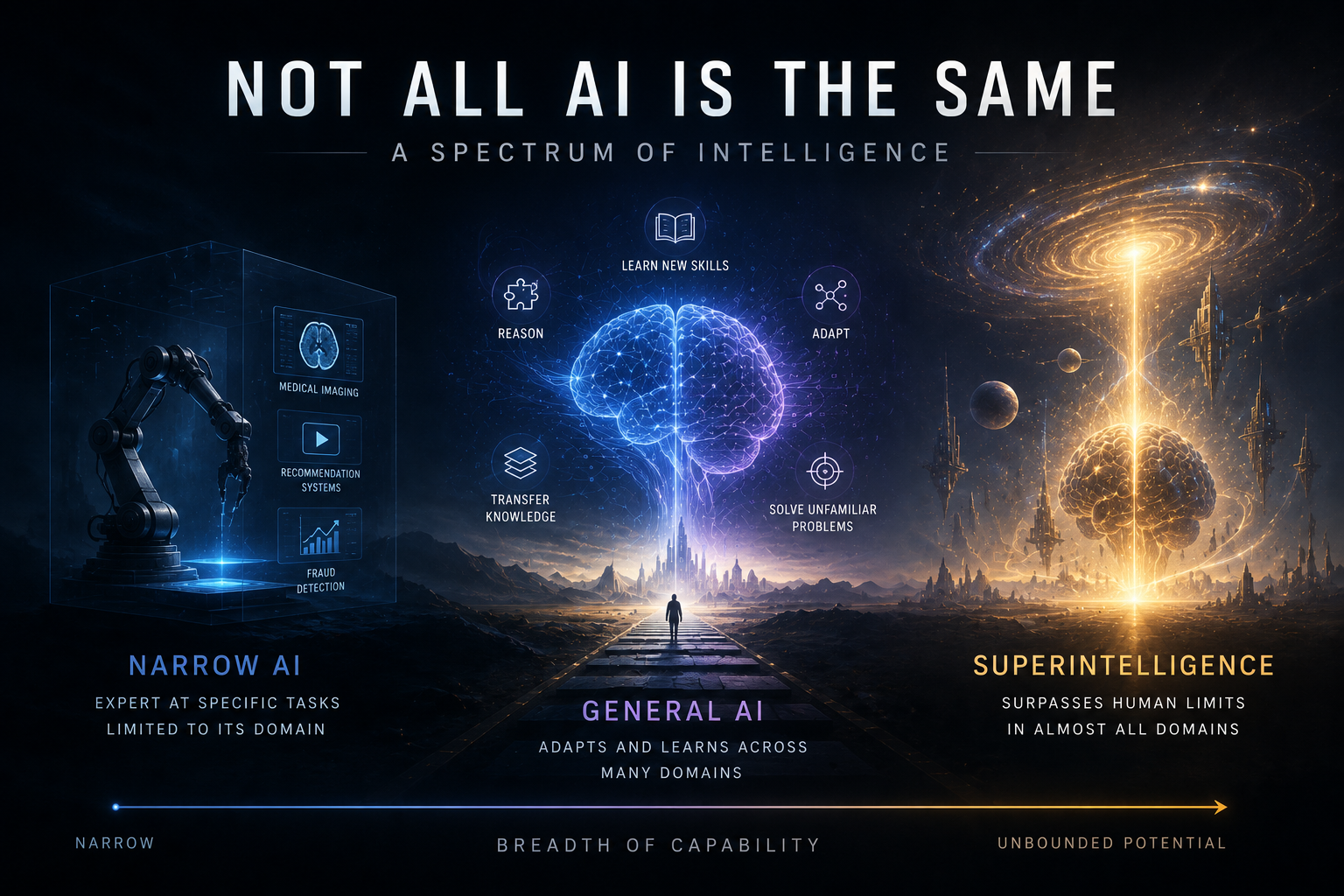
One of the easiest mistakes people make when talking about AI is treating it like a single thing. As if there is just “AI” and then increasingly smarter versions of it. But that framing hides something important.
Different AI systems are not just separated by performance. They are separated by the kind of intelligence they possess. And once you see that distinction clearly, a lot of the confusion around AI suddenly starts making more sense. Because a system that can dominate one task may still completely fail at another.
- A chess engine can defeat world champions but cannot drive a car.
- A language model can write essays but struggles with entirely unfamiliar situations.
- A recommendation algorithm can predict your next movie choice while having no understanding of movies themselves.
These are not small gaps. They reveal something fundamental about how AI systems are structured.
The Spectrum of Intelligence
I think the best way to understand AI categories is to stop asking:
“How intelligent is this system?”
and start asking:
“How broadly can this system operate?”
That changes everything. Imagine three different systems.
The first can detect tumors in medical scans more accurately than most doctors. But outside that domain, it becomes useless. It cannot hold a conversation, cook a meal, or adapt to a completely new task without being redesigned.
The second can learn new skills across many domains. It can read books, transfer ideas between fields, solve unfamiliar problems, and adapt without requiring task-specific rebuilding.
The third goes even further. It not only learns across domains but consistently outperforms the best humans in almost every intellectual task imaginable.
Those systems are not simply “better versions” of one another. They represent entirely different categories of intelligence.
Narrow AI
At one end of the spectrum is what we call narrow AI. This is the type of AI most people already interact with every day.
Narrow systems are built for specific domains:
- image recognition
- recommendation systems
- voice assistants
- fraud detection
- translation
- chess engines
They can become incredibly capable within those domains. Sometimes even superhuman. But their intelligence is tightly bounded.
- A chess engine understands chess positions, not strategy in life.
- A recommendation system predicts clicks, not human meaning.
- A self-driving model may navigate roads but fail completely in situations outside its training environment.
That limitation matters. Because narrow AI does not truly generalize. It maps patterns within a constrained slice of reality. The moment the environment shifts too far outside those patterns, the system often breaks in surprisingly obvious ways.
And I think this is where many people get misled. Modern AI systems often feel broadly intelligent because they produce fluent outputs. But fluency is not the same as generality. A system can sound intelligent while still operating inside narrow statistical boundaries.
General AI
Now imagine something very different.
A system that is not locked into one domain. Instead of mastering a single task, it can learn entirely new tasks without being rebuilt from scratch. That idea leads to what people call general AI. The important distinction is not perfection. It is adaptability.
A general system could:
- transfer knowledge between domains
- learn unfamiliar skills
- reason through new environments
- build abstractions
- and improve itself across different kinds of problems
In other words, it would not just perform tasks. It would learn how to learn. That is much closer to how humans operate.
Humans are not born knowing physics, language, or programming. What makes human intelligence powerful is the ability to acquire competence across radically different environments using shared underlying cognitive structures. General AI would represent something similar computationally. And importantly, it would still have limitations.
It would still face constraints:
- time
- resources
- incomplete information
- imperfect reasoning
General intelligence does not mean infinite intelligence. It means flexible intelligence.
Superintelligence
A system that not only operates generally, but surpasses human capability across essentially all cognitive domains. Then there is the final category. This is what people mean by superintelligence. And I think this is where discussions often become abstract very quickly. Because once intelligence exceeds human intellectual capacity consistently, prediction itself becomes difficult.
A superintelligent system might:
- solve scientific problems humans cannot solve
- invent entirely new technologies
- discover patterns invisible to human cognition
- optimize systems beyond human comprehension
At that point, the limitation is no longer domain specialization. The limitation becomes physics, computation, and available information. That is a very different threshold.
Not Just Bigger Models
One misconception I see constantly is the assumption that general AI is simply a larger version of today’s systems.
- Bigger models.
- More parameters.
- More data.
- More compute.
But scale alone may not be enough. Because current systems are still heavily dependent on pattern recognition inside massive training distributions. They often struggle with:
- truly novel environments
- deep causal reasoning
- long-term abstraction
- robust transfer across unfamiliar domains
Humans can adapt surprisingly quickly with very little data. AI systems usually cannot. That difference matters more than benchmark scores sometimes suggest.
The Hard Part Nobody Fully Understands Yet
I think one of the most important things people miss is this:
We still do not fully understand what produces general intelligence.
We know how to build systems that recognize patterns extremely well.
We know how to optimize performance on specific tasks.
We know how to scale learning.
But robust generalization remains difficult.
Humans build internal world models.
We reason causally.
We adapt goals.
We question assumptions.
We transfer abstractions between unrelated environments.
Current AI systems still struggle with many of those capabilities in deep ways. And that suggests something important: general intelligence may require more than scaling existing architectures. It may require entirely new ideas.
The Real Difference
The easiest way to think about the spectrum is probably this:
A narrow AI is like a highly specialized tool.
Extremely effective within a specific domain.
Almost useless outside it.
A general AI is more like a highly adaptable human mind.
Capable of learning new skills and operating across many environments.
A superintelligence is something beyond that.
Not just a better problem solver, but potentially a creator of entirely new ways of solving problems humans themselves may never discover.
And ultimately, the key distinction is not how sharp the tool becomes. It is how many different kinds of problems the system can meaningfully engage with.