One of the most common misconceptions about AI is that prompt engineering is about finding the perfect command.
It is easy to imagine a language model as a machine waiting for instructions: tell it what to do, and it executes the request. The better the instruction, the better the result.
But that is not quite what is happening.
A language model generates text based on patterns in its context. This changes how we should think about prompt engineering.
Rather than treating a prompt simply as a command, think of it as a way of shaping the context in which the model generates its response.
How context shapes AI responses
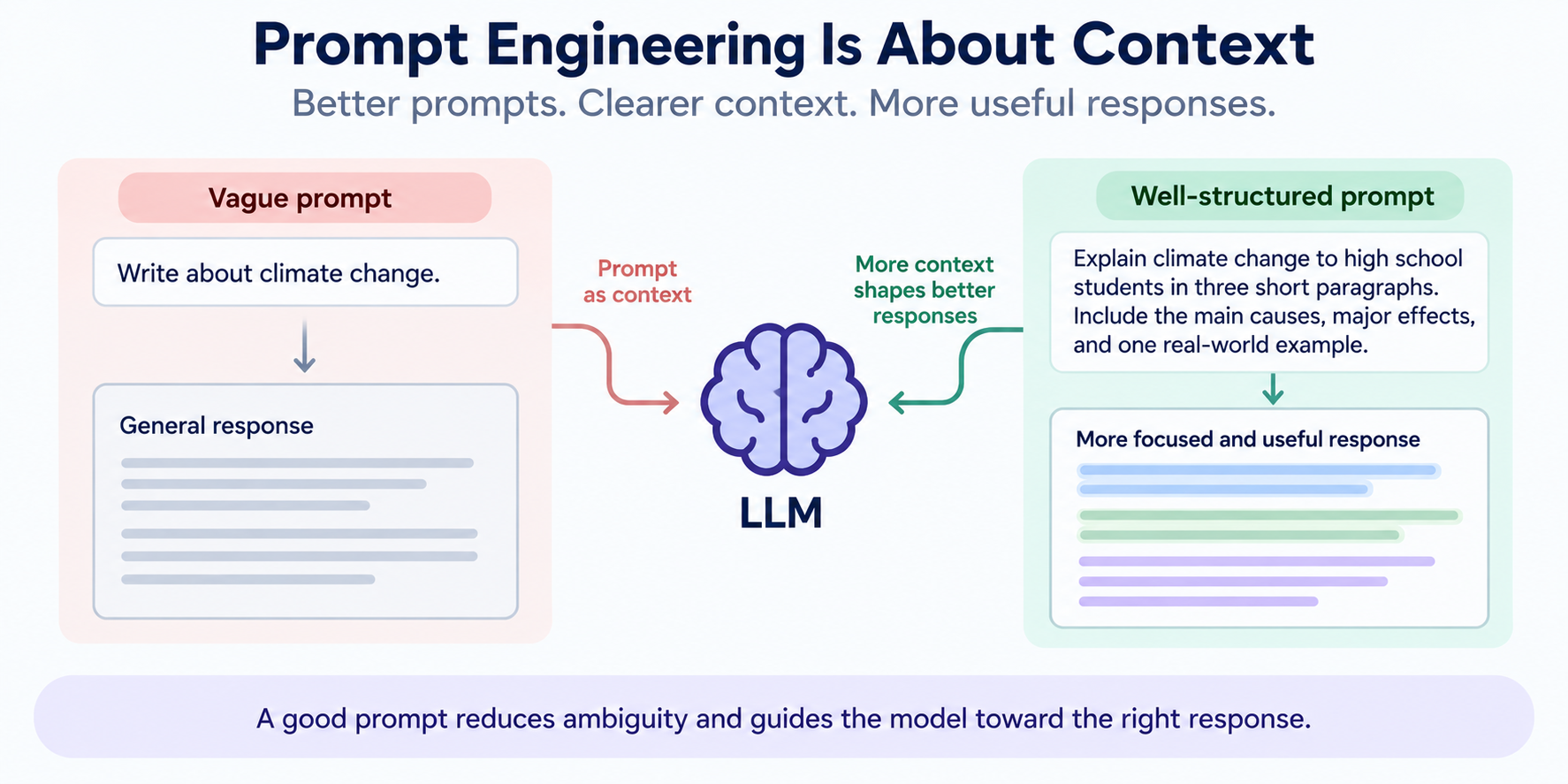
Consider two prompts:
Write about climate change.
And:
Explain climate change to high school students in three short paragraphs. Include the main causes, major effects, and one real-world example.
Both prompts ask about the same topic, yet the responses can be dramatically different.
Why?
Because the second prompt provides much more context. It defines:
- The audience
- The structure
- The length
- The scope
- The style
These constraints reduce ambiguity about what the response should look like.
In other words, an effective prompt does more than tell the model a topic. It shapes the range of possible responses.
Why vague prompts can produce inconsistent results
At each stage of generation, a language model is effectively determining what comes next based on the context available to it.
When that context is vague, many continuations may be reasonable.
For example, if you simply ask:
“Write about climate change.”
Should the response be:
- Technical or simple?
- Short or detailed?
- Formal or conversational?
- Explanatory or persuasive?
- Focused on causes, effects, or solutions?
The prompt does not specify.
The model therefore has to infer what kind of response you intended.
This is why vague prompts can produce disappointing or inconsistent results. The problem is not necessarily that the model lacks the capability to answer. The context may simply leave too many plausible directions open.
Good prompts reduce ambiguity
The more I work with AI systems, the more prompting feels like reducing uncertainty.
A strong prompt removes ambiguity, establishes constraints, and creates clearer expectations.
Imagine asking:
Summarize this article.
That leaves several questions unanswered:
- How long should the summary be?
- Which information matters most?
- Who is the intended audience?
- Should opinions be included?
- What format should the summary use?
Now compare it with:
Summarize this article in three bullet points. Keep each bullet under fifteen words and focus only on factual information.
The second prompt establishes a much clearer target.
The model now has constraints on the format, length, and content of the response.
This does not guarantee a perfect answer, but it gives the model a more specific context from which to generate one.
Why examples are powerful in prompt engineering
One of the most useful techniques in prompt engineering is providing examples.
At first, this may seem unnecessary. If you can explain what you want, why show the model an example?
The answer relates to how language models learn and generate patterns.
When you provide an example of an input and its desired output, you are not merely describing the pattern. You are demonstrating it.
For example:
Input: “The product arrived late.”
Output: “Delivery issue”Input: “The package was damaged.”
Output: “Product condition issue”Input: “I was charged twice.”
Output:
The examples give the model a pattern to continue.
This approach is often called few-shot prompting when multiple examples are provided. The examples help communicate the desired relationship between inputs and outputs without requiring every rule to be described explicitly.
Structure is part of the prompt
Another thing people often underestimate is structure.
Language models are sensitive to how information is organized. Lists, headings, sections, examples, and numbered steps can all help communicate how the input is organized and what kind of output is expected.
For example, a prompt such as:
Task: Summarize the article
Audience: Executives
Length: 100 words
Format: Three bullet points
Focus: Business implications
is easier to interpret than a paragraph containing the same requirements without any structure.
A structured prompt can therefore act as a blueprint for the response.
The structure does not force the model to produce a particular answer, but it gives the model clearer patterns and constraints to work with.
Prompt engineering is an iterative process
Another reason people become frustrated with AI is that they treat prompting as a one-time action:
Write the prompt → get the answer → move on.
In practice, effective prompting often works more like refinement:
Provide context → observe the output → identify what is missing → revise the prompt → generate again
Each revision changes the conditions under which the model generates its response.
For example, if the model produces a summary that is too detailed, you can add a length constraint.
If it focuses on the wrong information, you can clarify what matters.
If the format is inconsistent, you can provide a more explicit structure or example.
The goal is not necessarily to find one magical prompt. It is to iteratively create better conditions for the desired output.
More instructions aren’t always better
There is an important limit to this approach.
Adding more instructions does not automatically produce a better response.
A prompt can become so long or complicated that its requirements are difficult to interpret or contain unnecessary constraints.
The goal is therefore not to maximize the number of instructions.
It is to provide the right context and constraints for the task.
A simple question may need only a short prompt. A complex task may require more detailed instructions, examples, formatting requirements, or additional context.
Good prompt engineering matches the amount of structure to the complexity of the problem.
The deeper idea behind prompt engineering
The deeper I look at language models, the less prompting feels like giving commands and the more it feels like designing the context around generation.
Every constraint can influence the result.
Every example can communicate a pattern.
Every piece of context can change what responses are likely to follow.
This is why the quality of an AI response is often determined before the final response is generated. The prompt establishes the context from which the model produces its output.
And this leads to an important next question:
What happens when the task is too complex to solve effectively in a single prompt?
Instead of trying to put every instruction into one increasingly complicated prompt, you can break the task into smaller stages and use the output of one stage to guide the next.
That is the idea behind multi-step AI workflows.