If a language model only generates responses from what it learned during training and the text in its current input, how can it answer questions about new, highly specific, private, or otherwise unfamiliar information?
It can’t reliably do so unless that information is provided to the model at generation time.
This is the fundamental idea behind retrieval-augmented generation (RAG). Instead of expecting the model to contain every relevant fact, a RAG system first retrieves useful information from an external source—such as documents, databases, or files—and adds that information to the model’s input. The model can then generate an answer based on the provided context.
Why language models need external context
During training, a language model learns patterns from a large but fixed training dataset. After training, the model does not automatically have direct access to updated facts, private documents, or every piece of niche information that exists elsewhere.
When you ask a question, its response is based on:
- What the model learned during training
- What is present in the current input or context
If the answer depends on something outside those sources—for example, a company’s internal report or a recent event—the model has no direct way to access it.
It may instead guess, extrapolate, or generate something that sounds plausible without being correct.
That leads to a necessary principle:
If a model can only use information available in its context, external knowledge must first be brought into that context.
How retrieval-augmented generation (RAG) brings knowledge into context
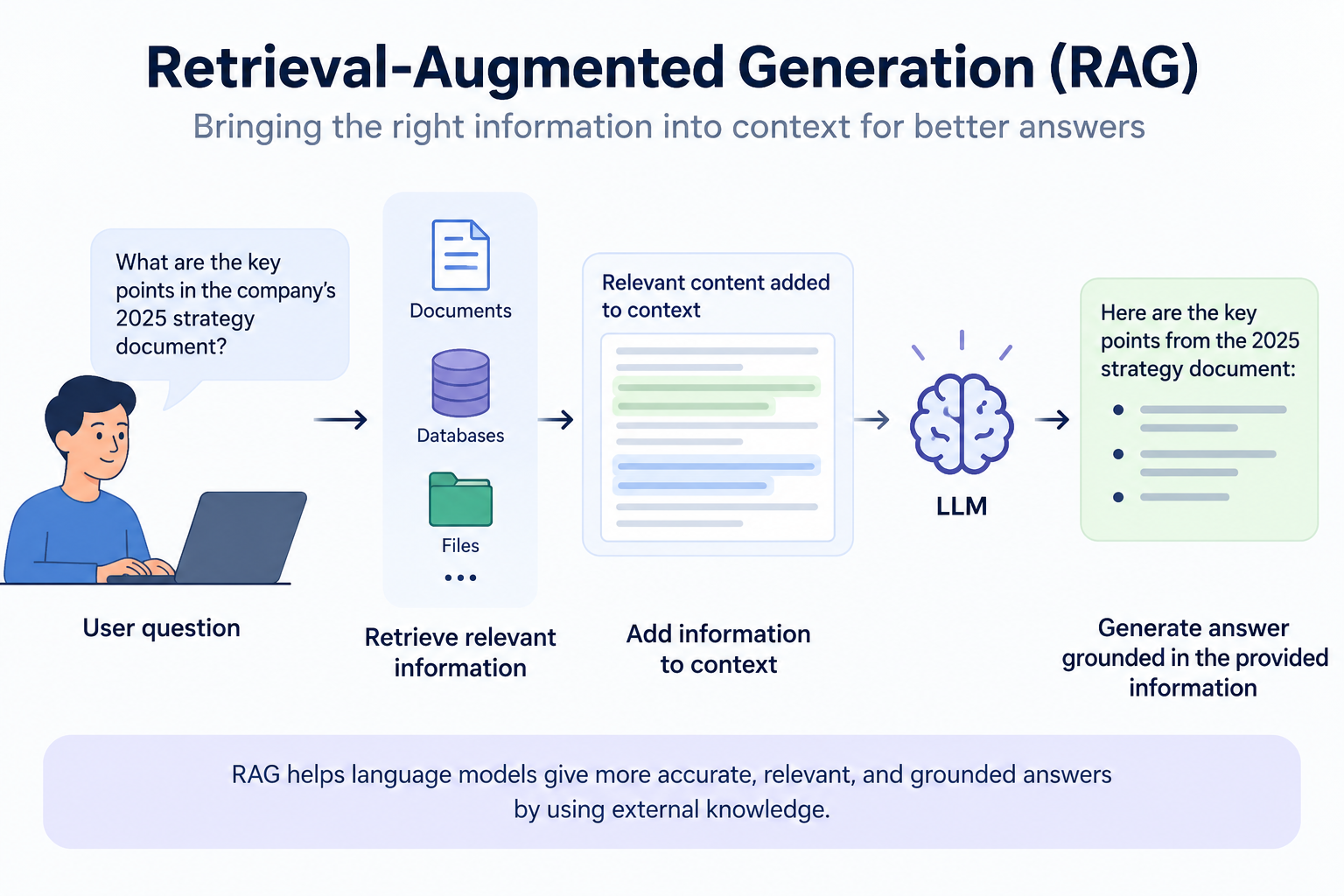
A RAG system separates the process into two broad stages: retrieval and generation. In practice, this can be part of a multi-step AI workflow, where each stage performs a specific function and passes information to the next.
First, the system identifies information relevant to the user’s question. This information might come from documents, files, databases, or another connected data source.
Second, the system inserts the selected information into the model’s input. The language model then uses that context when generating its response.
Conceptually, the flow looks like this:
User question → Retrieve relevant information → Add information to context → Generate answer
The important point is that the language model does not need to have memorized the retrieved information during training. The relevant content is supplied as part of the input at the time the answer is generated.
Why context can improve accuracy
Language models generate text by predicting likely next tokens based on their context.
When relevant facts are present in that context, the model has specific information it can condition its predictions on. Without that information, there may be many plausible continuations based on general patterns learned during training.
This can make the response more grounded in the supplied information and reduce the likelihood of unsupported or fabricated claims, often referred to as hallucinations.
However, retrieval does not guarantee correctness. The retrieved information still needs to be relevant, complete, and trustworthy, and the model must interpret it correctly.
A simple example of RAG
Consider the question:
“What are the key points in the company’s 2025 strategy document?”
If the model has never been given that document, it cannot reliably identify its actual key points. It might produce a generic answer involving familiar themes such as growth, innovation, and efficiency, but those themes may have nothing to do with the company’s real strategy.
Now suppose the system retrieves relevant excerpts from the document and includes them in the input:
Here is the 2025 strategy document:
[relevant paragraphs]
Question: What are the key points?
The model’s task has changed.
Rather than relying primarily on general patterns, it can now summarize or extract information from the supplied document. The resulting answer is therefore grounded in the actual text provided to it.
The underlying reason is the model’s context. Without the document, many generic continuations are possible. With relevant excerpts included, continuations that reflect those excerpts become much more likely.
How does a RAG system find the right information?
Providing external information is useful only if the system can identify which information is relevant to the question.
A system generally cannot simply add every available document to the model’s input. That would introduce unnecessary information and may exceed the available context or make it harder for the model to focus on the material that matters.
Instead, the retrieval step selects a smaller subset of potentially relevant information.
Semantic search and similarity
This selection is often based on semantic similarity, rather than relying only on exact keyword matches.
For example, a user might ask:
“What are the company’s growth plans?”
A relevant document might describe the company’s expansion strategy without ever using the exact phrase “growth plans.”
A retrieval system needs to recognize that these expressions can refer to related concepts.
This is where learned representations, such as embeddings, become useful. Text can be represented in a mathematical space where items with related meanings tend to be closer together. A retrieval system can compare a query with documents or document segments in this space to identify potentially relevant content.
The result is a retrieval process that can find useful information even when the query and source material use different wording.
More information is not always better
It is tempting to assume that giving the model more information will always produce a better answer. It does not.
If the context contains large amounts of irrelevant or weakly related material, the additional information can introduce noise and make it harder for the model to identify what matters.
This creates an important RAG design principle:
The goal is not to retrieve as much information as possible. The goal is to retrieve the most useful information for the question.
Retrieval quality therefore matters just as much as generation quality.
A system can produce a poor answer even when the language model itself is capable of answering the question if the retrieval step supplies the wrong documents, misses important information, or provides incomplete context.
What happens when retrieved information is wrong?
External context improves the model’s access to information, but it does not automatically make that information correct.
A RAG system can still fail when:
- The relevant document is not retrieved.
- The retrieved information is incomplete.
- The retrieved source is misleading or inaccurate.
- Irrelevant documents are included.
- The model misinterprets the supplied context.
In other words, RAG shifts part of the reliability problem from the model alone to the entire retrieval-and-generation pipeline.
Good answers depend on both finding appropriate information and using that information correctly.
Is a RAG system the same as a search engine?
Not exactly.
A search engine typically retrieves information in response to a query and presents search results. A RAG system uses retrieval as an intermediate step in a larger process.
The retrieval component finds potentially relevant information. That information is then added to the model’s context, and the language model generates an answer using the supplied material.
So the model is not necessarily “looking something up” by itself while generating each token. Instead, the surrounding system prepares relevant context before generation.
This distinction is important when thinking about how language models interact with external knowledge.
Test your understanding
Consider these three situations.
1. A question about a legal contract
If you ask a model about the specific terms of a contract, what information should be brought into its context?
The relevant sections of the actual contract should be provided so the model can base its answer on the document rather than relying on generic knowledge about contracts.
2. Ten retrieved documents, but only two are relevant
What happens if a retrieval system provides all ten?
The eight irrelevant documents add noise. They can make it harder for the model to distinguish the information that actually answers the question.
This is why retrieval systems need to balance recall—finding relevant information—with precision—avoiding unnecessary information.
3. Python performance optimization and snake biology
Suppose a system retrieves articles about both Python programming and Python snakes.
Why could this happen?
Because the word “Python” is ambiguous. A retrieval system that relies too heavily on surface-level word similarity may identify both meanings as relevant.
If the irrelevant snake-related documents are added to the context, they introduce noise and can potentially confuse the model or degrade the final answer.
A stronger retrieval system needs to account for the meaning and context of the query, not just the presence of matching words.
The bigger picture: retrieval plus generation
The key mental model is simple:
RAG combines information retrieval with language generation.
The language model generates the response, while an external retrieval process supplies relevant information that may not be available from the model’s training alone.
This makes it possible to build systems that work with:
- Up-to-date information
- Domain-specific knowledge
- Private documents and company data
- Question answering over document collections
- Company knowledge bases
- Applications that combine search with language-model reasoning
The central idea is not that the model suddenly gains permanent knowledge of the external data. Instead, the system retrieves relevant information and places it in the model’s context at the time it is needed.
That distinction is the foundation for understanding how retrieval-augmented generation works—and why the quality of the retrieved context can have such a significant effect on the quality of the final answer.