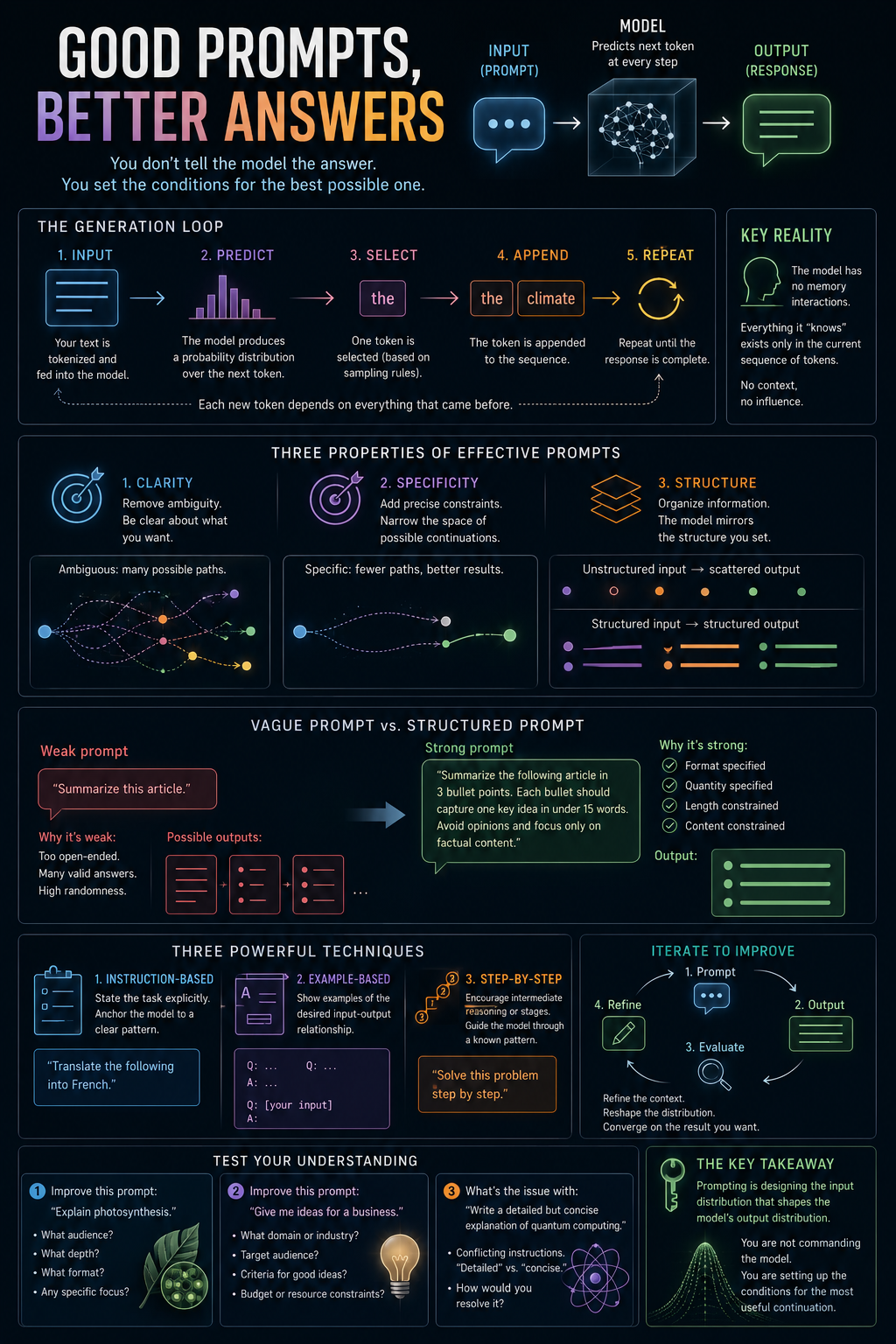
One of the most common misconceptions about AI is that prompting is about finding the perfect command. As if the model is a machine waiting for instructions. You tell it what to do. It executes the request. And the better the instruction, the better the result.
But that’s not really what’s happening. Because a language model isn’t following commands. It’s extending patterns. And that changes how we should think about prompting entirely.
The Hidden Role Of Context
Consider two prompts:
Write about climate change.
And:
Explain climate change to high school students in three short paragraphs. Include the main causes, major effects, and one real-world example.
Both prompts ask about the same topic. Yet the responses will be dramatically different. Why? Because the second prompt creates far more context.
It defines:
- the audience
- the structure
- the length
- the scope
- the style
In other words, it narrows the range of possible continuations. And that’s the real purpose of a prompt. Not to tell the model what to do. But to shape what becomes likely.
The Problem With Vague Prompts
At every step, a language model is trying to answer a simple question: What comes next? If the context is vague, many answers are plausible.
Should the response be technical?
Simple?
Short?
Opinionated?
Formal?
Narrative?
The model sees multiple valid paths. And because several continuations fit, the output becomes less predictable. This is why vague prompts often produce disappointing results. Not because the model lacks capability. But because the context fails to narrow the possibilities.
The model is guessing which path you intended. And sometimes it guesses wrong.
Good Prompts Reduce Uncertainty
The more I work with AI systems, the more prompting feels like reducing uncertainty. A strong prompt removes ambiguity. It creates constraints. It establishes expectations. And constraints are surprisingly powerful.
Imagine asking: Summarize this article.
That leaves many questions unanswered.
How long should the summary be?
What information matters most?
Who is the audience?
What format should be used?
Now compare it with: Summarize this article in three bullet points. Keep each bullet under fifteen words and focus only on factual information.
Suddenly the space of possible responses becomes much smaller. The model now has a clearer target. And clearer targets tend to produce better results.
Why Examples Work So Well
One of the most interesting discoveries in prompting is how effective examples can be. At first, that seems strange. Why show the model an example when you could simply explain what you want? The answer comes from how language models learn.
Remember: they are pattern completion systems. Show them a pattern and they naturally continue it. Provide an example of the desired input and output. The model often treats the prompt as the beginning of a sequence and extends it accordingly.
You’re no longer describing the pattern. You’re demonstrating it. And demonstration is often more powerful than explanation.
The Surprising Value Of Structure
Another thing people underestimate is structure. Language models are remarkably sensitive to how information is organized.
Lists.
Sections.
Headings.
Examples.
Numbered steps.
These patterns carry meaning. A structured prompt often produces a structured response. An unstructured prompt often produces an unstructured response. Not because the model prefers one over the other. But because it tends to mirror the patterns it sees. The prompt becomes a blueprint for the output.
Prompting Is An Iterative Process
I think one reason people become frustrated with AI is that they treat prompting as a one-time action.
Write the prompt.
Get the answer.
Move on.
But in practice, prompting works more like refinement.
You provide context.
Observe the output.
Identify what is missing.
Then adjust the context.
Each revision changes the conditions under which the model generates text. And those small changes can have surprisingly large effects. Often the fastest way to improve an answer isn’t changing the model. It’s improving the prompt.
The Bigger Lesson
The deeper I look at language models, the less prompting feels like giving instructions and the more it feels like designing environments. You’re not commanding the system. You’re creating the conditions under which certain responses become more likely.
Every constraint shapes the outcome.
Every example shapes the outcome.
Every piece of context shapes the outcome.
And once you see prompting that way, something important becomes clear. The quality of an AI response is often determined long before the first token is generated. It is determined by the context that made that response possible in the first place.