For a long time, one problem kept appearing whenever machines tried to understand language: words don’t mean much on their own.
Their meaning depends heavily on their relationships with other words. And those relationships can be surprisingly complicated.
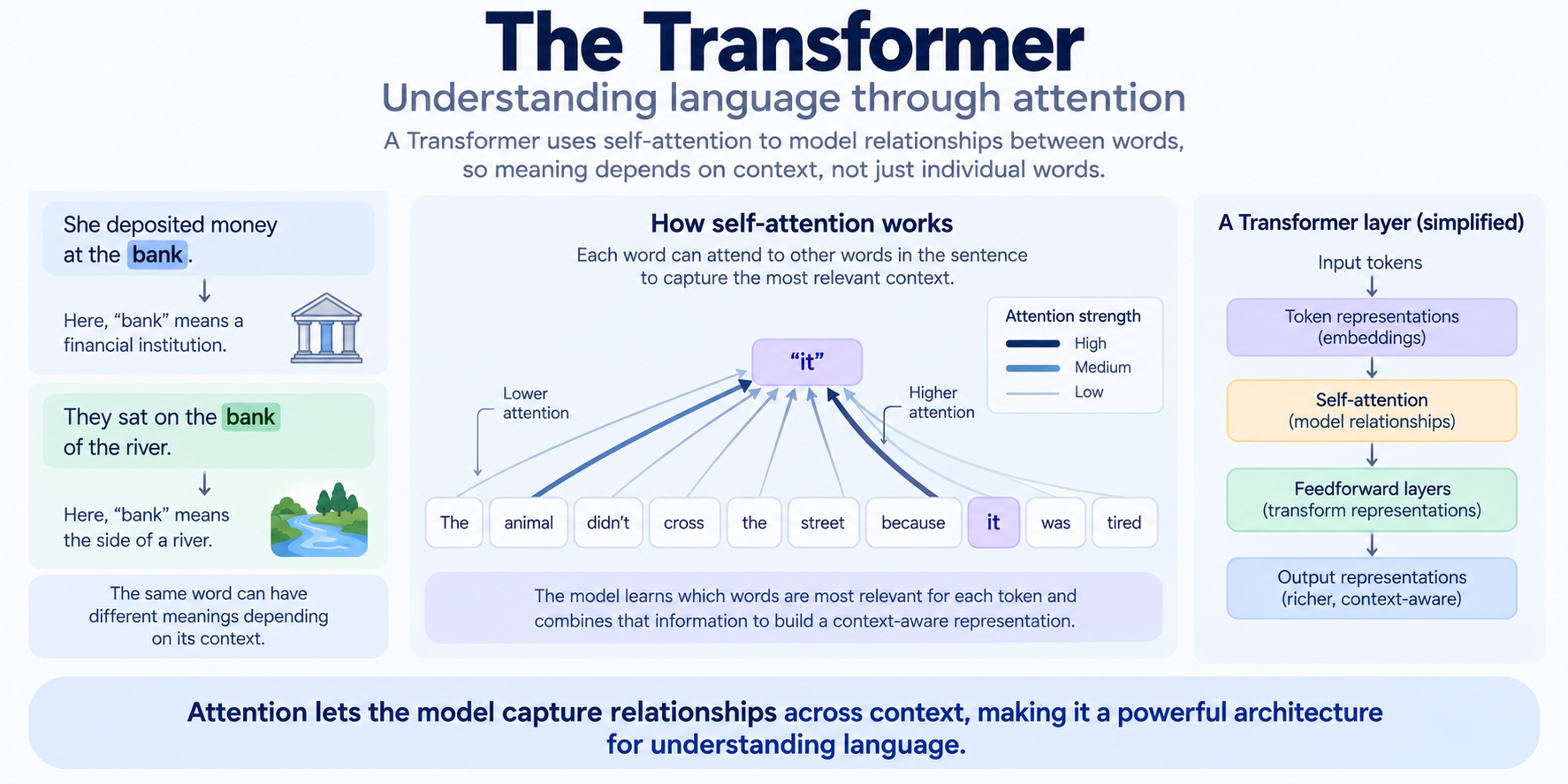
Take a simple word like “bank.”
Without context, it could refer to a financial institution.
Or the side of a river.
The word itself does not tell you which meaning is intended.
The surrounding context does.
That reveals a deeper truth about language: meaning depends on relationships and context, not just individual words.
The Transformer architecture became important because it gave neural networks a powerful way to model those relationships using a mechanism called self-attention.
What is a Transformer?
A Transformer is a neural-network architecture that uses attention mechanisms to model relationships between elements in its input. This ability to capture relationships across context is what made Transformers so important to modern AI.
The context problem in language
At first, the problem might not seem particularly difficult.
Just look at the nearby words.
Problem solved.
Except language does not always work that way.
Sometimes the information that determines the meaning of a word appears much earlier in a sentence. Sometimes it appears later. Sometimes several words interact to determine what a particular word means.
As sentences and documents become longer, the model has to deal with increasingly complex relationships.
It needs to determine:
- Which words are relevant?
- How strongly are they related?
- Which relationships matter for the current prediction?
- How does the meaning of one word change depending on the surrounding context?
These are surprisingly difficult problems for a language model to solve efficiently.
The limitation of sequential language processing
Earlier neural-network approaches often processed language sequentially.
One word arrives.
Then the next.
Then the next.
Information is carried forward as the sequence unfolds.
This approach can work well for many tasks, but it creates challenges when important pieces of information are far apart.
A relationship between two words may depend on information that appeared many steps earlier. The model has to preserve and use that information as the sequence continues.
As the distance grows, capturing these long-range relationships can become more difficult.
The fundamental problem is this:
Language is sequential, but meaning is highly relational.
A model needs to understand not only what came immediately before a word, but also which other parts of the context are relevant to it.
A different idea: attention
The Transformer introduced a powerful alternative.
Instead of relying primarily on information being passed sequentially from one position to the next, the architecture uses attention to let each position consider information from other positions in the sequence.
The key question becomes:
For this word or token, which other parts of the context are most relevant?
This is the basic intuition behind self-attention.
Rather than treating every surrounding word as equally important, the model learns different weights for different relationships.
Some tokens receive more attention.
Others receive less.
The resulting representation incorporates information from the parts of the context that are most relevant to the current position.
How self-attention works
Self-attention is easier to understand through an example.
Consider:
“The animal didn’t cross the street because it was tired.”
What does “it” refer to?
To interpret the sentence, the model needs to consider relationships between “it” and other words in the context.
Self-attention provides a mechanism for representing those relationships.
At a high level, the model takes the representations of the tokens and computes how strongly they should interact with one another. These relationships are represented through attention weights.
The result is a new representation for each token that incorporates information from other relevant tokens.
This happens across the sequence and can be repeated across multiple layers.
The important idea is not that every word simply “looks at” every other word equally.
It is that the model can learn which relationships matter and assign different weights to them.
Why context changes the representation
This is particularly important for ambiguous words.
Consider:
“She deposited money at the bank.”
and:
“They sat on the bank of the river.”
The word “bank” is the same in both sentences.
But its surrounding context is different.
In the first sentence, words such as “deposited” and “money” provide signals associated with a financial institution.
In the second, “river” provides a strong signal for the other meaning.
Through contextual processing, the model can build different representations of the same token depending on the surrounding information.
This is one of the central ideas behind modern language models:
The meaning represented for a token depends on its context.
Why Transformers were such a major shift
The Transformer architecture changed how neural networks could process relationships within sequences.
Earlier approaches were strongly tied to sequential processing. Transformers made it possible to process relationships across a sequence using attention mechanisms that can connect different positions directly.
This has important practical advantages.
Models can efficiently capture relationships between distant tokens, and Transformer architectures can be highly parallelized during training.
The architecture also scales effectively, which helped make it the foundation for many modern AI systems.
A system built on relationships
The Transformer is more than just an attention mechanism.
At a high level, a Transformer processes token representations through layers that include attention and other neural-network components.
Each layer transforms the representations.
The resulting representations are passed through additional layers, allowing the model to build increasingly rich representations of the input.
At a simplified level:
Tokens → representations → attention → transformed representations → more layers → richer representations
The process is repeated many times.
As the representations become richer, the model can capture increasingly complex patterns and relationships in the data.
Words can become associated with concepts.
Concepts can be associated with context.
Context can influence how relationships are represented.
And those representations can ultimately support tasks such as prediction and generation.
Why attention matters beyond language
The underlying idea is broader than text.
Many types of data contain relationships between their components.
Images contain relationships between regions and visual features.
Audio contains relationships across time.
Documents contain relationships between different passages and concepts.
Other modalities can also be represented as sequences or sets of elements whose relationships matter.
The broader lesson is therefore not simply that Transformers are good at words.
It is that attention provides a flexible way for neural networks to model relationships between elements in their input.
Why Transformers became the foundation of modern language models
The significance of Transformers becomes clearer when you connect the architecture to language-model training.
A Transformer provides a mechanism for building context-sensitive representations.
A language-model training objective can then use those representations to learn patterns from large amounts of text.
This combination became extremely powerful.
The architecture determines how information can interact.
Training determines what patterns the model learns from the data.
Together, they provide the foundation for modern large language models.
This distinction is important because a Transformer is an architecture, not itself a complete language model or a training objective.
The Transformer provides the structure.
Training turns that structure into a learned model.
The bigger lesson
The deeper I look at Transformers, the more they feel like a shift in perspective rather than simply another neural-network architecture.
The important idea was that understanding information often requires understanding relationships between its parts.
Attention provides a mechanism for modeling those relationships.
For language, that means a token can be represented in relation to the surrounding context rather than being treated as an isolated symbol.
That architectural shift helped enable the large language models we use today.
But architecture alone does not explain how these models acquire their capabilities. A Transformer provides the architecture; training determines what the model learns.
The next question is: How does a Transformer actually learn useful patterns from enormous amounts of data?
That brings us to the surprisingly simple training objective at the heart of many language models: predicting what comes next.