One of the easiest ways to misunderstand machine learning is to imagine that the system somehow becomes “smarter” in a vague or magical sense.
But if you strip away the terminology, a much simpler question appears:
When a machine learns, what exactly is changing inside it? Because something clearly changes.
The inputs remain the same kind of inputs.
The task itself usually remains the same.
The external world does not reorganize itself for the model.
So the only place change can happen is inside the system’s internal structure. And that turns out to be the key to understanding how machine learning actually works.
Start With a Simple Example
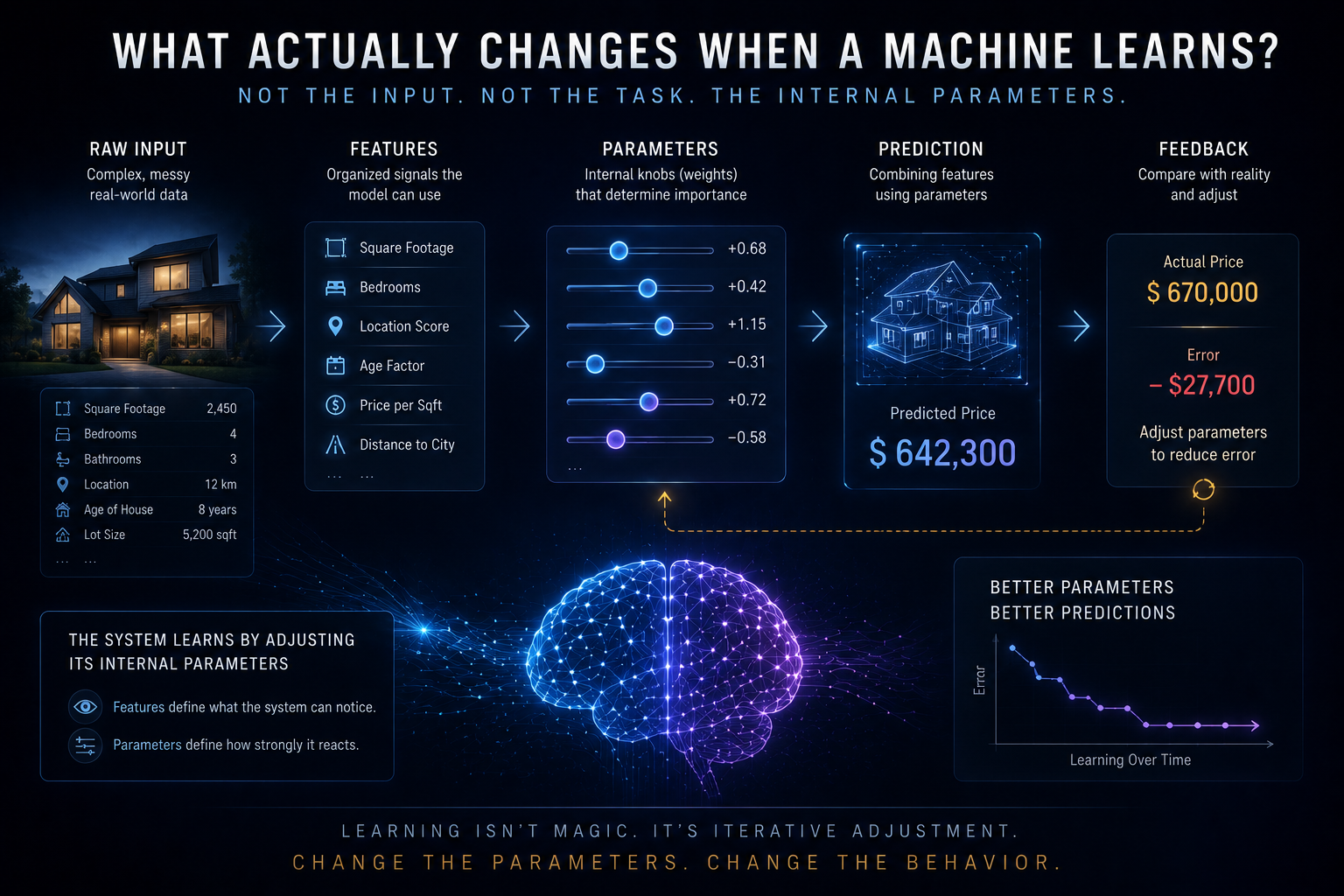
Imagine a system designed to predict house prices. You give it information like:
- square footage
- number of bedrooms
- location
- age of the building
At first glance, those just look like pieces of data.
But the system cannot use raw information directly in a meaningful way unless it decides what parts of that information actually matter. That leads to one of the most important ideas in machine learning:
Features.
Features Are What the System Notices
A feature is simply an aspect of the input the system uses to make predictions.
In a house pricing model:
- square footage could be a feature
- distance from the city center could be another
- number of bathrooms might matter too
In spam detection:
- specific words
- suspicious links
- email structure
- sender behavior
can all become features.
And this matters because raw reality is messy. Features are essentially the system’s attempt to organize the chaos of the world into usable signals. A bad feature set creates bad learning no matter how advanced the model is.
If you ignore location entirely while predicting house prices, the system will struggle even if everything else is perfect. Because it literally cannot notice one of the most important variables.
And that reveals something deeper: machine learning is partly about deciding what is worth paying attention to.
The Hidden Knobs Inside the System
But features alone are not enough.
The system still needs to decide:
- how important each feature is
- how features interact
- which signals matter more than others
This is where parameters enter the picture.
Parameters are the adjustable internal values that shape the model’s behavior.
You can think of them like knobs.
One knob controls how strongly square footage affects price.
Another adjusts the importance of location.
Another changes how much age reduces value.
The model combines features using these internal settings to produce a final prediction. And during learning, these are the things that actually change.
If the model consistently underestimates large houses, it increases the influence of size-related parameters.
If it overvalues certain neighborhoods, it adjusts those parameters downward.
Learning, at its core, is really the repeated adjustment of internal numerical relationships. That sounds less magical than “artificial intelligence.”But it is also a much more accurate description.
The More Interesting Layer: Representation
Things become even more interesting once you move beyond simple systems.
Because advanced AI models do not just rely on human-defined features. They learn internal representations automatically.This is one of the most important ideas behind modern AI. Take image recognition.
The raw input is nothing more than pixel values.
Tiny numerical intensities arranged in grids.
But deep inside the model, those pixels gradually transform into increasingly abstract internal structures:
- edges
- shapes
- textures
- objects
- faces
The system constructs intermediate representations that make the world easier to interpret. And these representations are not manually programmed. They emerge during learning because they become useful for solving the task. That matters enormously.
Because in many machine learning systems, representation quality matters more than the learning algorithm itself.
A good representation exposes hidden structure.
A poor representation hides it.
Which means intelligence is not just about learning faster. It is also about seeing the world in the right way.
The Full Learning Pipeline
At a high level, most machine learning systems follow the same basic structure:
- An input enters the system.
- The system extracts or constructs useful features.
- Internal parameters combine those features into predictions.
- Feedback reveals whether the prediction was correct.
- The parameters adjust slightly.
- The cycle repeats.
Over time, the model gradually reshapes itself around patterns inside the data. And that reshaping process is what we call learning.
Not understanding.
Not consciousness.
Not awareness.
Just iterative structural adjustment guided by feedback.
The Misleading Part of Machine Learning
I think one reason machine learning feels mysterious is because the final behavior often looks far more intelligent than the underlying mechanism sounds.
A recommendation system predicts what you want.
A language model generates essays.
An image model recognizes faces.
But internally, the system is still fundamentally manipulating representations and adjusting parameters based on statistical structure.
That does not make the achievement less impressive.
If anything, it makes it more fascinating.
Because it suggests that many forms of intelligence may emerge from surprisingly simple underlying principles repeated at enormous scale.
And that possibility changes how we think about intelligence itself.
Not as something magical.
But as something that may arise from systems capable of building increasingly useful internal representations of reality and continuously reshaping themselves through feedback.
Which is a much stranger idea when you really sit with it.