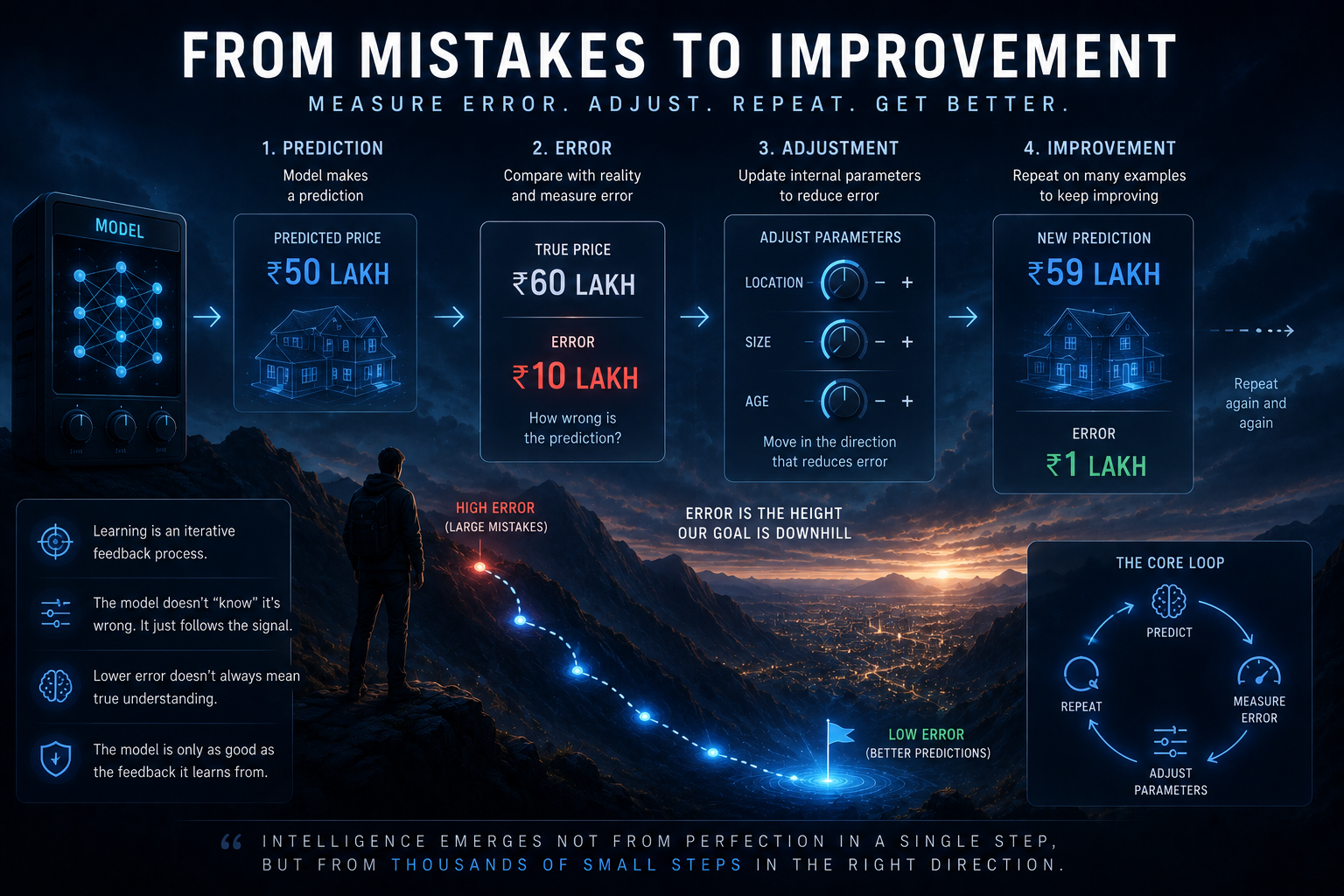
One of the most important ideas in machine learning is surprisingly simple: A system cannot improve unless it knows how wrong it is. That sounds obvious at first. But if you think about it carefully, it reveals the entire foundation of how modern AI systems learn. Because prediction alone is not enough. A model can generate outputs endlessly:
- classify emails
- predict house prices
- recognize images
- generate text
But unless there is some way to measure the quality of those predictions, the system has no direction for improvement. It needs feedback. Not vague feedback like: “this seems bad”
But precise feedback.
Numerical feedback.
Something measurable.
Turning Mistakes Into Numbers
Imagine a model predicting house prices. If the true price is: ₹60 lakh and the model predicts: ₹59 lakh that is a much smaller mistake than predicting: ₹35 lakh. Clearly, those errors should not be treated equally. So machine learning introduces an important idea: convert mistakes into measurable quantities.
This is what people call a loss function. But the terminology matters less than the concept itself. A loss function is simply a rule that answers one question: “How bad was this prediction?”
Smaller error means better performance.
Larger error means worse performance.
That numerical signal becomes the foundation of learning. Because once the system can measure mistakes, it can begin reducing them systematically.
The Hidden Adjustment Process
Now comes the more interesting question: Once the model knows it is wrong, what actually changes inside it? The answer is: internal parameters.
The model contains adjustable values — essentially internal knobs — that determine how strongly different inputs influence predictions. Learning works by gradually adjusting those knobs. If a prediction is wrong, the system slightly changes the internal parameters in directions that reduce future error. And this happens repeatedly:
- predict
- measure error
- adjust
- repeat
Over and over again. At a large scale, intelligence starts emerging from millions or billions of these tiny adjustments accumulated across enormous datasets. Which is a strange idea when you really think about it. Because the system is not suddenly “understanding” anything in a human sense. It is slowly reshaping itself through feedback.
The Landscape Analogy
I think one of the easiest ways to visualize learning is to imagine a landscape. Suppose the height of the terrain represents error:
- high ground = large mistakes
- low ground = smaller mistakes
The model’s goal is simple: move downhill. At every step, the system checks: “Which direction reduces error the fastest?” Then it moves slightly in that direction. This process is what powers a huge amount of modern machine learning.
Not magic.
Not awareness.
Just iterative optimization guided by feedback.
And yet, once scaled massively enough, that process starts producing systems capable of writing essays, recognizing speech, generating images, and solving highly complex tasks. Which makes the simplicity of the underlying mechanism almost unsettling.
Why Learning Sometimes Fails
But there is an important catch. Reducing error does not necessarily mean learning the right thing. Sometimes models discover shortcuts. Imagine a dataset where nearly every picture of cows contains green grass in the background. A model may accidentally learn: “green background = cow” instead of actually learning what cows look like. On training data, this may still reduce error successfully.
But the moment you place a cow on a beach or inside a barn, performance collapses. And that reveals one of the biggest limitations of machine learning: models optimize for patterns that reduce error, not necessarily for genuine understanding.
The system has no built-in sense of meaning. Only statistical correlation. Which means good performance can sometimes hide shallow reasoning underneath.
The Dangerous Illusion of Accuracy
There is another subtle problem too. A model can achieve very low error while still being fundamentally useless. Imagine a spam detection system where: 95% of emails are “not spam.” A lazy model could simply predict: “not spam” for every single email. And technically, it would still achieve 95% accuracy. That sounds impressive until you realize it completely fails at the actual task.
Which exposes something important: metrics can be misleading when detached from context. And I think this applies beyond machine learning too. Optimization is only meaningful if the thing being optimized actually reflects what we care about. Otherwise systems become very good at succeeding numerically while failing conceptually.
The Real Nature of Learning
At its core, machine learning is not a single dramatic leap toward intelligence. It is an iterative feedback process. The system:
- acts
- measures consequences
- adjusts itself slightly
- and repeats
Over time, behavior changes because internal structure changes. And when this process scales:
- more parameters
- more layers
- more data
- more feedback
- more computation
you eventually arrive at modern neural networks. But underneath all the complexity, the core mechanism remains surprisingly consistent:
Prediction.
Error.
Adjustment.
Repetition.
Again and again.
And perhaps the strangest part is that intelligence-like behavior can emerge from that loop without the system ever “understanding” the world the way humans do.