One of the most interesting questions in AI appears the moment a neural network gets something wrong.
The network receives an input. It processes that input through multiple layers. It makes a prediction.
Then the prediction turns out to be incorrect.
At that point, a simple question emerges: How neural networks learn from its mistakes?
The mistake appears at the end of the network, but the prediction was shaped by everything that happened before it. So how can the network determine what needs to change?
The answer involves backpropagation: a process that sends information about the error backward through the network so its parameters can be adjusted.
Why deep neural networks make learning difficult
Imagine trying to identify why a company failed.
Was it a bad decision made yesterday?
A strategy chosen six months ago?
Or a hiring decision made two years earlier?
The final outcome may be the result of many interconnected decisions.
Neural networks face a similar problem.
A prediction is not produced by a single component. It emerges from a chain of transformations.
Each layer receives information, transforms it, and passes the result forward.
By the time the final prediction appears, many intermediate computations may have contributed to it.
So when the prediction is wrong, the network needs a way to determine how those earlier computations contributed to the final error.
That creates the central challenge of neural-network learning:
How do you use an error at the output to adjust the many parameters that contributed to it?
Why fixing the last layer isn’t enough
At first, it seems tempting to blame the final layer.
After all, that’s where the prediction was produced.
But that explanation quickly falls apart.
Imagine a student gives the wrong answer to a question. The mistake might have happened in the final step, or it might have originated from a misunderstanding much earlier in the reasoning process.
Correcting only the final answer doesn’t necessarily solve the underlying problem.
The same idea applies to neural networks.
A final layer can only work with the information it receives. If earlier layers produced poor representations, the final layer may not have enough useful information to make the correct prediction.
Which means improvement cannot happen only at the end.
The entire chain needs feedback.
The key idea behind backpropagation
This leads to one of the most important ideas in neural-network training.
If information flows forward through the network to produce a prediction, information about the error can be propagated backward to determine how the network’s parameters contributed to that error.
Layer by layer.
Step by step.
The network calculates how sensitive the error is to changes in its parameters. These signals provide information about which parameter adjustments would tend to reduce the error.
This is the basic intuition behind backpropagation.
It is not the network “understanding” why it failed.
It is a mathematical procedure for calculating how the error relates to parameters throughout the network.
Learning through feedback
Backpropagation can sound mysterious because it is easy to imagine the network reflecting on its mistakes.
But that’s not what happens.
The network doesn’t form an explanation of why it failed.
Instead, training produces numerical feedback about the error.
Those signals are then used to calculate updates to the network’s parameters.
Some parameters may change in one direction.
Others may change in another.
Each individual adjustment can be small.
But collectively, repeated adjustments can gradually change the network’s behavior.
From error to parameter updates
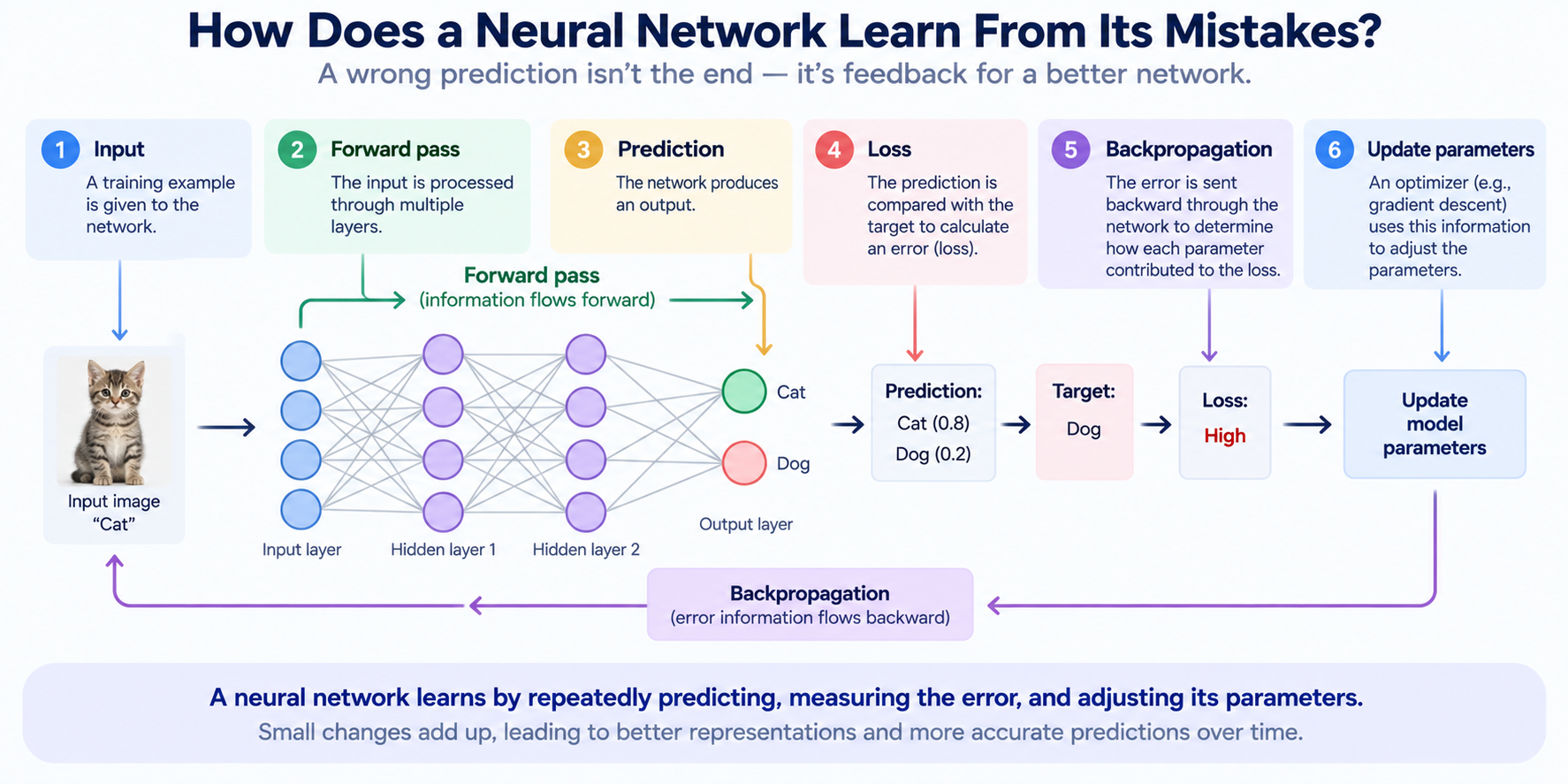
At a high level, neural-network training follows a repeating cycle:
- Input enters the network.
- The network processes the input through its layers.
- The network produces a prediction.
- The prediction is compared with the target.
- An error or loss is calculated.
- Backpropagation calculates how parameters contributed to that loss.
- An optimization algorithm updates the parameters.
- The process repeats.
This distinction is useful:
Backpropagation calculates the information needed to determine parameter adjustments.
An optimizer, such as gradient descent, uses that information to update the parameters.
Together, these processes allow the network to improve during training.
The surprising part: learning is distributed
What fascinates me most about neural networks is how little any individual component needs to understand.
No single neuron needs to know what a cat is.
No individual connection understands language.
No single layer necessarily comprehends the entire task.
Instead, learning is distributed across the network’s parameters.
Thousands, millions, or billions of small numerical adjustments can accumulate during training.
Over time, those adjustments can produce increasingly useful representations and more accurate predictions.
The behavior emerges from the interaction of many learned parameters rather than from a single component containing the answer.
The full learning loop
At a high level, the process is surprisingly simple:
Forward pass → prediction → loss → backpropagation → parameter update → repeat
Information flows forward.
A prediction is produced.
The prediction is compared with the target.
A loss measures the discrepancy.
Backpropagation calculates how the loss relates to the network’s parameters.
An optimizer uses those signals to adjust the parameters.
Then the cycle begins again.
Again.
And again.
Over many training iterations, the network can gradually become better at the task.
Learning changes the internal representation
There is an important consequence of this process.
Training doesn’t merely teach the network to produce better final answers.
The adjustments also change the internal representations produced by the network’s layers.
Patterns that help the task can become represented more usefully.
Relationships between features can become easier for later layers to exploit.
The network gradually develops internal representations that are useful for making its predictions.
This brings us to an important question:
What does information actually look like inside a neural network?
To answer that, we need to look at how neural networks represent information—and eventually how they can represent things such as meaning.
The bigger lesson
The deeper I look at neural networks, the less learning feels like a sudden breakthrough and the more it feels like a process of continuous correction.
A prediction is made.
An error is measured.
Feedback is calculated.
Parameters are adjusted.
Then the process starts again.
Over time, those small adjustments accumulate.
Patterns emerge.
Representations improve.
Predictions become more accurate.
And that simple cycle—predict, measure error, adjust, repeat—is one of the fundamental ideas behind how neural networks learn.