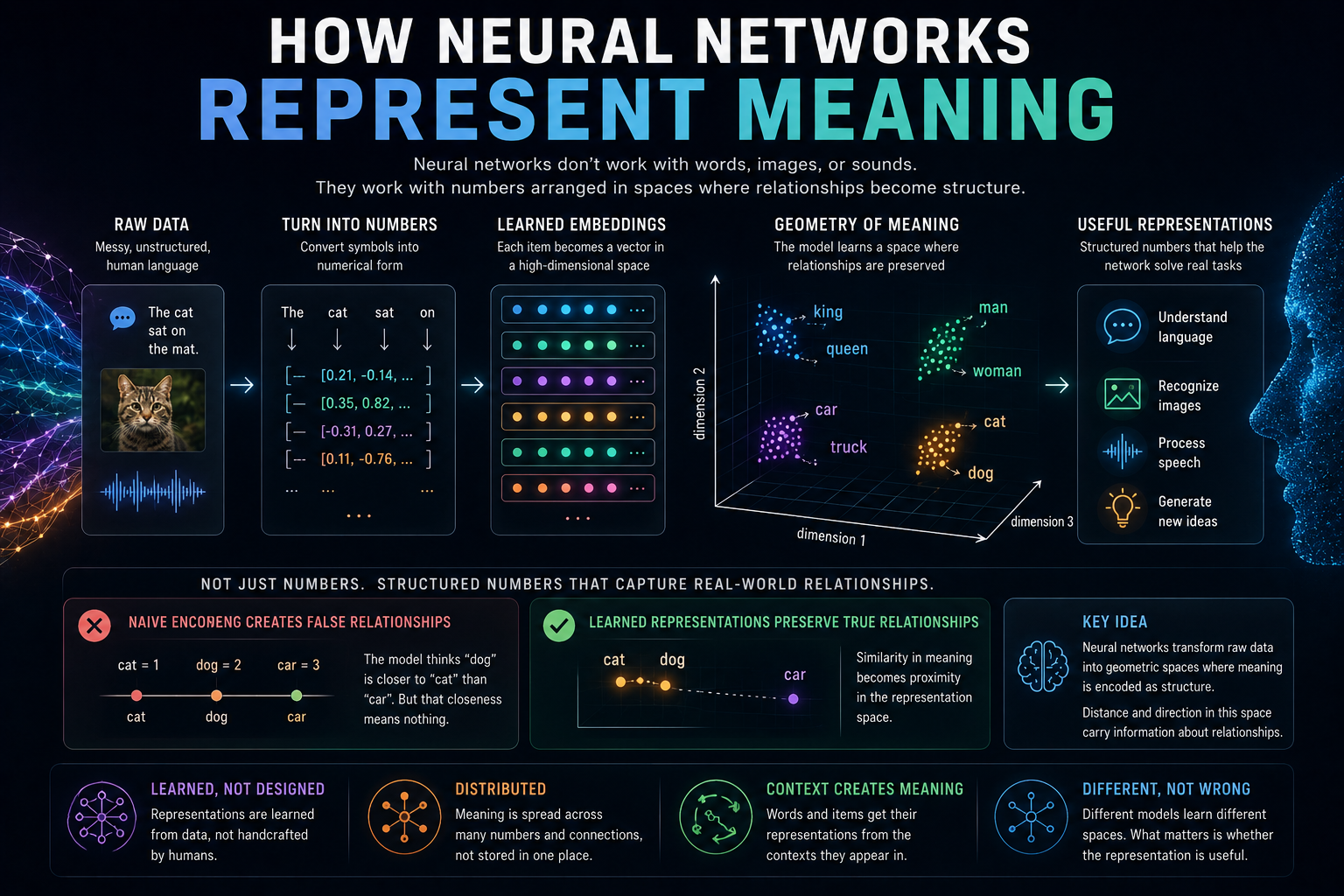
One of the most surprising things about modern AI is that it doesn’t actually work with words. At least not in the way most people imagine.
When we interact with a chatbot, it feels like the system is reading language directly. We type words. It responds with words. The entire interaction appears linguistic. But underneath the surface, something very different is happening. Because neural networks don’t understand words. They understand numbers.
And that raises an interesting question: How does a machine turn something as rich and messy as language into something it can actually work with?
The Problem With Simple Numbers
At first, the solution seems obvious. Assign every word a number.
Cat = 1
Dog = 2
Car = 3
Problem solved. Except it isn’t.
Because the moment you do that, you’ve accidentally created relationships that don’t exist. The model now sees “dog” as being closer to “cat” than “car” simply because 2 is closer to 1 than 3. But that numerical closeness is completely arbitrary.
The numbers contain structure.
The meaning doesn’t.
And that reveals an important principle. Converting information into numbers is not enough. The structure of those numbers matters.
The Hidden Geometry of Meaning
I think one reason AI feels mysterious is because meaning itself is surprisingly difficult to represent. Humans don’t organize concepts as isolated symbols. We organize them through relationships.
A cat is related to a dog.
A king is related to a queen.
A car is more similar to a truck than it is to a banana.
Meaning emerges from context and connections. Not from labels.
So if a machine is going to work with language effectively, it needs a numerical representation that preserves those relationships. Things that are similar should be close together. Things that are different should be farther apart. In other words, meaning needs a geometry.
Learning Instead of Designing
Earlier AI systems often relied on humans to create these representations manually. But modern systems do something far more interesting. They learn them. Instead of deciding in advance what words mean, the model gradually discovers useful relationships through exposure to enormous amounts of data.
Every word becomes a collection of numbers.
Not a single number.
A coordinate inside a much larger space.
And those coordinates shift during training. Over time, words that behave similarly begin moving closer together. Words that behave differently drift apart. The representation reshapes itself around patterns in the data. And eventually, something remarkable begins to emerge.
A Map Without Definitions
Consider words like:
- king
- queen
- man
- woman
Nobody explicitly tells the model how these concepts relate. There is no dictionary hidden inside the network. Instead, the model observes how these words appear across billions of examples. And gradually, structure emerges.
The model begins placing related concepts near one another. Not because it understands them in a human sense. But because they behave similarly across language. This is one of the strangest ideas in AI. Meaning is not stored as definitions. It emerges as position.
The model doesn’t know what a king is. It knows where “king” exists relative to everything else. And somehow, that turns out to be incredibly useful.
Beyond Language
The same idea appears almost everywhere in modern AI. Images begin as pixels.
Sounds begin as waveforms.
Videos begin as sequences of frames.
Raw data enters the system.
Then layers of transformations gradually convert that data into more useful representations.
Edges become shapes.
Shapes become objects.
Words become concepts.
Concepts become relationships.
And eventually, the model operates inside a structured space where useful patterns become easier to detect. The pattern repeats again and again.
The Bigger Shift
The deeper I look at modern AI, the more it feels like a story about representation.
Not intelligence.
Not reasoning.
Representation.
Because before a system can learn anything meaningful, it first needs a useful way of organizing information. And that may be one of the most underrated ideas in machine learning. The quality of learning often depends less on the algorithm itself and more on how reality gets represented internally.
A better representation makes hidden patterns visible.
A poor representation hides them.
Which means intelligence may not begin with answers. It may begin with finding the right way to represent the question.
And that is exactly what modern AI spends most of its time learning to do.