A language model can generate text, but by itself it cannot send an email, query a database, check the current weather, or run a piece of code.
So how can an AI system move beyond generating text and actually take actions?
The answer is AI tool calling.
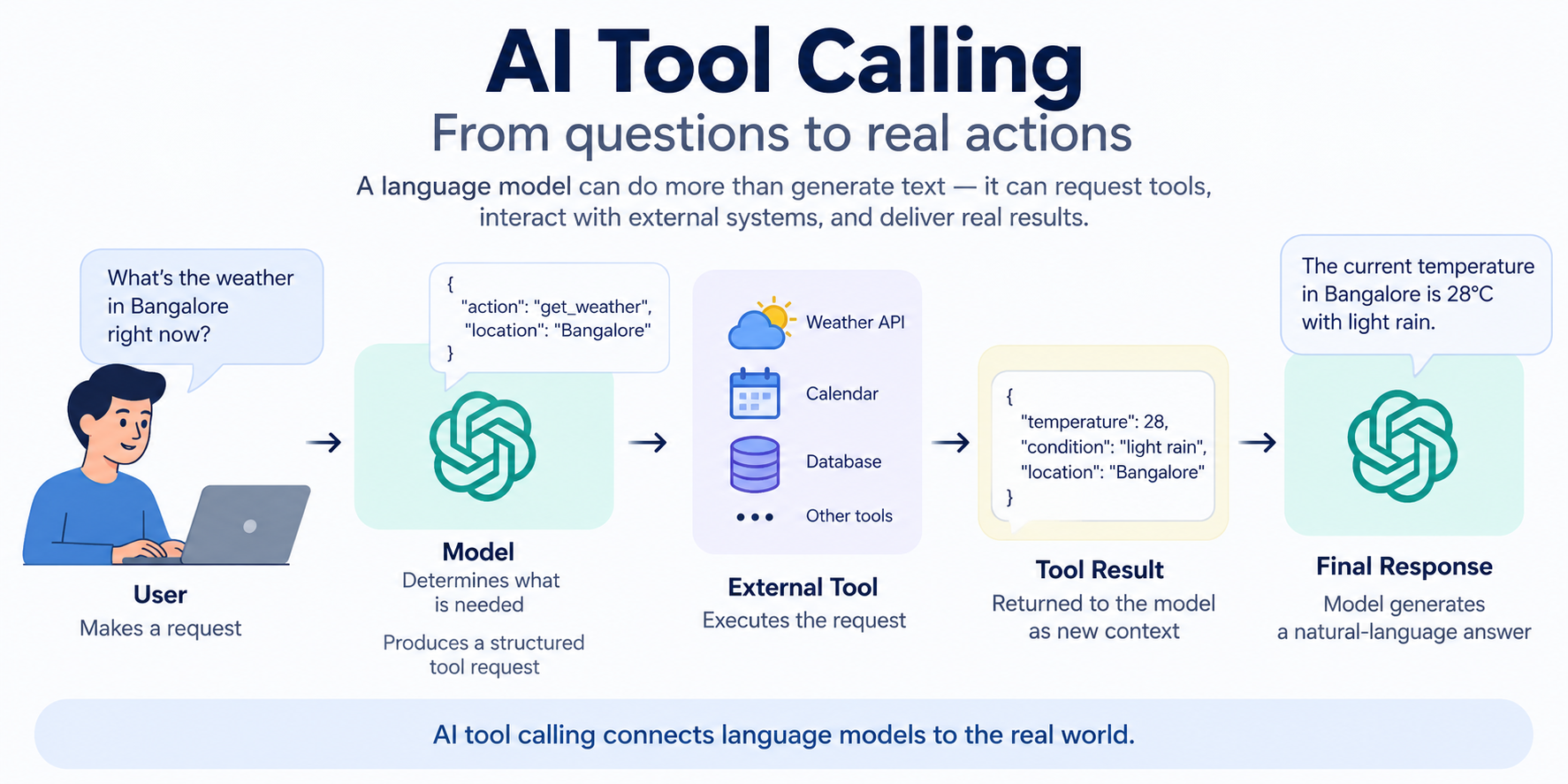
Tool calling gives a language model a structured way to request an action from an external system. The model determines what needs to happen and produces a structured tool request. A separate system executes that request, returns the result, and gives the model the result as new context.
The basic pattern is:
User → Model → Tool call → External system → Tool result → Model → Final response
This extends what a language model can do without requiring the model itself to directly operate external systems.
Why language models need tools
Start with the basic limitation.
A language model can describe what should be done:
- “Send an email.”
- “Look up the weather.”
- “Calculate the total.”
- “Query the customer database.”
But generating the sentence is not the same as performing the action.
If a user asks for today’s weather, a model’s general knowledge is not enough to provide reliable current conditions. The system needs access to a source of current weather data.
If a user asks to book a meeting, the system needs to interact with a calendar.
In both cases, generating text is only part of the task. The system also needs a way to interact with an external tool or service.
This leads to a simple design:
The model signals what needs to be done, and another system carries out the action.
What is AI tool calling?
AI tool calling is a mechanism that allows a language model to produce a structured request for an external function, API, service, or other tool. Tool calling is different from retrieval-augmented generation (RAG). RAG gives the model relevant external information; tool calling gives the system a mechanism for performing external actions.
Instead of responding only with natural language such as:
“I will check the weather.”
the model might produce a structured request such as:
{
  "action": "get_weather",
  "location": "Bangalore"
}
The exact format depends on the system, but the principle is the same: the output is designed for software to interpret rather than for a person to read.
The surrounding application receives the tool request, identifies the appropriate tool, executes it, and obtains a result.
That result is then returned to the model as additional context.
The model can use that information to produce the final response:
“The current temperature is 28°C with light rain.”
The model did not retrieve the weather itself. It requested a tool action, and another component performed it.
How tool calling works
A typical tool-calling workflow has several steps.
1. The user makes a request
For example:
“What’s the weather in Bangalore right now?”
The system sends the request to the language model along with information about the tools it is allowed to use.
2. The model determines what is needed
The model recognizes that answering the question requires current weather information.
Instead of guessing, it produces a structured request for the weather tool.
3. The external system executes the tool
The application receives the structured request and calls the appropriate weather service.
The tool might return information such as the current temperature and weather conditions.
4. The tool result is returned to the model
The application adds the result to the model’s context.
The model now has access to the information returned by the tool.
5. The model generates the final response
Using the returned data, the model produces a natural-language answer for the user.
The complete flow is:
User request → Model decides → Tool call → Tool executes → Result returned → Model responds
This is the core mechanism behind AI tool calling.
The model doesn’t execute the tool
A useful distinction is that the model is not the executor.
The model interprets the request, determines whether a tool is needed, and specifies what action should be taken.
The external system is responsible for actually executing that action.
This separation allows the system to combine two different capabilities:
- Flexible language-model reasoning: interpreting requests and deciding what may be needed
- Precise tool execution: performing operations through systems designed for those tasks
For example, a model can determine that a user wants to send an email, but an email service is responsible for actually sending it.
Likewise, a model can determine that a database query is required, while the application or database layer performs the query.
From a decision to an action
Consider a simple weather example.
User: “What’s the weather in Bangalore right now?”
Step 1: The model processes the request and recognizes that current data is required.
Step 2: The model generates a structured request for the weather tool.
Step 3: The external system calls the weather service.
Step 4: The weather service returns the current information.
Step 5: The result is provided to the model as additional context.
Step 6: The model generates the final response using that information.
The important transition is between steps 2 and 3.
The model doesn’t suddenly gain the ability to access the weather service. Instead, its structured output causes the surrounding application to invoke a tool.
How does an LLM know when to use a tool?
A language model needs information about the tools that are available to it.
For example, a system might define a weather tool with a location parameter. The model can then learn or infer that requests requiring current weather information may be handled by that tool.
During training or fine-tuning, models can be exposed to examples in which certain requests result in structured tool calls. This helps them learn patterns connecting user requests with appropriate tool use.
The model may therefore distinguish between requests that can be answered directly and requests that require an external operation.
For example:
“Explain how photosynthesis works.”
This generally does not require a tool if the necessary knowledge is already available in the model’s context.
But:
“What’s the weather in Bangalore right now?”
requires current external information, so a weather tool may be appropriate.
The model’s ability to choose correctly is important because having tools available does not mean every request should use one.
Why structured outputs matter
Natural language is flexible, but that flexibility creates ambiguity for software.
Consider:
“Maybe check the weather for Bangalore.”
A person can understand what this probably means. A program needs a much more explicit representation of the intended operation.
A structured tool request can specify:
{
  "action": "get_weather",
  "location": "Bangalore"
}
Now the surrounding system can identify the requested operation and its parameters.
This is why structured outputs are important in tool calling. They provide a predictable interface between the language model and the software that executes the action.
AI isn’t directly using the internet
One common misconception is that a language model automatically “uses the internet” when it has access to tools.
That’s not what happens.
The model itself produces outputs. The surrounding application determines what those outputs mean and can use them to interact with external systems.
If a system provides a web-search tool, the application can execute a search when the model requests it.
If a system provides a database tool, the application can execute a database operation.
If no connection to those systems has been built, the model cannot access them simply because it knows they exist.
There is no hidden connection to an external system.
Tool access must be explicitly provided by the surrounding system.
Tool calling can fail
Giving a model access to tools does not guarantee that the right action will always be taken.
Several things can go wrong.
The model chooses the wrong tool
A system may have multiple tools with overlapping capabilities, and the model may select an inappropriate one.
The model provides incorrect parameters
For example, it might identify the correct weather tool but provide the wrong location.
The model fails to recognize that a tool is needed
It might attempt to answer a question from its existing knowledge when current or external information is required.
The tool itself fails
The external service might be unavailable, return incomplete information, or produce an error.
So the reliability of a tool-using AI system depends on more than the language model. It also depends on tool selection, parameter generation, execution, and the quality of the returned results.
When should an AI system use a tool?
A useful rule is to use a tool when the task depends on information or capabilities outside the model’s available context.
For example:
| User request | Tool needed? | Why |
|---|---|---|
| “What is 234 × 567?” | Potentially | A calculator can perform the arithmetic precisely |
| “Explain how photosynthesis works.” | Usually not | The model can answer from available knowledge |
| “What’s the weather right now?” | Yes | Current data must come from an external source |
| “Query our customer database.” | Yes | The model needs access to the external database |
| “Summarize this document.” | Not necessarily | If the document is already provided, the model already has the required context |
The last example is particularly important.
If a document is already present in the model’s input, performing an unnecessary external search could introduce irrelevant information rather than improving the answer.
The goal is not to use tools as often as possible.
The goal is to use the right tool when it is actually needed.
From tool calling to more autonomous systems
Tool calling becomes more powerful when a system can perform multiple steps.
A simple interaction might look like:
User → Model → Tool → Result → Model
A more complex task might involve several actions:
User → Model → Tool A → Result → Model → Tool B → Result → Model → Final response
For example, a system could retrieve information, process it, perform a calculation, and then use the results to produce an answer.
At this point, the model is no longer limited to responding with text. It can participate in a workflow where it interprets, decides, delegates, and incorporates results.
This is an important building block for more autonomous AI systems.
The bigger shift
The key mental model is:
The model decides what needs to happen; tools perform the operation.
Tool calling creates a bridge between language generation and external capabilities.
The model can interpret a user’s request, determine that an external action or piece of information is required, and produce a structured request. The surrounding system executes that request and returns the result to the model.
Combined with the earlier idea of retrieving external information and placing it into the model’s context, this creates a much more capable architecture.
The progression is straightforward:
Language model → external context → tool calling → multi-step workflows
The model can now do more than generate text. It can work with external information, invoke specialized capabilities, and use the results to continue its reasoning and produce a response.
That is the foundation on which more capable AI assistants and autonomous systems can be built.