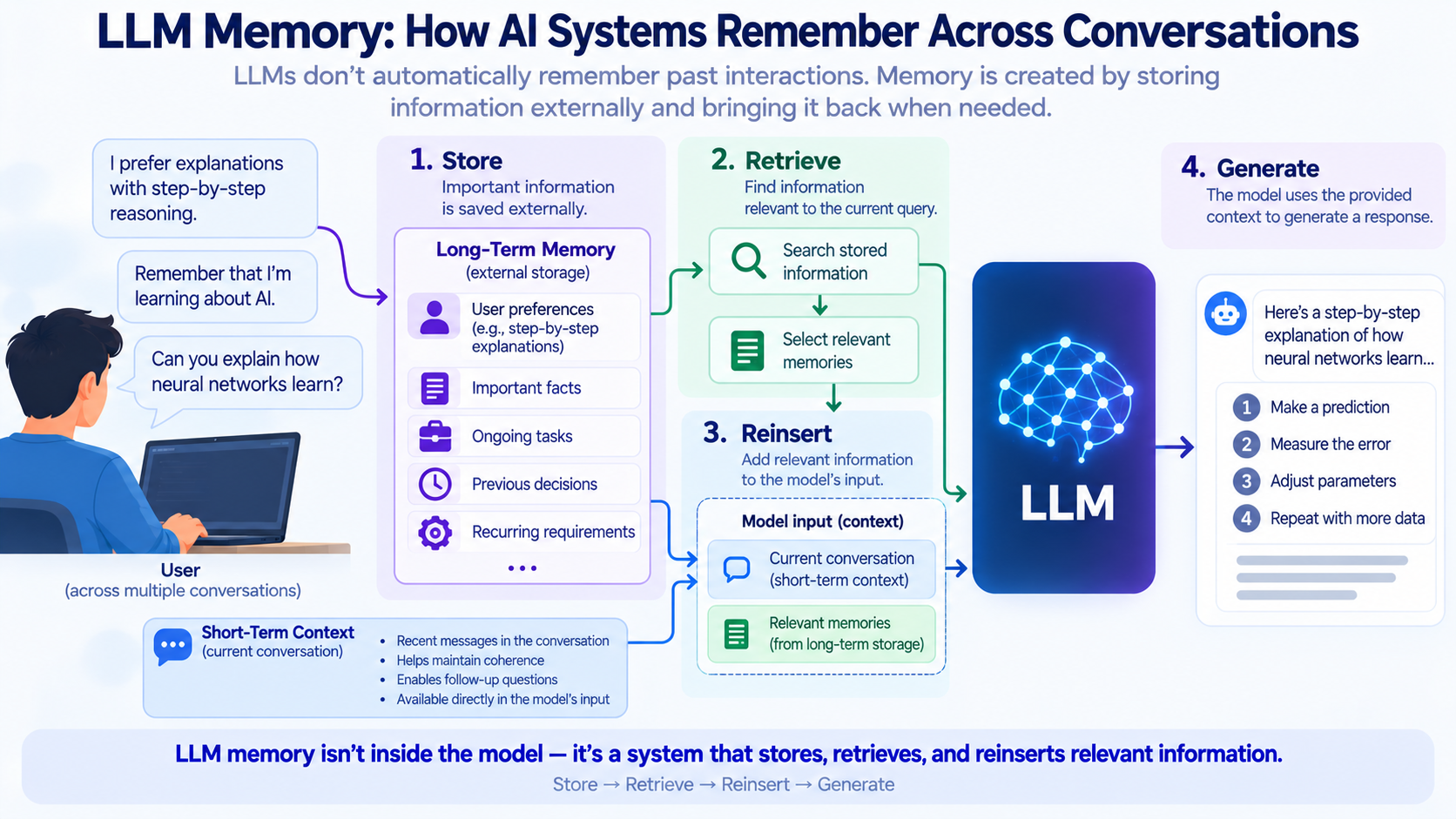
One of the most common misunderstandings about LLM memory is assuming that a language model simply remembers everything it has seen before. Mechanically, it doesn’t.
If a model generates a response based only on its current input, information from earlier interactions has no direct influence on the next response unless that information is provided again. If something from an earlier interaction is not present in the context the model receives, the model cannot directly use it.
This reveals an important limitation: From the model’s perspective, interaction is largely stateless.
Continuity has to be constructed outside the model. So the core problem becomes: How can a system preserve relevant information across multiple interactions and make it available when needed? The answer is to introduce persistence outside the model.
How LLM Memory Actually Works
Important information—such as user preferences, past decisions, ongoing tasks, or relevant facts—can be stored somewhere external. Then, when a new interaction occurs, the system can selectively retrieve some of that information and include it in the model’s input. The model can then use that information when generating its response. This creates the experience of continuity.
But notice what is actually happening. The model itself is not necessarily remembering the earlier interaction. The system is re-supplying the information that matters.
A useful mental model is: Store → Retrieve → Reinsert → Generate
That loop is at the heart of many systems that appear to have persistent memory.
Short-Term Context vs. Long-Term Memory
It helps to distinguish between two different forms of information available to an AI system.
Short-Term Context
The first is the current conversation. Recent messages can be included directly in the model’s input. This allows the model to maintain coherence within a session.
It can:
- answer follow-up questions
- refer to earlier statements
- maintain the current topic
- use information provided earlier in the conversation
This is often what people experience as conversational memory. But technically, it is context carried forward into the model’s input. If earlier information is no longer available in the context supplied to the model, it cannot simply be assumed to remain accessible.
Long-Term Memory
The second is information stored outside the current conversation. This could include:
- user preferences
- important facts
- previous decisions
- ongoing tasks
- relevant external information
This information does not need to be included in every interaction. Instead, the surrounding system can retrieve it when it appears relevant. That distinction is crucial.
Short-term context is information already available to the model.
Long-term memory is information stored externally and selectively brought back when needed.
A Simple Example of LLM Memory
Suppose a user tells the system:
“I prefer explanations with step-by-step reasoning.” The system can store that preference externally.
Later, in a completely new interaction, the user asks: “Explain how neural networks learn.”
Before generating the response, the system can retrieve the stored preference and include it in the model’s input. The model might effectively receive additional context such as: The user prefers step-by-step explanations.
The resulting response can now reflect that preference. But notice what happened. The model did not independently remember the user’s preference. The system retrieved the stored information and told the model again.
That distinction may seem subtle. It isn’t. It is fundamental to understanding how AI memory works.
What Should an AI System Remember?
Once memory is treated as an external system, another question appears: What should actually be stored? The answer cannot simply be:
Everything. Storing every interaction would quickly create enormous amounts of information. Much of it would be irrelevant.
Some of it would become outdated.
Some information might only matter for a few minutes.
Other information could remain useful for months.
A useful memory system therefore needs to identify information that is likely to matter later.
For example:
- stable preferences
- important facts
- ongoing projects
- previous decisions
- recurring requirements
The system then needs another mechanism at generation time: Which stored information is relevant to this particular interaction? This is where retrieval becomes important.
Memory Requires Retrieval
Imagine that a system has thousands of pieces of stored information about a user. A new question arrives. It would be inefficient to insert everything into the model’s context. Instead, the system needs to identify the subset that is most relevant.
Conceptually, the process looks like this:
Current query → Search stored information → Select relevant memories → Add to context → Generate response
This is similar to how retrieval works with external knowledge. You don’t give the model an entire database every time it answers a question. You retrieve the information that appears useful and provide that information as context. The same principle can be applied to stored user information and previous interactions.
More Context Does Not Mean Better Memory
It may seem that giving the model more information should always make it better. But that isn’t necessarily true. Language models have limits on how much context they can process effectively. More importantly, irrelevant information can dilute the signals that actually matter.
Imagine asking: “Explain neural networks for a beginner.” and giving the model hundreds of unrelated memories about the user’s previous conversations.
The relevant preference might be: “The user is a beginner.” But that information could be buried among dozens of irrelevant details.
The result may actually become worse. So the goal of memory is not to preserve everything. The goal is to preserve and retrieve what matters.
Poor Memory Can Make AI Worse
External memory also introduces new failure modes. Suppose the system stores an outdated preference. The user once said: “I prefer very short answers.” Six months later, they now want detailed explanations. If the old preference is retrieved automatically, the system may continue producing short answers even though the information is no longer accurate. The same problem can occur with incorrect information.
If the system stores something that was wrong and later retrieves it as context, the model may incorporate that information into its response. So an AI memory system needs to consider more than storage.
It needs to deal with:
- relevance
- accuracy
- freshness
- conflicts
- expiration
- retrieval quality
Memory therefore becomes a systems problem, not simply a model capability.
The Model Does Not Necessarily Change
This leads to one of the most important ideas in understanding LLM memory. Suppose the model answers differently today because it knows a user’s preference that it did not know yesterday. It may appear that the model itself has changed. But the underlying model parameters may be exactly the same. What changed was the context supplied to the model.
Yesterday: User input → Model → Response
Today: User input + Retrieved memory → Model → Response
The model can therefore behave differently without its internal parameters being updated. The surrounding system changed what the model was given. This is a powerful distinction.
LLM Memory Is External State
We can now describe the mechanism more precisely. What we call “memory” in many AI systems is better understood as external state that is selectively reintroduced into the model’s input. The model itself remains a generator. The surrounding system manages information that persists beyond an individual interaction.
The complete loop becomes: Store → Retrieve → Reinsert → Generate
And over repeated interactions, this can create the experience of a system that remembers you. But the continuity comes from the system managing state—not necessarily from the model modifying its own parameters.
Test Your Understanding
Consider three situations.
1. A User Mentions a Stable Preference
A user says: “I’m a beginner in programming.” Should that information be stored and reused later? Potentially, yes—if it is likely to improve future interactions and the system is designed to treat it as a persistent user attribute. The important question is not simply whether the information exists. It is whether it is useful later.
2. A User Asks Unrelated Questions
A user asks about cooking, then physics, then travel, then programming. Should every previous interaction be included in future responses? Probably not. Doing so would add irrelevant context and could make the model’s response less focused. The system needs to distinguish between information that persists and information that was only relevant to a particular interaction.
3. A User Gives a Temporary Instruction
A user says: “For this question, answer in a humorous tone.” Should that instruction become permanent memory? Probably not. If the system stored it as a long-term preference, the user might unexpectedly receive humorous answers in future conversations where they wanted a serious tone.
This illustrates an important principle: Not every piece of context should become memory.
Some information is temporary.
Some is persistent.
Some is relevant only to a particular task.
A useful memory system has to know the difference.
From Memory to More Advanced AI Systems
This mechanism becomes even more interesting when combined with the other capabilities we’ve been exploring. Stored information can be retrieved like external knowledge. Retrieved information can be inserted into the prompt as context. The model can then use that context during generation.
And external systems can provide capabilities beyond information retrieval. For example, a system could remember an ongoing goal, retrieve the relevant history, determine what needs to happen next, and interact with external tools to make progress.
This is where AI tool calling becomes important. Tool calling allows an AI system to move beyond generating information and interact with external systems that can perform operations or return information. Memory and tool calling therefore solve different problems.
Memory helps a system preserve and retrieve relevant state. Tool calling gives a system a mechanism for interacting with the outside world. When combined, they enable more sophisticated workflows.
A system could remember an ongoing task, retrieve the relevant context, decide what needs to happen next, call an external tool, receive the result, and continue from there. At that point, we are moving beyond a model that simply generates text. We are building a system that can maintain state, track progress, and act over time. The model provides the reasoning and generation layer.
The surrounding system provides memory, state, retrieval, and tools. And this distinction becomes critical for understanding how AI systems move from simply responding to users toward maintaining goals and taking actions across multiple steps.