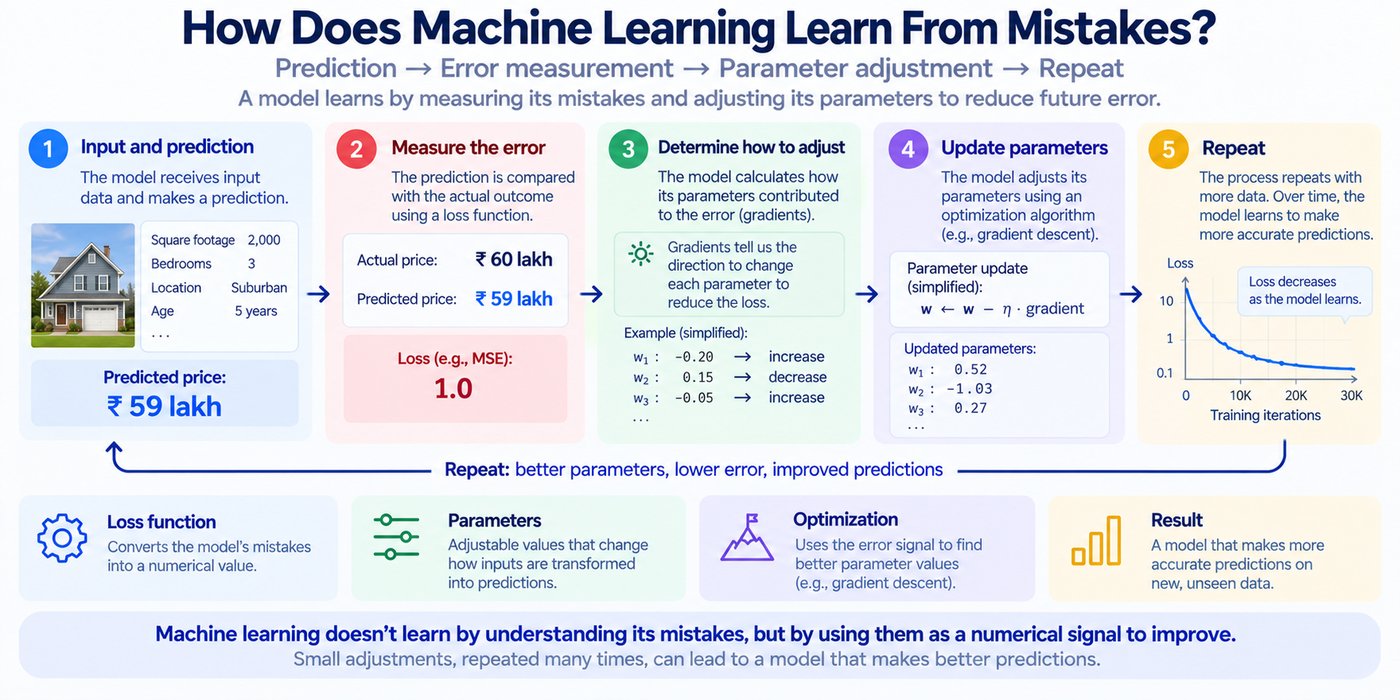
One of the most important ideas in machine learning is surprisingly simple:
A system cannot improve unless it has some way to measure how wrong its predictions are.
A model can make predictions endlessly:
- classify emails
- predict house prices
- recognize images
- generate text
But prediction alone is not enough.
The system needs feedback that tells it whether those predictions are improving or getting worse. And that feedback needs to be measurable.
This creates the basic learning loop behind how machine learning learns:
Prediction → error measurement → parameter adjustment → repetition
Understanding this loop makes it much easier to understand what machine-learning models actually learn.
Why prediction alone isn’t enough
Imagine a model predicting house prices.
The actual price is ₹60 lakh.
The model predicts ₹59 lakh.
That is a much smaller error than predicting ₹35 lakh.
Clearly, the system needs some way to distinguish between those outcomes.
Otherwise, it would know that it made a prediction but have no useful signal telling it how good or bad that prediction was.
This is where the idea of a loss function comes in.
Turning mistakes into numbers
A loss function is a rule that converts the difference between a model’s prediction and the desired outcome into a numerical value representing the model’s error.
The exact calculation depends on the task.
But the basic idea is simple:
Smaller loss generally means the prediction is closer to the desired outcome.
Larger loss means the prediction is worse according to the chosen objective.
That numerical signal gives the learning process direction.
The model can now compare its performance and adjust itself in an attempt to reduce future loss.
What actually changes inside the model?
This leads to a more interesting question:
Once the model knows it is wrong, what actually changes?
The answer is its parameters.
A machine-learning model contains adjustable numerical values that influence how inputs are transformed into predictions.
Learning changes those values.
A simplified version of the process looks like this:
- The model makes a prediction.
- The prediction is compared with the desired outcome.
- A loss value is calculated.
- The model determines how its parameters should change.
- The parameters are updated.
- The process repeats.
Each individual adjustment may be small.
But repeated across many training examples, those adjustments can substantially change the model’s behavior.
This is why machine learning can look intelligent from the outside even though its learning process consists largely of numerical optimization.
The landscape analogy
One useful way to visualize this process is as a landscape.
Imagine that the height of the terrain represents error:
- High ground: large error
- Low ground: smaller error
The model’s training process attempts to move toward regions of lower error.
At each update, it uses information about the loss to determine how its parameters should change.
This is the basic intuition behind gradient-based optimization and methods such as gradient descent.
The model is not consciously thinking:
“I made a mistake. I should understand why.”
Instead, the optimization process uses numerical information about the loss to adjust parameters in directions expected to improve the objective.
Not awareness.
Not reflection.
Iterative optimization guided by feedback.
Why learning can still go wrong
Reducing error does not necessarily mean that a model has learned the pattern we intended.
Sometimes a model discovers a shortcut.
Imagine a dataset where nearly every picture of a cow contains green grass in the background.
A model might discover that the presence of green grass is strongly associated with the target label.
That shortcut may help reduce training error.
But put the cow on a beach or inside a barn, and the shortcut may stop working.
The model has learned a statistical pattern that was useful in the training data—but not necessarily the underlying feature we cared about.
This reveals an important limitation:
Machine learning optimizes an objective. It does not automatically understand whether the patterns it uses make sense to a human.
That distinction becomes especially important when we evaluate whether a model can generalize beyond its training data.
The dangerous illusion of accuracy
There is another subtle problem.
A model can achieve high accuracy while still failing at the task we actually care about.
Imagine a spam-detection system where 95% of emails are not spam.
A model that predicts “not spam” for every email would achieve 95% accuracy.
That sounds impressive until you realize that it identifies no spam at all.
This exposes an important principle:
A metric is only useful when it measures something relevant to the actual goal.
The same issue appears throughout machine learning. Optimizing a numerical objective is not enough. We also need to understand what that objective represents and whether success on it corresponds to useful behavior.
A system can become extremely good at optimizing the wrong thing.
The real nature of machine learning
At its core, machine learning can be understood as an iterative feedback process:
Predict.
Measure the error.
Adjust the parameters.
Repeat.
Over time, those adjustments change the model’s behavior.
The process can become enormously complex when you introduce:
- More parameters
- More layers
- More data
- More computation
- More sophisticated optimization methods
But the underlying idea remains surprisingly consistent.
Prediction.
Error.
Adjustment.
Repetition.
This raises a deeper question:
What exactly is changing inside the model as those parameters are adjusted?
The answer leads to features, parameters, and internal representations—and to a better understanding of what machine-learning models actually learn.