One of the easiest ways to misunderstand machine learning is to imagine that models somehow “understand” raw data directly.
But they don’t.
A machine-learning system does not see the world the way humans do. It does not look at a house and intuitively understand neighborhood quality, architecture, or emotional value. It does not read an email and experience suspicion.
What it works with are signals, patterns, and relationships represented as data.
And that raises an important question:
If a machine-learning system improves over time, what exactly is changing inside it? What do machine learning models learn?
Because something clearly changes.
The data itself does not change.
The task usually stays the same.
The outside world remains what it is.
So where does learning happen?
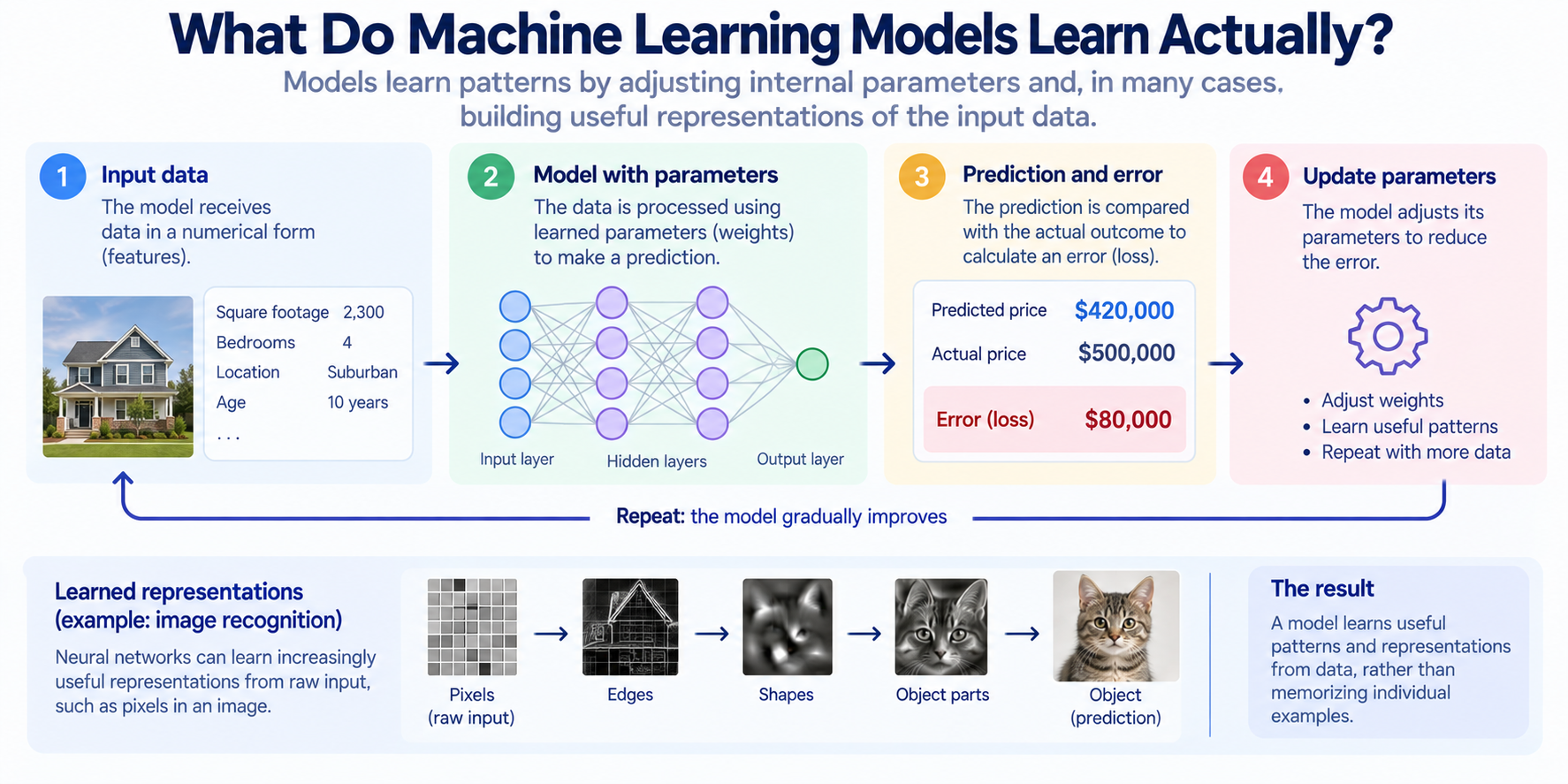
It happens through changes to the model’s internal parameters and, in more advanced systems, the representations it builds from the input.
What a machine-learning model pays attention to
Take a simple example: predicting house prices.
A model might receive inputs such as:
- Square footage
- Number of bedrooms
- Location
- Age of the building
At first glance, these are simply pieces of information. But the model still has to learn which signals are useful for making predictions and how those signals relate to the outcome.
This is where features come in.
A feature is an input variable or measurable property that a model can use as a signal when making predictions.
In spam detection, features might include:
- Suspicious words
- Unusual links
- Sender patterns
- Message structure
In house-price prediction, location might matter far more than the color of the walls.
This matters because real-world data is messy. It can contain useful signals alongside irrelevant information and noise.
A model can only learn from information that is represented in a form it can use.
If you completely exclude location from a house-price model, even a powerful algorithm will struggle to account for one of the factors that may strongly influence prices.
The problem is not that the model lacks intelligence.
The relevant signal simply isn’t available to it in a useful form.
The hidden parameters inside a model
Recognizing useful signals is only part of learning.
The model also has to determine:
- How strongly different features should influence predictions
- Which patterns deserve more influence
- How different signals should interact
- How those relationships should change the final output
This is where parameters enter the picture.
Parameters are adjustable internal values that influence how a model transforms inputs into predictions.
You can think of them as a large collection of numerical settings.
A parameter might influence how much a particular feature contributes to a prediction. Other parameters can determine how combinations of inputs affect the result.
Learning happens by adjusting these parameters during training.
If the model repeatedly makes predictions that are too low for certain houses, the parameter values can change in ways that alter future predictions.
If it consistently makes another type of prediction too high, other parameter values may shift in the opposite direction.
Over time, the model’s internal parameters are adjusted to produce better results on the training objective.
And this is one of the strange things about machine learning:
What looks like intelligence from the outside can emerge from enormous numbers of small numerical adjustments inside the model.
Models can learn representations too
But modern AI goes deeper than simply learning the importance of predefined features.
Many neural networks can also learn internal representations of their inputs.
Consider image recognition.
At the beginning, the system receives pixels—numerical values arranged in a grid.
As information passes through successive transformations, the model can learn increasingly useful representations.
A simplified conceptual progression might look like:
Pixels → edges → shapes → object parts → objects
The exact representations learned by a real neural network are much more complicated than this simplified sequence. But the underlying idea is important.
The model is not necessarily given a complete description of what a useful feature should look like.
It can learn transformations that make useful patterns easier to represent.
This is one reason neural networks became so important in modern AI.
They can learn not only relationships between inputs and outputs, but also increasingly useful intermediate representations.
Why representation matters
This leads to one of the most important ideas in machine learning.
How information is represented affects what a model can learn from it.
A poor representation can hide useful relationships.
A useful representation can make those relationships easier to capture.
This is particularly important as problems become more complex.
A raw image contains enormous amounts of numerical information. A useful representation can organize that information into patterns that help distinguish objects.
The same general principle appears in language.
Instead of treating every word as an isolated symbol, modern neural networks learn numerical representations that capture relationships between words and other elements of the input.
So learning is not simply about finding better predictions.
It is also about developing useful ways of representing information.
Why more data is not always better
It is tempting to assume that giving a machine-learning model more information will automatically make it better.
But more information is not necessarily more useful information.
Suppose you add hundreds of irrelevant signals:
- Random numbers
- Uninformative variables
- Noisy correlations
The model may find patterns in them anyway.
And because machine-learning systems optimize according to an objective rather than human intuition, they can sometimes learn relationships that look useful in the training data but do not generalize well.
A model does not “know” that a larger house is valuable in the human sense.
It adjusts its internal parameters based on patterns in the data and the objective it is trained to optimize.
That distinction matters.
Machine learning discovers statistical patterns; it does not automatically assign those patterns human meaning.
The real nature of learning
At its core, machine learning can be understood as a process in which a model gradually changes its internal parameters in response to feedback from data.
A simplified learning loop looks like this:
- Inputs enter the model.
- The model transforms the inputs into a prediction.
- The prediction is compared with the desired outcome.
- The resulting error provides a learning signal.
- The model adjusts its parameters.
- The process repeats.
Over time, those adjustments can change the model’s behavior.
The deeper you look, the more machine learning starts to feel less like magic and more like an enormous process of iterative adaptation.
Small adjustments.
Repeated again and again.
Until useful patterns and representations emerge.
And that raises the next question:
How do we know whether the model has actually learned patterns that work beyond the examples it was trained on?
That is the problem of generalization.