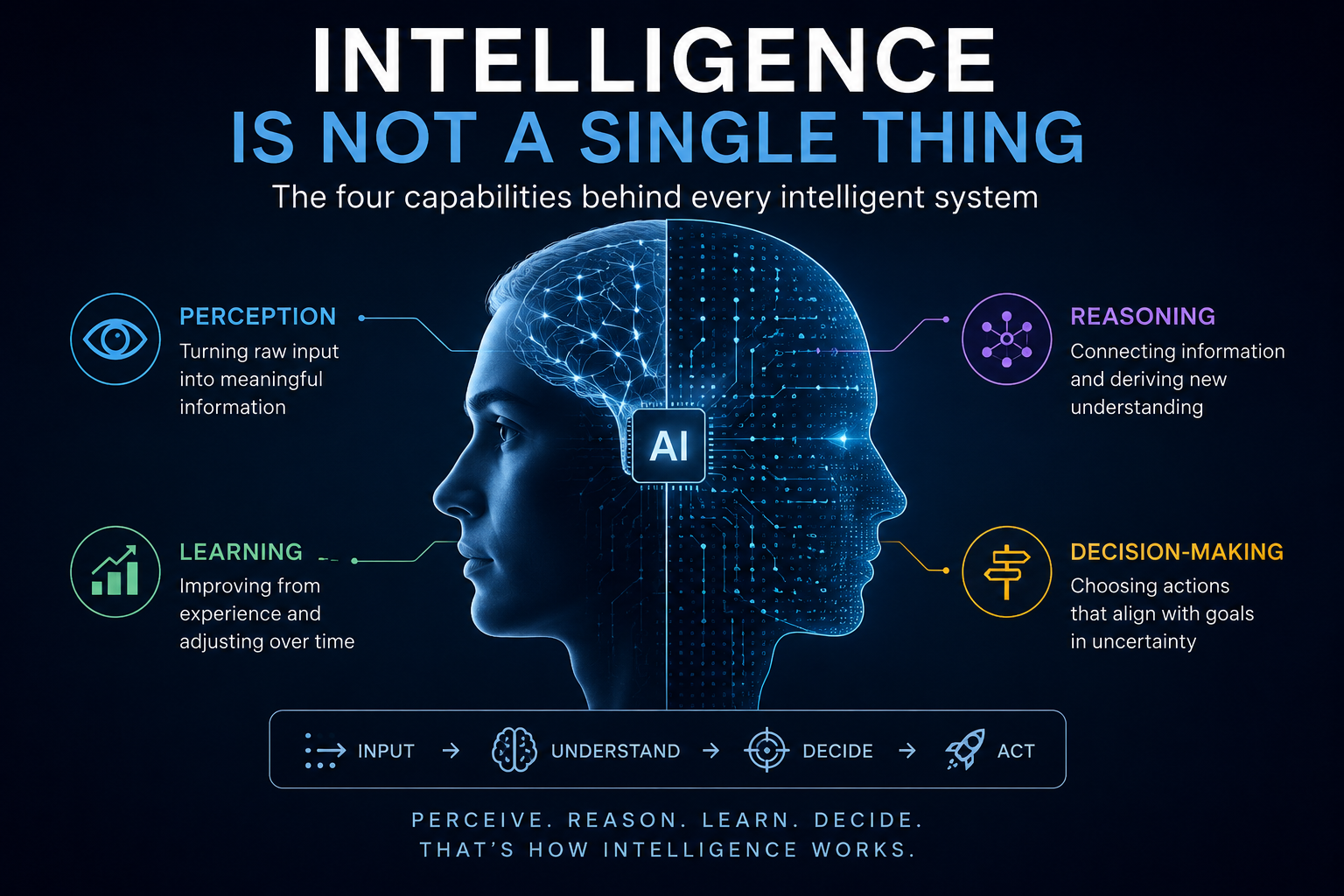
Most people talk about intelligence as if it’s one mysterious property that either exists or doesn’t. Something is either intelligent or it isn’t. Human or machine. Smart or dumb.
But the more I think about it, the less useful that framing becomes.
A better way to understand intelligence is to stop treating it like a label and start treating it like a collection of capabilities. Because once you break it down, intelligence starts looking far less magical and far more structural.
Imagine placing a system into the real world. It receives signals from its environment. It responds. It adapts. And eventually, people begin judging it based on how well it handles situations, especially unfamiliar ones. At that point, a more interesting question appears:
What exactly are we calling “intelligence”?
The First Layer: Perception
Everything begins with perception.
Humans are constantly flooded with raw sensory input. Light enters the eyes. Sound waves hit the ears. Pressure reaches the skin. But we don’t experience reality as disconnected signals.
We experience meaning.
- A face.
- A question.
- A moving car.
- A dangerous situation.
That transformation is easy to underestimate. The world provides noise. The brain extracts structure from it. Machines face the same problem.
For an AI system, the input might just be pixels in an image or numbers from a sensor. Somehow, it still has to recognize objects, language, patterns, or intent from that chaos.
And that turns out to be much harder than it sounds. A chair viewed from one angle looks completely different from another. Lighting changes everything. Backgrounds create ambiguity. Real-world data is messy.
Perception is not just sensing information. It’s interpreting it.
The Second Layer: Reasoning
But perception alone is not enough.
Intelligence also requires connecting information together. If you see dark clouds and strong wind, you infer that rain is probably coming. Nobody explicitly tells you that in the moment. You construct the relationship internally.
That process is reasoning. It allows systems to move beyond observation and into inference. Machines attempt something similar.
If a system knows:
- all humans need oxygen
- and this entity is human
then it can conclude:
- this entity needs oxygen
The mechanics may differ from human thought. Sometimes it happens through formal logic. Sometimes through statistical approximations. But the underlying idea remains the same.
Reasoning is about deriving new understanding from existing information.
The Third Layer: Learning
Then comes learning.
One of the defining characteristics of intelligence is that it improves with experience. Humans do not memorize every possible variation of a chair before recognizing one. After enough exposure, the brain generalizes patterns automatically. That ability matters because the real world is too large to hardcode manually.
Machines learn for the same reason.
A spam filter, for example, does not start with perfect knowledge. Initially, it makes poor predictions. But after seeing enough examples, it adjusts its internal structure and becomes more accurate over time.
That distinction is important.
Traditional software follows fixed instructions.
Learning systems modify themselves based on data.
That shift changed everything in AI.
The Fourth Layer: Decision-Making
And finally, decision-making.
Intelligence is not just understanding the world. It is acting within it.
Humans constantly choose between alternatives under uncertainty:
- what to say
- where to go
- how to respond
- what risk to take
Machines do something similar.
A navigation system chooses routes.
A recommendation engine selects content.
A self-driving car decides when to brake, steer, or accelerate.
Every decision happens with incomplete information and uncertain outcomes. Which means intelligence is not about perfection. It is about selecting useful actions despite uncertainty.
Putting the Pieces Together
Now combine all four capabilities:
- perception transforms raw input into meaningful information
- reasoning connects information together
- learning improves performance over time
- decision-making turns understanding into action
Once a system integrates these capabilities effectively, something interesting happens. It begins to behave in ways we associate with intelligence.
Not necessarily because it thinks like a human.
But because it can operate inside complex, changing environments without requiring explicit instructions for every situation.
That distinction matters more than most people realize.
The Misleading Part of AI
I think one reason AI discussions become confusing is because people often treat intelligence as if it must resemble human consciousness. But many AI systems are extremely capable without “understanding” the world the way humans do. A calculator can solve equations instantly. But few people would call it intelligent because it follows rigid rules without adaptation.
Meanwhile, a game-playing AI can defeat world champions through learning and strategy while having absolutely no idea what the game means outside its environment. That creates an uncomfortable gray area.
The more capable systems become, the harder it gets to define intelligence in purely human terms. And maybe that was never the right definition to begin with.
What Artificial Intelligence Actually Is
At its core, artificial intelligence is not a single technology. It is the attempt to build systems that can:
- perceive patterns
- relate information
- learn from experience
- and make decisions aligned with goals
especially in situations where writing explicit step-by-step instructions becomes impractical. That is the common thread behind most modern AI systems. A voice assistant converts sound into meaning, maps that meaning to actions, improves recognition over time, and executes tasks. A recommendation system learns behavioral patterns and predicts what users are likely to want next.
A self-driving car interprets sensor data, predicts surrounding behavior, and continuously chooses actions in real time.
Different systems. Different domains. But the same underlying structure appears again and again. And the deeper you look, the more intelligence starts to feel less like magic and more like the ability to operate effectively under complexity.
Which may ultimately be the most useful definition of intelligence we have.