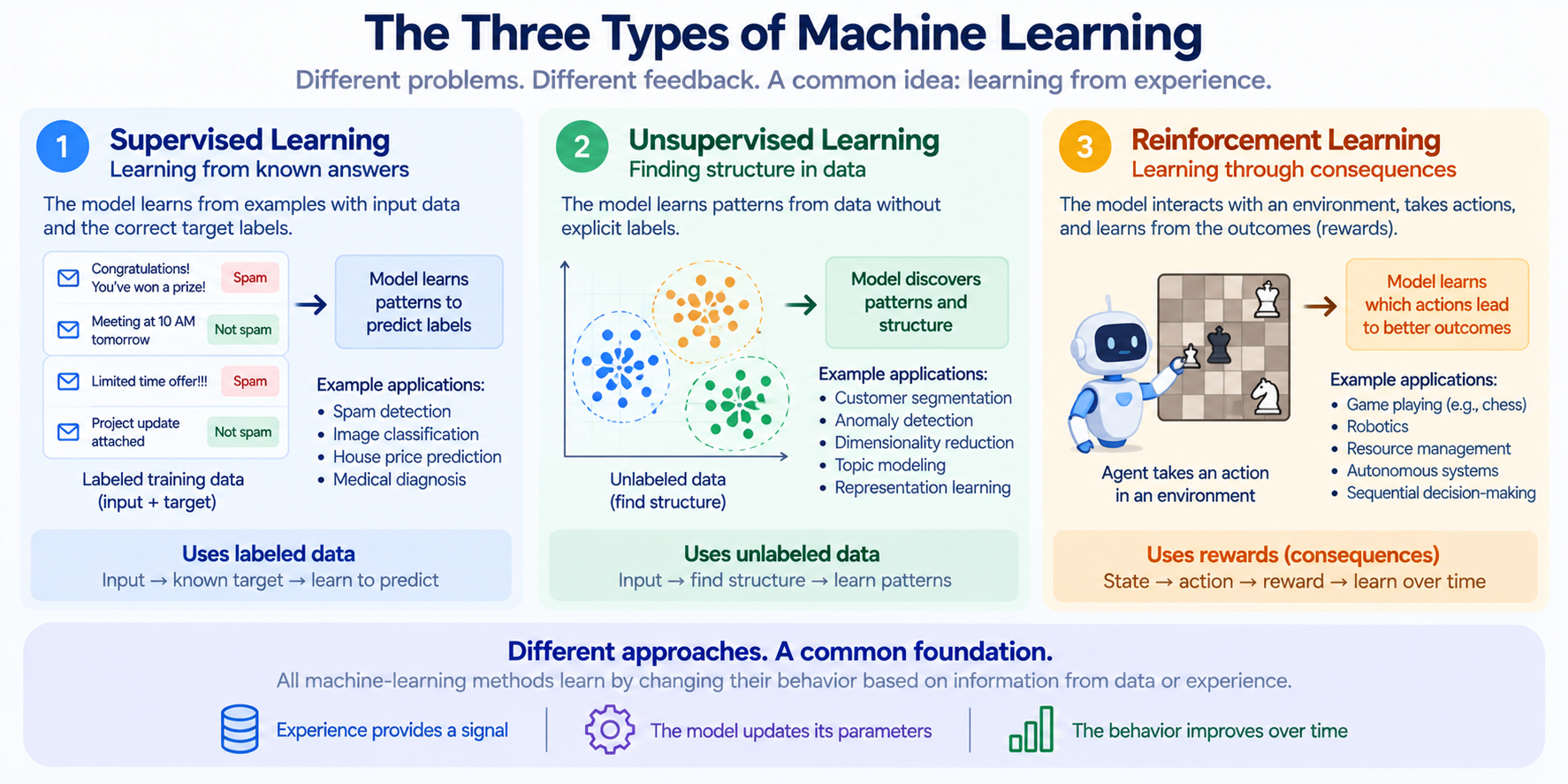
One of the most important things to understand about machine learning is that not all learning works the same way. There are different types of machine learning.
But people often talk about “AI learning” as if there were one universal mechanism underneath everything.
But a more fundamental question comes first:
What kind of feedback does the system receive while learning?
That changes the problem entirely.
In some cases, the system receives examples with known answers.
In others, it receives data without explicit labels and tries to discover useful structure.
And sometimes, it learns through the consequences of its own actions over time.
These approaches are known as supervised learning, unsupervised learning, and reinforcement learning. These are the three types of machine learning.
They represent different ways of learning from data and experience.
1. Supervised learning: learning from known answers
Imagine training a system to recognize spam emails.
You give it examples:
- This email is spam.
- This one is not spam.
- This one is spam again.
The system makes predictions, compares them with the known labels, and adjusts itself to reduce its errors.
This is supervised learning.
Conceptually, it is one of the easiest forms of machine learning to understand because the training data provides an explicit target.
The model receives an input and a corresponding label or desired output. It learns patterns that help connect the input to that target.
For spam detection, those patterns might involve:
- Suspicious phrases
- Unusual formatting
- Link structures
- Sender behavior
The goal is to produce predictions that align well with the provided labels.
This approach can be extremely effective.
But it has an important limitation:
Someone needs to provide useful labeled training data.
Creating those labels can require significant human effort, and some real-world information is difficult or expensive to label.
That leads to a different approach.
2. Unsupervised learning: finding structure in data
Now imagine giving a system a large collection of data without providing explicit labels.
There is no:
“This is the correct answer.”
Instead, the system has to find useful patterns or structure within the data.
This is broadly described as unsupervised learning.
Depending on the method and objective, a system might:
- Group similar examples together
- Detect unusual examples
- Identify patterns
- Learn compact representations
- Discover relationships within the data
For example, a clustering algorithm could group similar customer records without being told in advance which customers belong to which categories.
The system is not necessarily being told what those groups mean.
It is identifying structure according to the objective and method being used.
This reveals an important distinction:
Learning does not always require a human-provided label for every example.
Large amounts of real-world data are unlabeled, so methods that can learn useful structure without manually labeled targets can be valuable.
But unsupervised learning also introduces a challenge.
If there is no explicit answer telling the system what is correct, defining and evaluating the learning objective can be more difficult.
3. Reinforcement learning: learning through consequences
Then there is reinforcement learning.
This approach is different from both supervised and unsupervised learning.
Instead of simply receiving labeled examples or analyzing a fixed dataset, the system interacts with an environment.
It:
- Takes an action
- Receives an outcome or reward signal
- Updates its behavior
- Acts again
Imagine training a system to play chess.
Rather than providing the correct move for every position, the system can learn through repeated interaction with the game.
A game produces an eventual outcome.
The system then has to learn which actions and sequences of actions tend to lead to better results.
This creates a difficult problem because feedback can be delayed.
A decision made much earlier in a game may contribute to an outcome that appears much later.
The system therefore has to learn not only which actions produce immediate results, but which actions can lead to better long-term outcomes.
This makes reinforcement learning particularly relevant to problems involving sequential decisions.
The system may need to balance:
- Exploration
- Experimentation
- Immediate rewards
- Long-term consequences
That is very different from simply predicting a known label.
Why these three types of machine learning approaches differ
At first glance, supervised, unsupervised, and reinforcement learning may look like technical categories.
But they reflect a deeper difference in the kind of information available to the learning system.
Supervised learning
The training data provides known targets.
The model learns from examples where the desired output is available.
Unsupervised learning
The data provides structure without explicit target labels.
The system attempts to identify useful patterns or representations within the data.
Reinforcement learning
The environment provides consequences.
The system learns which actions lead to better outcomes over time.
A useful way to remember the distinction is:
Supervised learning → answers
Unsupervised learning → structure
Reinforcement learning → consequences
Each creates different strengths and challenges.
Supervised learning depends on suitable labeled data.
Unsupervised learning can work with unlabeled data, but defining useful objectives and interpreting the resulting structure can be challenging.
Reinforcement learning can handle sequential decision-making, but delayed feedback and exploration make the learning problem substantially more complex.
What they have in common
Despite their differences, these approaches share an important underlying idea.
A system changes its behavior based on information obtained from data or interaction.
The exact feedback differs.
The learning objective differs.
The optimization process can differ.
But the broader pattern remains:
Experience provides a signal, and the system uses that signal to change its internal behavior.
This becomes especially important when we look inside the learning process itself.
How does a model turn a prediction into an error?
How is that error represented numerically?
And how does the model use that information to change its internal parameters?
Those questions lead to the next layer of the story.
The bigger shift
One of the most interesting implications of machine learning is that intelligence starts looking less like a fixed property and more like a process of adaptation through feedback.
Different learning approaches expose systems to different kinds of signals.
Some provide explicit answers.
Some provide patterns and structure.
Some provide consequences over time.
But underneath these differences is a common idea:
Learning involves changing a system’s behavior in response to information from its experience.
And once we understand that, we can ask a more precise question:
How does a machine actually learn from its mistakes?
That is where prediction error, loss functions, and parameter adjustment enter the story.