One of the easiest ways to misunderstand machine learning is to imagine that a system somehow becomes “smarter” in a vague or magical sense.
But if you strip away the terminology, a much simpler question appears:
What changes when a machine learns?
Something clearly changes.
The inputs remain the same kind of inputs. The task usually remains the same. The external world does not reorganize itself for the model.
So where does the learning happen?
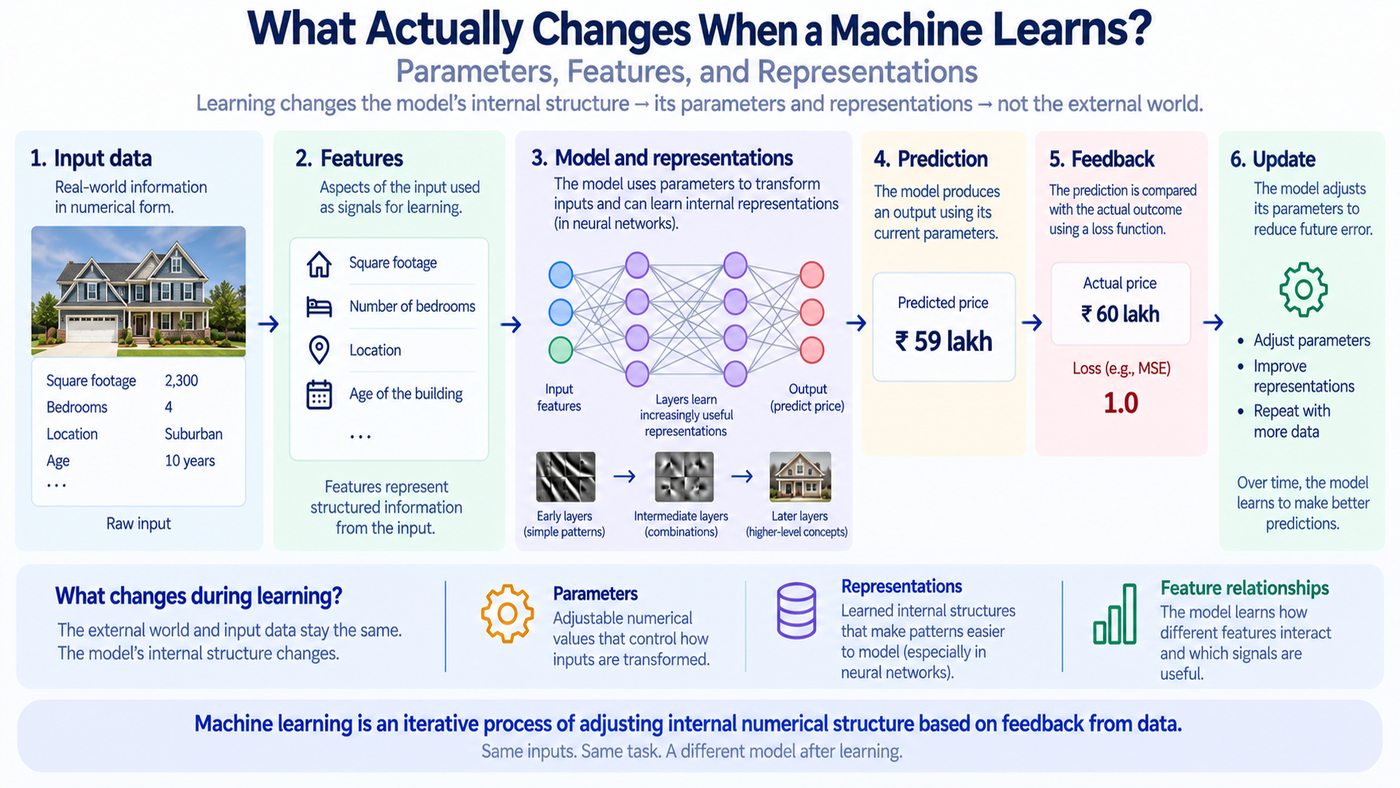
The answer is inside the model’s internal structure. During training, a machine learning model adjusts numerical parameters and, in more advanced systems, develops useful internal representations of the data.
Understanding this distinction is one of the simplest ways to understand how machine learning works.
Start With a Simple Example
Imagine a system designed to predict house prices. You give it information such as:
- square footage
- number of bedrooms
- location
- age of the building
At first glance, these are simply pieces of data.
But the system still has to determine which parts of that information are useful for making a prediction. This leads to one of the most important ideas in machine learning:
Features.
What Are Features in Machine Learning?
A feature is an aspect of the input that a machine learning model uses to make predictions.
In a house-pricing model:
- square footage could be a feature
- distance from the city center could be another
- number of bathrooms might matter as well
In spam detection, features could include:
- specific words
- suspicious links
- email structure
- sender behavior
Features turn parts of the input into signals that the model can use.
This matters because raw reality is messy. A dataset can contain useful information alongside irrelevant information and noise. If an important signal is missing, even a sophisticated model may struggle.
For example, if you completely ignore location while predicting house prices, the model cannot use one of the potentially important variables in the prediction.
This reveals something deeper about machine learning: what information enters the model matters, because a model can only learn from patterns represented in its input.
What Are Parameters in Machine Learning?
Features are only part of the process.
The model also needs to determine:
- how strongly each feature influences the prediction
- how different signals interact
- which patterns should have more influence than others
This is where parameters enter the picture.
Parameters are adjustable internal values that shape a machine learning model’s behavior. You can think of them as numerical settings that the model changes during training.
In a simple house-price model, one parameter might determine how strongly square footage affects the prediction. Another might influence the contribution of location. Another might affect how building age influences the result.
The model combines these signals using its internal parameters to produce a prediction.
During learning, the parameters are adjusted.
If the model consistently underestimates the prices of larger houses, training can change the relevant parameters. If it consistently overestimates prices in certain situations, other parameters may be adjusted.
At its core, this means that learning involves repeatedly changing internal numerical relationships so that the model performs better on its task.
That sounds less mysterious than “artificial intelligence.”
But it is also a much more useful way to think about what learning actually means.
The More Interesting Layer: Internal Representations
Things become more interesting when we move beyond simple machine learning models.
Advanced AI systems do not necessarily depend entirely on features that humans define manually. Many models learn internal representations that transform the original input into forms that are increasingly useful for the task.
Consider image recognition.
The raw input consists of pixel values—numerical values arranged across an image.
As information passes through a deep neural network, different layers can learn increasingly useful patterns. Earlier representations may respond to relatively simple visual patterns, while deeper representations can capture more complex structures.
Conceptually, the progression might look like:
- edges
- shapes
- textures
- object parts
- objects or faces
The important point is that these representations are not simply written into the system by a programmer. They can emerge through training because they help the model perform its task.
This is one reason representation is such an important concept in modern AI.
A useful representation can expose patterns that would otherwise be difficult for the model to learn.
A poor representation can hide them.
Why Representation Matters
This leads to a broader idea about machine learning.
Learning is not only about changing parameters. It is also about developing useful ways of representing information.
Suppose two systems receive the same raw data. If one system develops a representation that makes important relationships easier to distinguish, it may be able to learn the task more effectively.
This is particularly important in deep learning, where multiple layers transform information into increasingly abstract representations.
Instead of relying only on manually selected signals, the model can learn representations from the data itself.
That changes what machine learning systems can do.
They are not simply adjusting numbers attached to predefined inputs. They can also learn increasingly useful internal structures for working with those inputs.
The Full Machine Learning Learning Loop
At a high level, the process can be summarized as a repeating cycle:
- An input enters the system.
- The model processes the input using its current parameters and representations.
- The model produces a prediction.
- Feedback measures how well the prediction performed.
- The model adjusts its parameters.
- The process repeats across many examples.
Over time, the model’s internal structure changes.
Those changes affect how it responds to future inputs.
That gradual change is what we mean when we say the model has learned.
It is not consciousness.
It is not awareness.
It is not the system suddenly understanding the world in a human sense.
It is an iterative process in which internal numerical structure is adjusted based on experience and feedback.
More Data Does Not Automatically Mean Better Learning
There is another important point.
It is tempting to assume that giving a machine learning model more information will automatically make it better.
But more information can also introduce noise.
Suppose a model receives hundreds of irrelevant or weakly related signals. It may discover patterns that appear useful in the training data but do not generalize well to new examples.
This is why the quality of the information matters alongside its quantity.
A model needs useful signals, appropriate representations, and parameters that capture relationships that generalize beyond the examples used during training.
More data can help, but more data by itself is not a guarantee of better learning.
What Really Changes When a Machine Learns?
We can now answer the original question more precisely.
When a machine learning model learns, the outside world does not change.
The training examples do not suddenly become different.
Instead, the model changes its internal numerical structure.
Depending on the system, that can involve:
- adjusting parameters
- learning relationships between features
- developing internal representations
- changing how inputs are transformed into predictions
The result is that the same kind of input can produce a different output after training because the internal structure of the model has changed.
That is the physical and computational meaning behind the word learning in machine learning.
The Bigger Lesson
The deeper I look at machine learning, the less learning feels like a mysterious process in which a machine suddenly becomes intelligent.
It is closer to iterative structural adjustment.
Inputs enter.
Patterns are detected.
Predictions are produced.
Feedback reveals errors.
Parameters change.
Representations become more useful.
And the cycle repeats.
Over many examples, those small changes can produce surprisingly sophisticated behavior.
This gives us a useful mental model for understanding modern AI:
Machine learning is not simply about storing more information. It is about changing the internal structure of a system so that it can respond more effectively to patterns in data.
And once you understand what changes inside the model, the next question becomes much more interesting:
What different ways can a machine learn from data and feedback?
That leads naturally to the three major learning paradigms: supervised learning, unsupervised learning, and reinforcement learning.