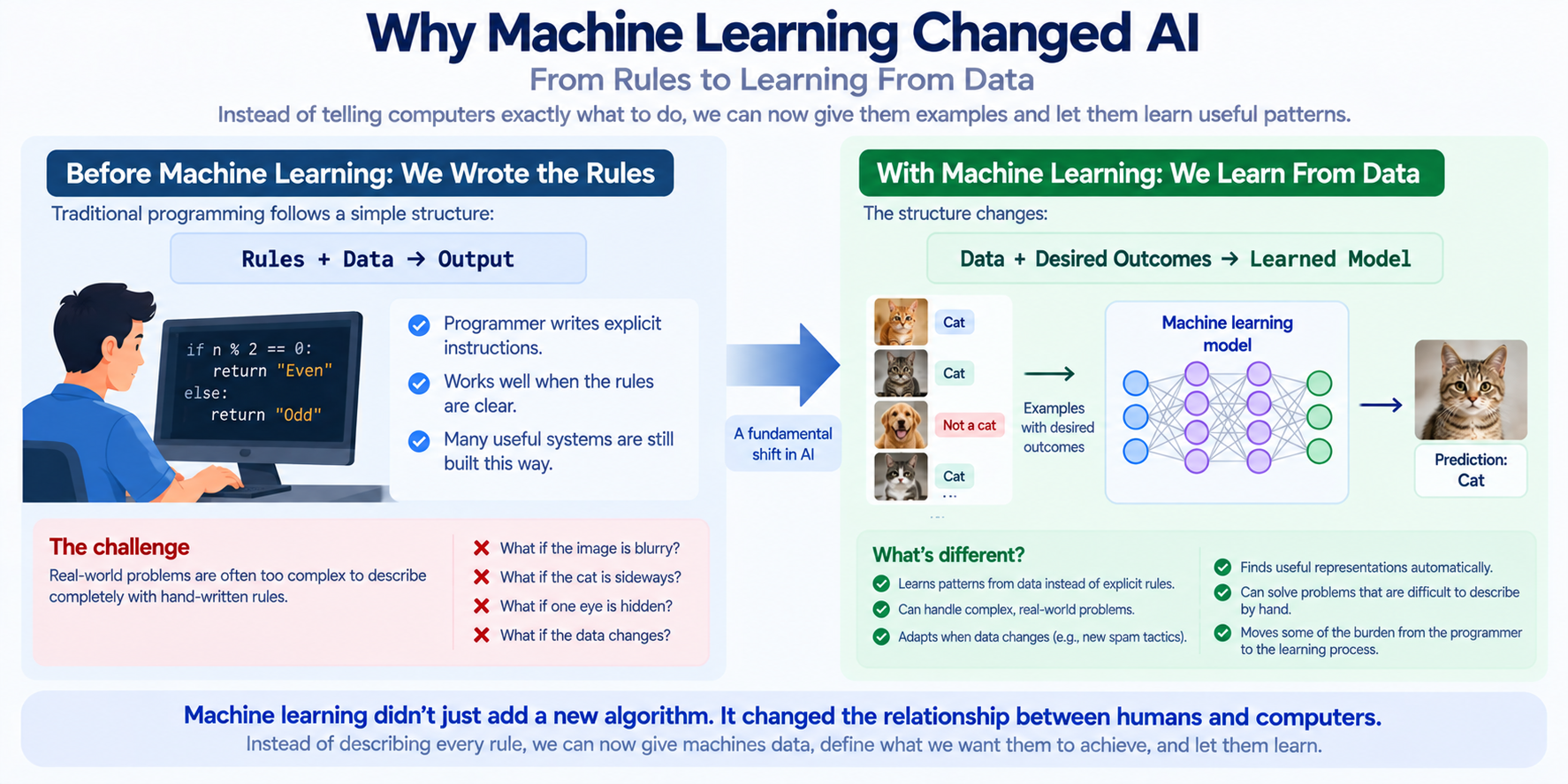
For a long time, making a computer intelligent meant telling it exactly what to do. If you wanted a program to recognize something, make a decision, or solve a problem, you had to describe the rules yourself.
That approach worked surprisingly well for problems where the rules were clear. But the real world is rarely like that.
The problem wasn’t that computers were too slow. Rather, the problem was that we often didn’t know how to write all the rules. Machine learning changed this relationship between humans and computers.
Why machine learning changed AI becomes clearer when we look at the kinds of problems computers struggled with: recognizing faces, understanding speech, detecting spam, recommending content, or making sense of messy human language.
Instead of trying to describe every rule explicitly, we could give a machine examples, define what we want it to achieve, and allow it to discover patterns that help produce the desired result.
That was a much deeper change than simply creating a new type of algorithm.
Before Machine Learning: We Wrote the Rules
Traditional programming follows a relatively direct structure:
Rules + Data → Output
A programmer writes the instructions. The computer follows them. For example, imagine a simple system that decides whether a number is even or odd.
You can write a rule: If the number is divisible by 2, classify it as even. Otherwise, classify it as odd.
The rule is explicit. There is no mystery about what the computer is doing.
This works because we understand the structure of the problem well enough to describe it. Many useful software systems are still built this way.
But consider a very different problem: Is this a picture of a cat? It sounds simple to a human. But try writing the rules.
You might start with:
- Look for two eyes.
- Look for two ears.
- Look for a nose.
- Check the shape of the face.
- Look for fur.
- Check the position of the ears.
But immediately, the rules start breaking down.
What if the cat is facing sideways?
What if one eye is hidden?
What if the image is dark?
What if the cat is partially covered?
What if the picture is blurry?
What if the cat looks completely different from the examples you’ve seen?
The problem isn’t that there are no patterns. The problem is that the patterns are too complicated to describe completely by hand. And this is where the fundamental idea behind machine learning begins to appear.
Machine Learning Changes the Problem
Instead of asking:
“What rules should I write?”
we can ask:
“Can a machine learn useful patterns from examples?”
The structure changes.
Instead of:
Rules + Data → Output
we move toward:
Data + Desired Outcomes → Learned Model
The human still defines the problem. We still decide what data to use, what outcome matters, how the system should be evaluated, and what constraints it must operate under. But we no longer have to specify every pattern manually.
The machine learning system can adjust its internal parameters so that its predictions become better on the examples it is trained on.
This is the fundamental shift. Machine learning moves some of the burden of describing complex patterns from the programmer to the learning process.
That sounds like a small change.It wasn’t.
Why This Matters
Consider a spam filter.
A traditional system could use rules such as:
- If an email contains a certain word, mark it as spam.
- If the sender is unknown, increase the spam score.
- If the message contains suspicious links, increase the score.
This can work. But spammers can change their behavior.
They can change the wording.
They can use different links.
They can disguise suspicious messages.
Eventually, the number of rules becomes difficult to maintain. A machine learning system can approach the problem differently.
Give it many examples of:
- spam emails
- legitimate emails
and it can learn statistical patterns that help distinguish between them. The programmer doesn’t necessarily need to describe every suspicious combination of words or formatting patterns. The model can learn relationships from the examples.
And when the data changes, the model can potentially be retrained. This doesn’t make machine learning automatically better. It makes it possible to solve a different class of problems.
The Computer Is No Longer Just Following Instructions
This is perhaps the most important conceptual change. In traditional programming, the programmer determines the logic.
The computer executes it. In machine learning, the programmer still designs the system, but part of the logic is learned from data rather than explicitly written as rules.
The resulting model may contain millions, billions, or even more learned parameters. Those parameters collectively influence how the model responds to new inputs.
So instead of saying:
“Here is the complete rule for recognizing this pattern.”
we can say:
“Here are many examples. Find a set of parameters that allows you to make useful predictions.” The computer is still executing mathematical operations. It hasn’t suddenly developed human-like intelligence. But the source of some of its behavior has changed.
Some of the rules are no longer directly written by us. They emerge through optimization over data. That is a profound change in how we build intelligent systems.
Learning Is Not the Same as Memorizing
There is an important catch. If a machine simply memorizes its training examples, it hasn’t really learned a useful general pattern.
Imagine showing a model thousands of pictures of cats and then asking it to identify one of the exact pictures it has already seen. That doesn’t tell us much.
The interesting question is:
Can it recognize a cat in a picture it has never seen before?
This is the idea of generalization.
A machine learning model is useful when the patterns it learns from its training data help it perform well on new, unseen examples. This is one reason machine learning is fundamentally different from a simple lookup table.
The goal isn’t merely to remember the past. The goal is to extract patterns that remain useful beyond the examples used for training. Of course, models can still overfit, memorize parts of their training data, or learn shortcuts that fail in the real world.
Learning from data does not guarantee understanding. It simply gives us a mechanism for discovering patterns that would be difficult or impossible to specify manually.
But Where Do Those Patterns Come From?
This raises a deeper question. If we aren’t writing the rules ourselves, what exactly is the machine learning system changing?
The answer is its parameters.
A model begins with parameters that do not yet encode useful task-specific behavior. During training, the model makes predictions. Those predictions are compared with the desired outcome using some measure of error or loss.
The learning algorithm then adjusts the parameters to reduce that error.
Over many iterations, the parameters change.
Eventually, they can encode patterns that help the model make better predictions.
So when we say:
“The machine learned.”
we don’t mean that something mystical happened inside the computer. We mean that the model’s parameters were adjusted through training so that its behavior became better suited to the task.
This idea becomes much more important when we look at neural networks later.
More Data Does Not Automatically Mean Better Learning
It is tempting to think that machine learning is simply:
More data → More intelligence
But it isn’t that simple. The quality of the data matters. The labels may be wrong.
The examples may be biased. The training data may not represent the situations the model will encounter later. The objective may reward the wrong behavior. And the model itself may have limitations.
A model can become very good at optimizing for the patterns present in its training data while still performing badly in the real world.
This is why machine learning involves much more than feeding data into an algorithm.
We have to think about:
- What data are we using?
- What are we asking the model to predict?
- What does success mean?
- How are we measuring errors?
- Will the learned patterns generalize?
- What happens when the real world differs from the training data?
The ability to learn from data creates enormous possibilities. It also creates new ways for systems to fail.
Machine Learning Did Not Remove Humans
Another common misunderstanding is that machine learning means humans are no longer involved.
They are.
Humans still choose:
- the problem to solve
- the data to collect
- the target or objective
- the model architecture
- the training process
- the evaluation criteria
- the deployment environment
- the constraints around the system
Machine learning changes where some of the problem-solving happens. Instead of manually encoding every useful pattern, we provide a framework in which the system can learn patterns from examples. This becomes especially powerful when the patterns are too numerous, subtle, or complicated for humans to describe explicitly.
Three Ways a Machine Can Learn
Once we accept the idea that machines can learn patterns from experience, another question appears:
What does “learning” actually mean?
There isn’t just one answer.
In supervised learning, the model learns from examples where the desired output is known.
For example:
Image → Cat
Email → Spam
House features → Price
The model learns a relationship between inputs and known outcomes.
In unsupervised learning, the system works with data without predefined labels and tries to discover useful structure within that data.
For example, it might identify groups of similar customers or discover patterns in a large collection of documents.
In reinforcement learning, the system interacts with an environment, takes actions, receives feedback such as rewards or penalties, and learns which actions tend to produce better outcomes.
These approaches are different ways of turning experience into improved behavior.
And they lead to an important idea:
Machine learning is not one algorithm. It is a family of approaches for learning useful patterns from data or interaction.
Why Machine Learning Changed AI
So why was machine learning such a major turning point for artificial intelligence? Because many interesting problems don’t come with a clean instruction manual. We don’t know all the rules for recognizing a face.
We can’t easily write every rule needed to understand natural language. We can’t manually describe every pattern that distinguishes useful recommendations from irrelevant ones.
We often don’t even know what all the relevant patterns are. Machine learning gives us another possibility.
Instead of requiring humans to fully understand and encode the solution beforehand, we can provide examples, objectives, feedback, and computational resources that allow a model to discover useful patterns through training.
That changes what kinds of problems computers can realistically tackle.
From Rules to Learned Representations
The story doesn’t end with machine learning. As the problems became more complicated, another question emerged:
What if the useful patterns themselves are difficult to describe?
For simple problems, humans can often provide meaningful features. But for images, speech, language, and other high-dimensional data, deciding exactly which features matter can itself be extremely difficult.
This is where neural networks become important.
Neural networks can learn not only parameters for making predictions, but also increasingly useful internal representations of the input. Instead of manually deciding every representation, the model can learn transformations that turn raw inputs into representations useful for the task.
That idea eventually leads us toward deep learning, embeddings, Transformers, and modern language models.
But the underlying shift remains the same.
We moved from:
“Tell the computer the rules.”
toward:
“Give the computer enough information and feedback to learn useful patterns.”
The Deeper Shift
Looking back, machine learning can seem like just another technique in computer science. But conceptually, it changed the relationship between humans and computation.
Traditional software asks humans to describe the solution.Machine learning allows humans to describe the problem, examples, objectives, and constraints, while part of the solution is discovered through learning.
That doesn’t mean machines suddenly became intelligent in the human sense.
It means we found a way to make useful computational behavior emerge from data and optimization without explicitly programming every rule behind it.
And that opened the door to problems that traditional rule-based programming struggled to handle.
The next question is even more fundamental:
When a machine “learns,” what actually changes inside the model?
To answer that, we need to look beyond the idea of learning itself and examine the things that change during training: features, parameters, and internal representations.